


What is a resume profile?
Short Answer: A resume profile is a 2-4 sentence paragraph at the top of your resume that names your role, scope (years/scale managed), signature capability, and value alignment with the target employer. Use a profile if you have 3+ years of relevant experience. Use a summary if you have 5+ years and want to lead with accomplishments. Use an objective if you’re entry-level, switching careers, or returning to work.
A short paragraph of 2 to 4 sentences, the resume profile appears just below your name and contact information and tells a hiring manager who you are, what you do, and why you’re a fit for the role. It’s the first thing a recruiter reads during the 7-to-10 second first-pass scan, and in most applications, it’s also the first thing the applicant tracking system parses. A strong profile earns you the next 30 seconds of attention. A weak one gets you skipped.
This piece explains exactly what a resume profile is (and how it differs from a summary or objective), showcases 12 real resume profile examples organized by career stage and industry, and exposes what AI resume builders consistently get wrong—from generic buzzwords to cookie‑cutter phrasing that fails to stand out. By seeing what works and what doesn’t, you’ll be equipped to craft a profile that captures attention and keeps it.

What a Resume Profile Is
A resume profile is a concentrated pitch: who you are professionally, the scope of your experience, and the value you bring to the specific role you’re applying for. Unlike a cover letter, a profile lives inside the resume itself. Unlike a skills section, it’s written in prose.
In 2 to 4 sentences, or roughly 40 to 80 words, a strong profile has four components:
- Role identity — your current or target professional title
- Scope marker — years of experience, team size, revenue or scale managed, industry vertical
- Signature capability — the one thing you do better than most people in your field
- Value alignment — a phrase that connects your experience to what the target employer needs
Resume Profile vs. Summary vs. Objective: Which One You Need
Before you decide which format to use, it helps to understand the differences between a resume profile, a summary, and an objective.
| Format | Length | Best for | Lead with |
|---|---|---|---|
| Profile | 2–4 sentences (40–80 words) | Most working professionals | Role + scope + value |
| Summary | 3–5 sentences (50–100 words) | 5+ years in relevant field | Accomplishments with numbers |
| Objective | 2–3 sentences (30–50 words) | Entry-level, career changers, returners | Target role + transferable skills |
These three terms get used interchangeably, and that’s a problem — they serve different purposes, and picking the wrong format weakens your resume before a recruiter reads a single line:
- If you have three or more years of directly relevant experience, use a profile or summary.
- If your next role isn’t an obvious extension of your current one — career change, entry-level, return-to-work after a gap — use an objective.
- For everyone else, the profile is usually the right format. It’s shorter than a summary (recruiters read it in full) and more confident than an objective (you’re already in the field, not pivoting in).
We cover the professional summary format in depth in a separate walkthrough, and when a resume objective works instead handles the career-change scenario. Our collection of 50 resume summary examples is the practical companion piece — comparing those side-by-side with the profile examples below clarifies which format matches your career stage.
12 Resume Profile Examples by Role
To show how a strong profile looks in practice, here are 12 real resume profile examples organized by role, career stage, and industry
1. Customer Success Manager
Customer success manager with 6 years in B2B SaaS, managing books of 80+ accounts across mid-market and enterprise. Equipped with a track record of reducing churn from 14% to 6% over two fiscal years by rebuilding the quarterly business review cadence. Looking to lead a larger CS team at a Series B or C company scaling past $20M ARR.
2. Registered Nurse (New Graduate)
Registered Nurse (BSN, NCLEX-RN May 2026) with 500+ clinical rotation hours across med-surg, pediatric, and emergency departments at a Level II trauma center. Adept in patient handoff (SBAR), IV placement, and bilingual Spanish/English patient intake. Seeking an RN role at a teaching hospital with a new-grad residency program.
3. Senior Software Engineer
Senior software engineer with 8 years of experience building distributed systems in Go and Python, most recently as tech lead on a payments platform processing $2.8B annually. Expert in Kubernetes, Kafka, and PostgreSQL tuning under high write volume. Drawn to staff engineering roles at late-stage startups where platform reliability is the bottleneck.
4. Marketing Director
Marketing director with 11 years across B2B SaaS and DTC, leading teams of 6 to 18 across paid, content, and lifecycle. Known for elevating a Series B product from $4M to $18M ARR in 22 months through paid LinkedIn and account-based marketing. Looking to head marketing at a Series C or later-stage company with a complex multi-segment buyer.
5. Paralegal
Paralegal with 5 years at a mid-size civil litigation firm, managing discovery for cases with document volumes exceeding 40,000 pages. Notary public and certified in e-discovery platforms (Relativity and Everlaw). Seeking a senior paralegal role supporting commercial litigation at a firm with 20+ attorneys.
6. Financial Analyst
Financial analyst with 4 years in corporate FP&A for a mid-cap healthcare company. Recognized for establishing the monthly forecasting model that the CFO now uses in board reporting and leading the annual planning process for a $90M cost center. Drawn to senior analyst or manager-track FP&A roles at a venture-backed SaaS company.
7. Sales Representative (Entry-Level)
Recent business administration graduate with 12 months of B2B SaaS SDR experience, consistently hitting 110% of outbound quota. Well-versed in Salesforce, Outreach.io, and LinkedIn Sales Navigator. Looking to move into a closing AE role at a Series A or B startup selling to mid-market buyers.
8. Executive Assistant
Executive assistant with 9 years supporting C-suite executives at venture-backed startups (most recently a CEO of a $200M ARR SaaS company). Armed with a background in calendar management across five time zones, international travel, and board-meeting logistics. Seeking a chief-of-staff-adjacent EA role at a company past $100M ARR where the role scopes into strategic projects.
9. Career Changer (Teacher to Instructional Designer)
Former middle-school teacher with 8 years of classroom experience and a recently earned instructional design certificate from Arizona State. Commended for building a district-wide math curriculum unit adopted by 14 schools. Looking to bring classroom instructional judgment into corporate L&D at a company investing in internal training.
10. Security Officer
Licensed security officer with 6 years at Class-A corporate office campuses, managing access control for up to 2,400 daily badge-ins with sub-90-second response time to CCTV-flagged events. CPR-certified, trained on Genetec Security Center and Milestone XProtect. Looking to bring corporate security experience into a healthcare sector role.
11. Senior Accountant
Senior accountant with 7 years across corporate accounting and public audit (CPA, Big Four background). Noted for leading the monthly close for a multi-entity SaaS company with $45M in annual revenue and implementing NetSuite, which cut close time from 11 to 6 business days. Seeking a controller-track role at a venture-backed company preparing for audit readiness.
12. Recent College Graduate (No Prior Work Experience)
Recent computer science graduate from the University of Washington with a 3.8 GPA, two software engineering internships, and a GitHub portfolio of 14 production-ready projects. Proficient in Python, TypeScript, and PostgreSQL. Seeking an entry-level software engineer role at a product-led company willing to invest in new-graduate development.
Where Does the Resume Profile Go on the Page?
Your resume profile should sit directly under your contact block, before the experience section. This prime location ensures it’s the first thing recruiters and applicant tracking systems see. As for the heading, use ‘Qualifications Profile’ or ‘Professional Profile.’
Avoid labels like ‘About Me’ (too casual) or ‘Career Objective’ (a different format entirely). By positioning your profile here, you maximize its impact and set the tone for the rest of your resume.
How Applicant Tracking Systems Read Your Profile
University of Arizona Career Services notes in their resume summary statement guide that the top of the resume — where the profile sits — gets the heaviest scrutiny from both software parsers and human readers in the first pass. Most parsers treat the profile as high-priority text — it’s near the top of the document, and keywords there carry extra weight.
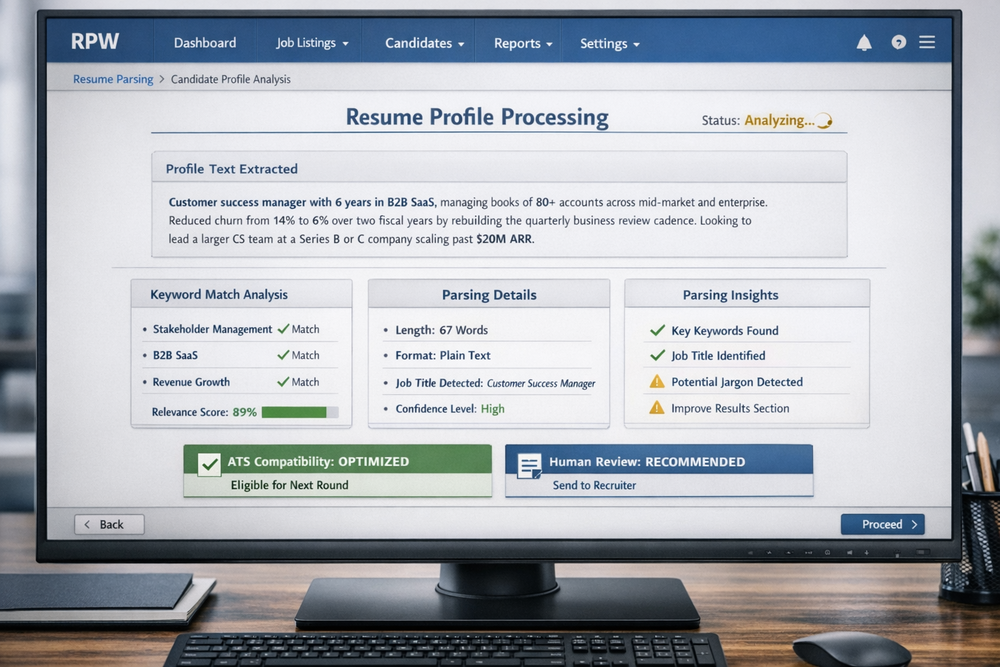
Three practical rules to follow:
1. Mirror 2–3 keywords from the job description. If the posting emphasizes “stakeholder management” and “revenue operations,” get at least one of those phrases into your profile verbatim.
2. Keep it in plain prose, not bullets. Bullets in the profile position confuse some parsers. Save bullets for the experience section.
4. Spell out the primary job title. “Senior Software Engineer” parses correctly; “Sr. SWE” may not.
Our applicant tracking system explainer covers the parser logic in more depth if you want to understand exactly what scoring rules are running on this section.
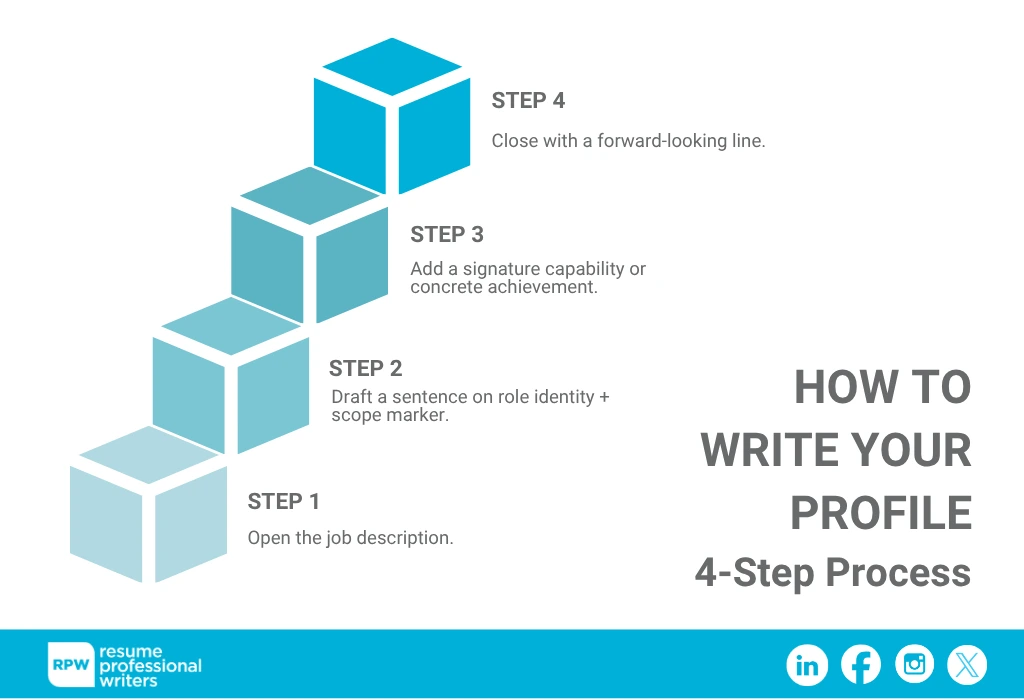
A 4-Step Process to Write Your Profile
Step 1: Open the job description.
Highlight the 3 most-repeated skills and the target job title verbatim.
Step 2: Draft a sentence on role identity + scope marker.
“Senior [role] with [X years] in [industry/vertical].”
Step 3: Add a signature capability or concrete achievement.
One specific thing, with a number if possible.
Step 4: Close with a forward-looking line.
What you’re looking to do next, scoped to the target company.
Cycle through your drafts until you hit 40–80 words and every sentence earns its place. If you’re stuck, our career library has role-specific guidance.
Where AI Resume Builders Fail on Profiles
ChatGPT, Rezi, Teal, Kickresume, and Enhancv all produce profiles that share three failures. This is the clearest place to differentiate a human-written resume from an AI-generated one:
1. Generic Scope Markers
AI builders default to “10+ years of experience in a fast-paced environment leading cross-functional teams.” Every AI-generated resume the recruiter saw today has that exact phrasing. It’s invisible.
2. Buzzword Stacking
“Results-driven, strategic-minded, passionate professional committed to driving success.” These phrases are the known fingerprint of AI-generated content. Some enterprise ATS platforms now flag resumes for exactly this pattern.
3. No Industry-Specific Language
AI builders write at a generic level because they have no context for your specific field. A nursing resume profile they produce will include “patient care” but not “SBAR handoff.” A legal profile will say “attention to detail” but not “Bates-numbered document review.”
What a human-written profile gets right: specific numbers (team size, revenue, campus scale), industry-native vocabulary, a real reason you’re looking at the target role, and language that mirrors the posting. You can use AI to produce a first draft, but if you publish the AI’s version unchanged, you’re handing the hiring manager a document that looks identical to 50 other applicants’ resume.
To populate the profile with the right kind of specific evidence, our list of 60 powerful accomplishments for a resume and our resume title and headline examples cover the building blocks. And if you want a structured second opinion on your current resume, our comprehensive resume analysis is a free starting point.
Common Resume Profile Mistakes That Kill Interviews

Even strong resumes can stumble at the profile stage. These common mistakes quietly undermine your credibility and cost you interviews—here’s what to avoid:
• Writing in the third person
“John is a senior marketing manager with 10 years…” reads like a bio on someone else’s website. Use first-person implicit (“Senior marketing manager with 10 years…”) — drop the pronoun but own the voice.
• Starting with “Seeking a role where…”
This pattern centers on what you want, not what you bring. Flip it: lead with your role identity and scope.
• Cramming in everything
A profile isn’t a career history. Pick the one scope marker and the one signature capability that match this job. Save the rest for the experience section.
• Using the same profile for every application
The profile is the most application-specific section of your resume. Small edits to the scope marker and one keyword per application raise your ATS match score meaningfully.
• Including irrelevant context
“Father of three, avid runner” belongs on LinkedIn (maybe). Not on the resume profile.
For examples of full resumes with strong profiles, see our worked examples by role library.

Get Your Resume Profile Written by a Specialist
If you’ve rewritten your profile five times and it still sounds off — too generic, too bold, or like it doesn’t say anything — the issue is usually that you’re too close to your own work. A second set of eyes can frame your scope and signature capability more sharply than you can from inside the role.
If you’d like us to have our team write your profile — tailored to specific target roles and ATS-tested — we’re happy to take a look at what you have now and suggest a rewrite. No pressure, no obligation.
Frequently Asked Questions
What is a resume profile?
A resume profile is a short paragraph of 2–4 sentences at the top of your resume that tells a hiring manager who you are professionally, your scope of experience, and the value you bring to the specific role. It lives directly under your contact block and is the first thing both the ATS and the human recruiter read. In 2026 hiring, it’s effectively the audition that determines whether the rest of your resume gets read at all.
How long should a resume profile be?
Between 40 and 80 words, or 2 to 4 short sentences. Shorter than a professional summary, longer than a one-line tagline. If you’re over 80 words, you’ve started listing accomplishments — move those to the experience section. If you’re under 40, you probably haven’t named your scope of experience or your value.
What’s the difference between a resume profile and a resume summary?
A resume profile is shorter (40–80 words, 2–4 sentences) and emphasizes who you are and where you’re going. A resume summary is longer (50–100 words, 3–5 sentences) and emphasizes what you’ve already accomplished — usually with specific numbers. Most working professionals can use either; summaries tend to work better for candidates with 5+ years of directly relevant experience.
Can I use AI to write my resume profile?
You can use AI to produce a first draft, but publishing the AI’s output unchanged is a mistake. AI builders default to generic phrasing (“results-driven,” “fast-paced environment,” “cross-functional teams”) that every AI-generated resume uses, so yours reads interchangeable. Treat the AI draft as a skeleton: rewrite the scope marker with your real numbers, replace the buzzwords with industry-specific vocabulary, and add one specific detail only you could know.
Where does the resume profile go on the page?
Directly below your contact block (name, phone, email, LinkedIn URL, city/state) and above your experience section. No heading is strictly required; the placement does the work. If you want a label, “Profile” or “Professional Profile” are the two conventional choices.