


What does a security officer job description cover today?
Short Answer: A security officer protects people, property, and assets at an assigned location. Core duties include monitoring premises, operating CCTV systems, controlling access at entry points, responding to alarms, and documenting incidents in written reports. Most states require a security guard license, and many employers prefer CPR/First Aid certification. Median annual wages run in the high-$30,000s, with armed and healthcare/corporate officers at the higher end of the range.
A security officer job description isn’t just a checklist of duties — it’s a blueprint for safeguarding people, property, and reputation. From monitoring CCTV feeds and enforcing access control to responding to alarms and documenting incidents, the role demands vigilance and adaptability. What changes is the context: hospitals emphasize patient safety, retail stores focus on loss prevention, and corporate offices prioritize confidentiality.
This piece explores sector‑specific differences, the skills employers value most, how to craft a resume that clears applicant tracking systems, and what the 2026 hiring market signals for professionals entering or advancing in this field.

Core Duties and Responsibilities Outlined in a Security Officer Job Description
A security officer’s day-to-day work centers on prevention, observation, and response. At most employers, the role includes six core duties:
• Patrol and Surveillance
Regular foot or vehicle patrols of assigned areas, checking doors, windows, perimeters, and restricted zones for signs of unauthorized access or damage.
• CCTV Monitoring
Watching camera feeds in a control room or on a mobile tablet, flagging unusual activity, and coordinating with responding officers on the ground.
• Access Control
Verifying identification at entry points, issuing visitor badges, escorting contractors, and enforcing badge-only or keycard-only zones.
• Incident Response
Reacting to alarms, medical emergencies, disputes, or security breaches — following documented procedures and coordinating with local law enforcement or emergency services when needed.
• Report Writing
Documenting every shift’s activity, filing incident reports for anything out of the ordinary, and maintaining logs that may be used in later investigations or legal proceedings.
• Customer and Visitor Interaction
In most settings, officers are the first face visitors encounter — directions, questions, and de-escalation of minor complaints fall within the role.
The U.S. Bureau of Labor Statistics projects an average of 162,300 openings for security guards and gambling surveillance officers each year from 2024 to 2034, mostly from replacement hiring rather than new positions, which indicates a steady demand and consistent opportunities. Applicants who understand the security officer job description and align their skills and resumes with employer expectations will be best positioned to secure these roles.
Duties by Sector: Corporate, Retail, Healthcare, and Event Security
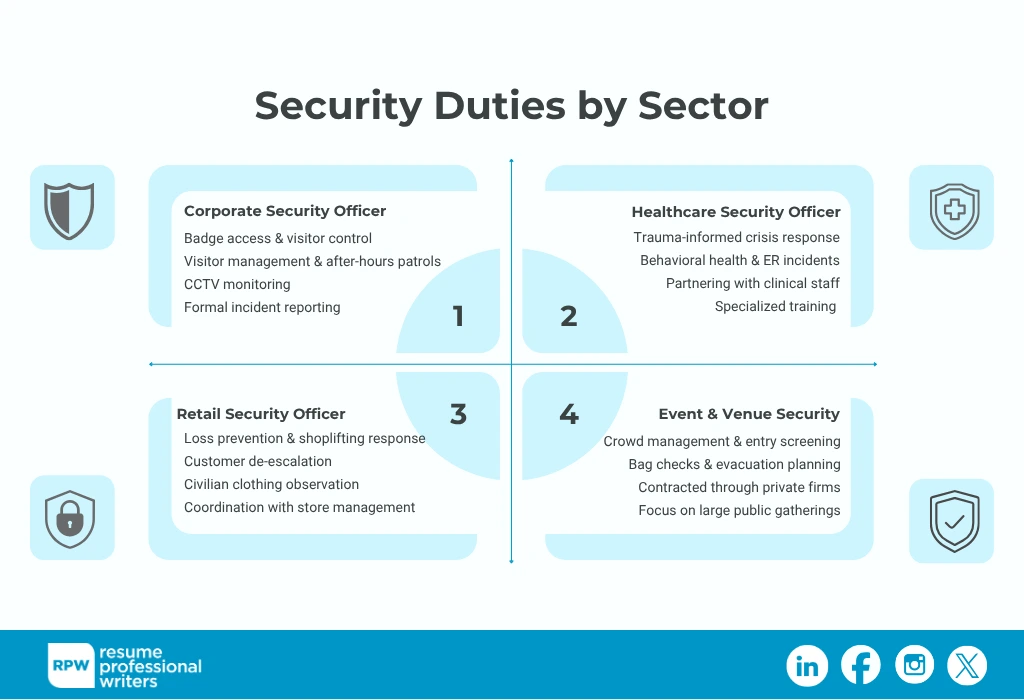
The core duties above apply broadly, but sectors emphasize different skills and add specific responsibilities:
Corporate Security Officer
Most time is spent on badge-based access control, visitor management, after-hours patrols, and CCTV monitoring in a centralized operations center. Formal written reports are central to the role — executives and legal teams rely on accurate incident documentation.
Retail Security Officer
Heavy emphasis on loss prevention, shoplifting response, and de-escalation. Officers often work in civilian clothing, observe customer behavior, and coordinate closely with store management. A retail security officer may spend most of a shift on the sales floor rather than at an access point.
Healthcare Security Officer
Hospitals require trauma-informed training, de-escalation with patients in crisis, and coordination with clinical staff. Officers frequently respond to behavioral health emergencies, domestic incidents brought in via the ER, and post-visit conflicts. Industry data from the U.S. Bureau of Labor Statistics on healthcare workplace violence documents that healthcare and social assistance workers experience some of the highest rates of workplace violence injuries of any U.S. sector, which is why hospitals invest heavily in specialized security training.
Event and Venue Security
Large public gatherings shift the role toward crowd management, bag checks, entry-point screening, and emergency evacuation coordination. Event officers typically work on contract with private security firms rather than directly for the venue.
Being explicit about the sector in your resume matters — hiring managers in each vertical look for different language and experience patterns.
Required Skills for Security Officer Roles in 2026
Employers screen security officer applicants for a consistent mix of skills across most sectors:
• Situational Awareness and Observation
Noticing what’s out of place — an unfamiliar vehicle, a propped-open door, a person acting nervously near a restricted area.
• Communication, Written and Verbal
Writing accurate incident reports, giving clear radio calls, de-escalating tense conversations.
• Physical Readiness
Ability to stand or walk for long shifts, respond quickly during incidents, and pass the employer’s medical screening. Most jobs don’t require athleticism — they do require stamina.
• Technology Fluency
Modern access-control platforms, CCTV systems, and incident-reporting software. Candidates comfortable with systems like Genetec, Milestone, or AMAG have a hiring edge.
• Calm Under Pressure
The single most common trait hiring managers cite. Officers who escalate a low-stakes incident into a crisis cost employers in reputation, legal exposure, and turnover.
• Customer Service Orientation
Officers are often the first face a visitor sees. Rude, cold, or overly aggressive officers damage the employer’s brand even when they follow procedure.
Credentials that strengthen an application
Requirements vary by state and sector, but the following credentials consistently appear in job postings:
- State security guard license (mandatory in most states)
- CPR and First Aid certification
- Armed license (for roles requiring it — check state regulations)
- ASP or PR-24 baton training (for applicable sectors)
- De-escalation certification (Verbal Judo, CPI, or equivalent)
- ASIS International Physical Security Professional (PSP) — for career advancement
How to Write a Security Officer Resume That Gets Interviews

Most security officer resumes fail the applicant tracking system test — not because the experience isn’t there, but because the formatting breaks parsing or the keywords don’t mirror the job posting. LinkedIn’s March 2026 U.S. Workforce Report tracks healthcare and corporate hiring as some of the most active sectors heading into mid-2026 — and these are exactly the corporate-tier and healthcare-tier security officer roles where pay tops the range, and where ATS-mediated hiring is most aggressive.
Your security officer resume is almost certainly getting parsed by software first. This is also where generic AI resume builders routinely fail candidates. A ChatGPT-generated security officer resume will list plausible-sounding duties, but it won’t know that a Verbal Judo certification matters for healthcare security, that ASIS PSP credentials advance corporate careers, or that retail security resumes need to emphasize loss prevention while hospital security needs trauma-informed language.
In our experience reviewing resumes across the security sector, the candidates who get interviews at the corporate and healthcare tiers are the ones whose resumes reflect sector-specific conventions, which is precisely what AI builders don’t have context for. Three practical fixes:
1. Use the exact job title from the posting
If the posting says “Security Officer,” write “Security Officer” — not “Security Professional” or “Protective Services Specialist.” Parsers match exact strings in most cases, and recruiters scan for the title they’re hiring.
2. Mirror the posting’s keywords in your skills section
If the job description emphasizes “CCTV,” “access control,” and “incident reporting,” those exact phrases need to appear in your resume. Our keyword lists by role cover the most common security-industry terms; the posting itself is the definitive source.
3. Quantify your experience
“Monitored the building” is vague. “Patrolled a 140,000-square-foot corporate campus, responding to an average of 12 alarm events per shift” is specific. Use numbers wherever you have them: campus size, response times, shift lengths, incident volume.
For a deeper walk-through, we break down picking the right resume format separately — in most cases, reverse-chronological is safest for a security officer resume running through ATS parsing.
Sample Security Officer Resume Summary
A strong professional summary sits at the top of the resume and tells the recruiter in 3–4 sentences why you’re the right fit. Here’s a before/after:
Before (Generic):
Experienced security officer with strong observation skills and a commitment to safety. Seeking a role where I can protect people and property.
After (Specific):
Licensed security officer with six years at a Class A corporate office campus, managing access control for 2,400 daily badge-ins and averaging under 90 seconds of response time to CCTV-flagged events. CPR-certified, state-licensed, and trained on Genetec Security Center and Milestone XProtect. Looking to bring corporate-security experience into a healthcare-sector role.
The after version names scope, specifies systems, and signals sector intent. Our walkthrough on writing a strong professional summary breaks the structure down further.
Security Officer Resume Bullet Points: Before/After
Security duties can sound repetitive on paper. The fix is always the same — lead with scope, add a number, end with outcome.
Weak: Monitored CCTV cameras.
Strong: Monitored 48-camera CCTV grid across three buildings; flagged and documented 14 after-hours access events over a 12-month period.
Weak: Responded to alarms and incidents.
Strong: Responded to an average of 8 alarm events per shift with a sub-90-second response time, coordinating with local police on two burglary investigations that led to arrests.
Weak: Wrote reports.
Strong: Authored daily activity reports and 35+ formal incident reports over 18 months; reports were cited in two civil cases and a workers' compensation claim.
The pattern across these examples is the same — every line earns its place by quantifying what you actually did. If you’re rebuilding your bullets from scratch, our deeper guides on how many resume bullet points per job and 60 powerful accomplishments for a resume walk through the structure with examples drawn from across industries.
What Security Officers Earn in 2026
The same BLS Occupational Outlook data shows median annual wages for security guards and gambling surveillance officers running in the high-$30,000s as of the latest survey. Pay varies widely by sector and location — armed officers and those in healthcare, corporate, or financial settings typically earn at the higher end of the range. Cost-of-living differences between regions also drive significant pay gaps. If you’re targeting one of the higher-paying tiers, our security industry resume specialists can position your credentials, post types, and incident-response work to match the hiring expectations at that level.
Career progression tracks predictably:
| Level | Title | Typical Years to Reach | Credentials That Help |
|---|---|---|---|
| Entry | Security Officer / Guard | 0 (with state license) | State guard license, CPR/First Aid |
| Mid | Lead Officer / Shift Supervisor | 2-4 | ASIS PSP, de-escalation training |
| Senior | Operations Manager | 5-8 | ASIS CPP, incident command training |
| Lead | Director of Security | 8-12 | ASIS CPP + management/MBA, executive protection |
| Exec | VP / Chief Security Officer | 12+ | CPP + ISACA CISM (if cyber-physical) |
Credentials like the ASIS PSP (Physical Security Professional) or CPP (Certified Protection Professional) can move you up the ladder faster and into roles that manage whole security programs rather than a single site.
Get a Security Officer Resume Built by a Specialist
A strong security officer resume balances two things: passing the ATS parser, and reading well to a recruiter who may spend less than 10 seconds on the first scan. Getting both right takes practice — and a second set of eyes.
If you’ve applied to a dozen security officer roles without interview callbacks, the issue is usually the resume, not your experience. Our team reviews resumes full-time and can spot the specific reasons yours is getting filtered out. If you’d like us to let our team rebuild your resume with ATS-tested formatting and security-sector language, we’re happy to take a look. No pressure, no obligation.
If you’re shopping around first, our guide on choosing the right resume writing service covers what to ask before you commit.
Frequently Asked Questions
What is the main job of a security officer?
The main job of a security officer is to protect people, property, and assets at an assigned location. That means patrolling the premises, monitoring CCTV and alarm systems, controlling access at entry points, responding to incidents, and documenting everything in written reports. Specific duties shift depending on the sector — corporate, retail, healthcare, and event security each emphasize different tasks.
What skills do you need to be a security officer?
Core skills include situational awareness, written and verbal communication, physical readiness for long shifts, technology fluency with access-control and CCTV systems, calm under pressure, and customer service orientation. Most states also require a security guard license, and many employers prefer CPR/First Aid certification. Advanced roles typically ask for de-escalation training and ASIS-industry credentials.
What is the difference between a security officer and a security guard?
The terms are often used interchangeably, but there’s a loose distinction. “Security guard” tends to refer to entry-level, single-site roles focused on observation and reporting. “Security officer” is a slightly broader term that implies more responsibility, credentialing, or supervisory scope. Job postings don’t always follow this pattern, so read the actual duties listed rather than relying on the title alone.
How do I write a resume for a security officer job?
Start with your state security license and certifications at the top. Use a professional summary that names the sector you’ve worked in, the scale of the site, and the systems you’ve used. In the experience section, quantify everything — campus size, response times, incident volume, shift length. Mirror the posting’s keywords in your skills section, keep the format to a single-column reverse-chronological layout, and avoid tables or text boxes that break ATS parsing.
Is security officer a good career in 2026?
Security officer work offers steady employment — the BLS projects about 170,000 openings per year through 2033 — and a clear progression path into supervisory and director roles. Pay varies widely by sector, with armed, healthcare, and corporate roles paying at the higher end. The work can be physically demanding and involve overnight shifts, but the barrier to entry is lower than many fields (most states require only a license and a clean background check), and credentials like the ASIS PSP or CPP can advance careers significantly.