


A narrative resume replaces traditional bullet points with short paragraphs that tell the story of your career — what you’ve done, why it mattered, and what you learned. It works best for academics, researchers, career changers, and senior professionals whose impact doesn’t compress into one-line bullets. For ATS-screened corporate roles, a traditional bullet-format resume remains the safer choice.
A traditional chronological resume lists duties. A narrative resume explains judgment, context, and outcomes. If you’re a job applicant looking for a perfect C-level post, consider preparing a narrative resume, the modern approach to rewriting traditional resumes. Know the best practices on how to write a narrative resume and check examples to guide you in your job search.
This piece covers what a narrative resume is, when it works better than a traditional format, how to structure one, and what a strong example actually looks like. It also covers where narrative format works against you — because for most ATS-screened roles, a traditional resume is still the safer bet.
What Do You Need to Know About a Narrative Resume
As the name suggests, a narrative resume takes the form of storytelling. Likewise, it lists your qualifications line by line as if you’re telling your story. To add, this job narrative may take either the first- or third-person points of view.
A narrative resume may be your best way to impress recruiters. Like traditional copies, this gives employers a better grasp of your skills and experiences as a job seeker—only this time, written in a different, unorthodox approach. Plus, this type of resume offers other benefits to job applicants. Here are a few upsides:
- It’s a complete detailed view of your work experience.
- Your value comes to life on paper.
- It brands your story to help you connect with your reader.
- Your job application is presented in an intriguing yet memorable way.
- It piques your reader’s interest, leading them to want to meet with and learn more about you.
Remember: A well-written narrative resume helps hiring managers to imagine you holding the target post.
What a Narrative Resume Actually Looks Like
A narrative resume keeps the standard sections — contact info, professional summary, work experience, education — but rewrites the body of each job as flowing prose. Instead of six bullets under a job title, you get two or three paragraphs that explain scope, decisions, and impact.
Here’s a traditional bullet-style entry:
Senior Program Manager, Atlas Logistics, 2021–2024

- Led cross-functional team of 12 across engineering and operations
- Delivered on-time rollout of warehouse automation project
- Reduced processing time by 34% year over year - Managed $4.2M annual budget
Now the same role in narrative format:
Senior Program Manager, Atlas Logistics, 2021–2024

Led the automation rollout across three regional distribution centers — a $4.2M program touching engineering, operations, and a 12-person cross-functional team. The project had slipped once before I inherited it, so my first 90 days were spent rebuilding the delivery plan and renegotiating scope with operations leadership. We shipped the first site on the revised timeline and used what we learned to cut processing time by 34% the following year. The program is now the template the company uses for new-site launches.
Same facts. Different emphasis. The narrative version shows judgment — what I changed, why it worked — that bullets tend to flatten. This is also where AI resume builders consistently fall short: they can produce a clean bullet list from a job history, but they can’t write the paragraph above because they don’t know which decisions defined your time in the role. That’s the judgment layer a human brings.
For a refresher on chronological, functional, and combination layouts, we have a separate comparison piece, and our CV examples library has long-form narrative samples by field.
When a Narrative Resume Works Better

A narrative resume is the right choice in specific situations.
• Academic and Research Positions
Many universities and funding bodies — especially in the UK, Netherlands, and increasingly Australia — have moved to “narrative CVs” (sometimes called Résumé for Research and Innovation or R4RI format) for grant applications and faculty roles. UK Research and Innovation has published detailed R4RI guidance that now governs most UKRI funding proposals, and the Royal Society and several EU funding bodies have adopted similar formats.
• Executive and Senior Leadership Roles
At the VP and C-suite level, the question isn’t what you did but how you decided. Narrative format gives room to show reasoning, trade-offs, and strategic context that bullets can’t. Harvard Business Review’s research on leadership origin stories makes a similar point: the story behind the decision matters as much as the decision itself, and executives are increasingly evaluated on narrative coherence.
• Career Changers
If you’re pivoting from teaching to instructional design, or from military service to operations management, a narrative format gives you room to explain why your past experience translates. Bullets tend to make a career change look disjointed. Prose makes it look intentional. The skill-grouped resume structures are a related option worth comparing — narrative leans on story, functional groups by skill.
• Consulting, Coaching, and Advisory Work
When your deliverable is judgment, a narrative resume format reflects the work more honestly than a task list ever will.
For every other situation, including most corporate jobs, the traditional format remains the safer bet. We’ll come back to why.
The 6 Sections of a Narrative Resume (and How to Write Each)
A narrative resume has the same backbone as a traditional one. What changes is the prose density in the middle sections.
1. Header and Contact Information
Name, city/state, phone, email, LinkedIn URL. Skip the full street address. Keep this tight and traditional — no narrative needed.
2. Professional Summary (Narrative Style)
Write three to four sentences. Pick one voice and stick with it — first person is fine. If you’re coming from a traditional resume and want more depth on building a professional summary, we have a separate walkthrough of the component parts. For inspiration drawn from real resumes, our collection of 50 resume summary examples shows how candidates at different career stages compress their best work into three lines.
Before (Traditional):
Results-driven operations leader with 12+ years of experience, skilled in cross-functional collaboration, process improvement, and team leadership.
After (Narrative):
Operations leader who has spent the last twelve years taking on rollouts other people didn't want. My best work has been at the intersection of messy processes and under-resourced teams — most recently a $4.2M warehouse automation program that had slipped twice before I took it over. I care about getting things shipped without burning people out, and I'm drawn to companies scaling past the stage where heroics still work.
3. Work Experience
This is where narrative format earns its keep. For each role, write two to four short paragraphs covering:
- Context: What was the situation when you arrived? What problem were you hired to solve?
- Decisions: What did you choose to focus on, and why? What trade-offs did you make?
- Outcome: What changed because of your work? Use numbers wherever you have them.
The third paragraph — outcome — is where most narrative resumes fall apart. Writers get philosophical and skip the metrics. Don’t. A narrative is not a pass on specifics; it’s a frame around them. The same metric-density discipline applies in bullet-point form too, and reading both side-by-side often clarifies which one fits a given role.
4. Education
Traditional format works fine here. Degree, institution, year, honors. One line each.
5. Skills
Either a short paragraph (“I work fluently across Python, SQL, and BI tooling, with deeper experience in Snowflake and Looker…”) or a clean list. ATS-screened applications benefit from a simple comma-separated list — more on that below.
6. Optional Sections
Publications, talks, volunteer work, languages, certifications. Narrative format suits publications especially well, since one sentence of context is often more useful than a citation alone.
To write a narrative resume takes effort and time. However, it’s all worth it once you land your target job. Thus, you have to make sure that your tool is good enough to win the interest of your potential employer. To make things easy for you, click on the video and heed these top tips.
A Short Narrative Resume Template
Copy this structure as a starting point:
[Your Name]
City, State, Zip Code · email@example.com · 555-0100 · linkedin.com/in/you
Summary
[3–4 sentences explaining who you are, what you’re known for, and what you’re drawn to next. First person is fine. Avoid buzzwords.]
Experience
[Role], [Company, Location], [MM/Year–MM/Year]
[Paragraph 1: the situation you walked into and what you were hired to do.]
[Paragraph 2: the one or two decisions or projects that defined your time here.]
[Paragraph 3: what changed as a result, with at least one number.]
Earlier Career
[Role], [Company, Location], [Employment Duration]
[Same structure, compressed to 1–2 paragraphs for older roles.]
Education
[Degree], [Institution, Location], [Year Completed]
Skills
[Short paragraph or clean list, depending on audience.]
Aim for two pages. Narrative resumes run slightly longer than traditional ones — three pages is acceptable for senior or academic histories, rarely appropriate otherwise.
Narrative vs. Traditional Resume: Where Each Wins
| Situation | Better Format |
|---|---|
| Applying through a company careers page (ATS-screened) | Traditional |
| Academic faculty or grant application | Narrative |
| Executive search firm or retained recruiter | Narrative (often) |
| Entry-level or first professional job | Traditional |
| Career changer with non-obvious pivot | Narrative |
| Federal job (USAJobs) | Traditional + KSA-style narrative statements used in federal applications |
| LinkedIn-sourced recruiter outreach | Either — ask the recruiter |
| Multiple roles to consolidate (e.g., consultant with several engagements) | Hybrid — see resume summary examples for multiple jobs |
If you’re applying through a company careers page that routes your resume through an ATS, stay traditional. Parsers are built to extract structured data — job titles, dates, skill keywords — and paragraph prose confuses them. You can still use narrative phrasing inside bullets, but the underlying structure should stay bullet-based.
Columbia University Career Education’s guide to writing a resume profile or summary statement documents the same point from the candidate side: the narrative belongs at the top of the resume in a tight summary, while the body needs the bullet structure parsers can read.
Narrative Resume Sample
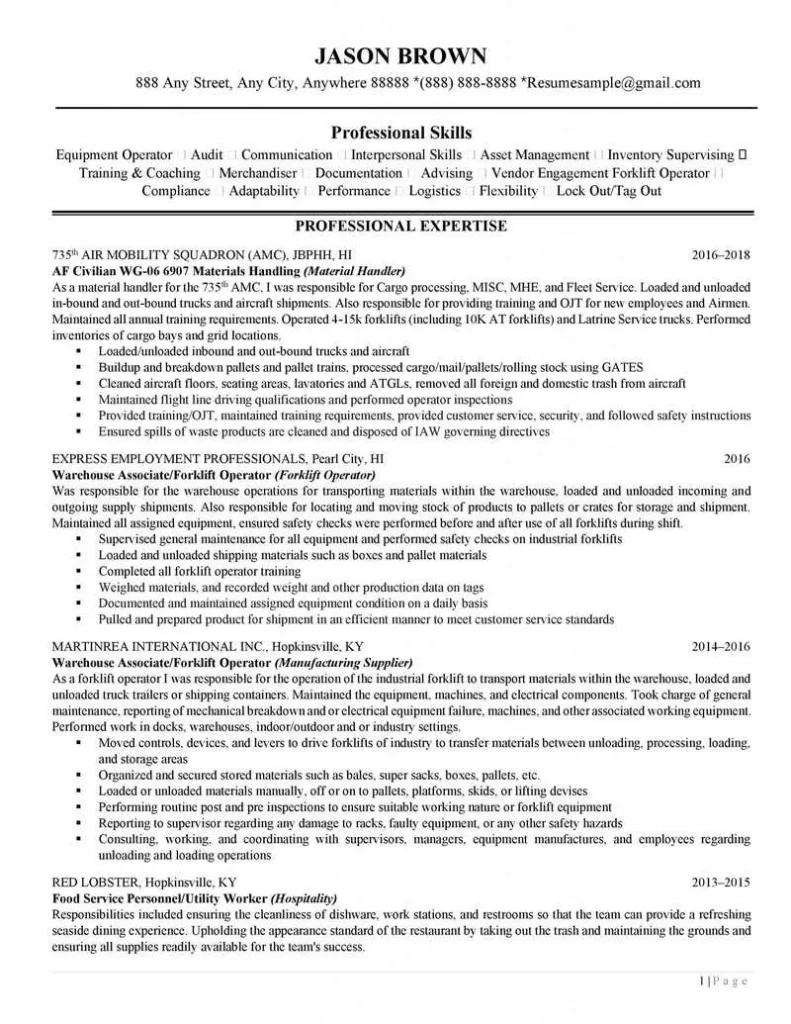
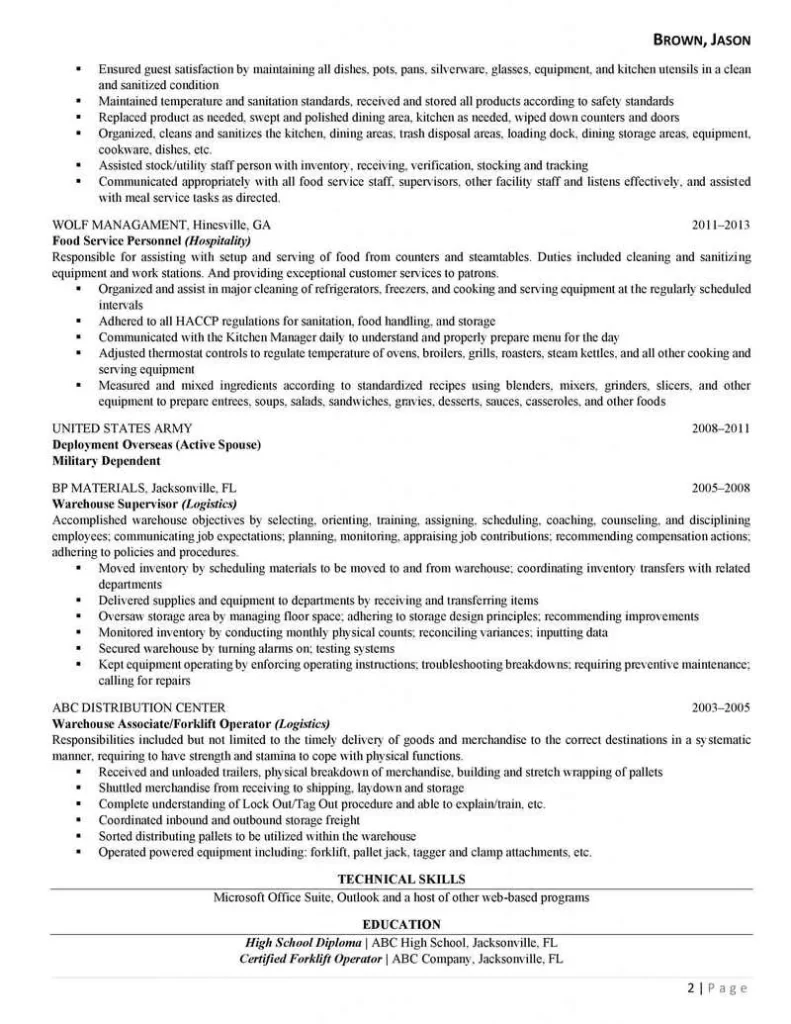
Your resume is your tool to market yourself to recruiters. Thus, having an effective resume is important to be noticed by hiring managers. It’s a great advantage if you know how to write a well-written resume. Plus, you can also benefit from using the less-travelled kind of resume—career narrative resume. To give you an idea on how it differs from a traditional one, check out two resume samples below.
Traditional Resume
Narrative Resume
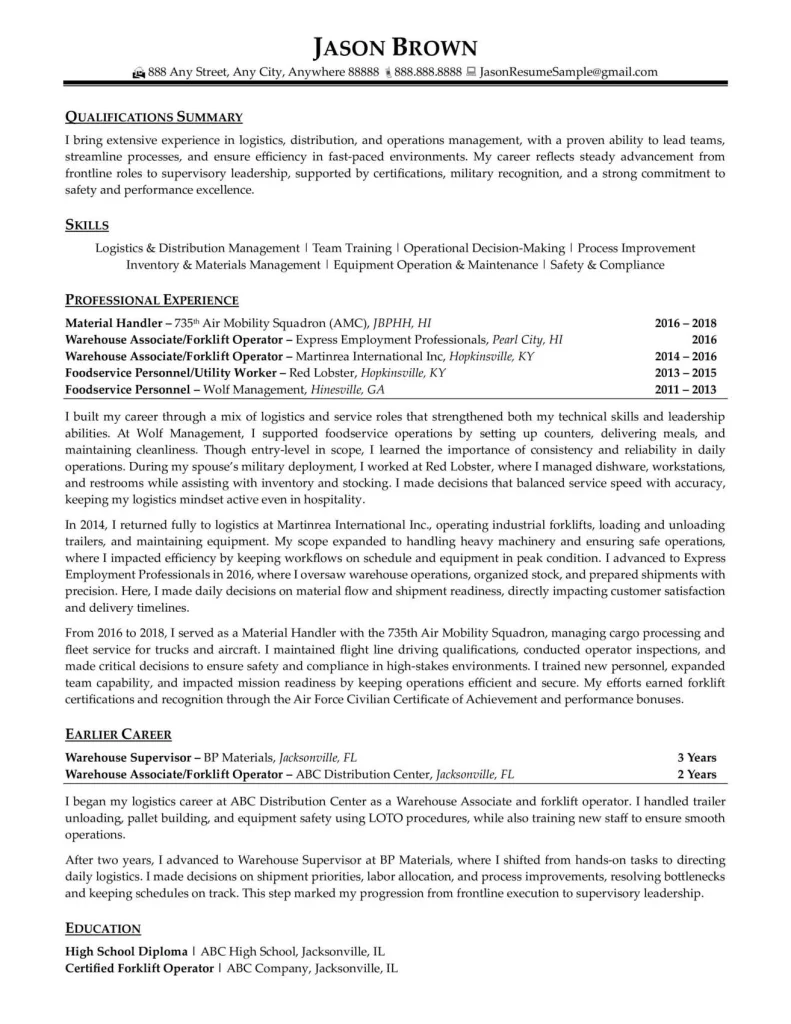
A career narrative lets you tell a firmer story better than a bullet-point list. Even if you have a long job history, you can still focus on pieces of info relevant to your target job. Just heed the best practices on how to write a narrative resume as your guide in writing your piece.
Lastly, understand that this format isn’t for every job seeker and industry. It serves well those who have an extensive work history and a long story to share. So, if you’re a job seeker with a seasoned career, make sure that when writing your job tool, your piece should speak of what you can bring to the table.
Common Narrative Resume Mistakes to Avoid
- Treating it as a cover letter. A narrative resume still belongs in the resume slot of an application. It’s not a personal essay. Stay professional, factual, and focused on outcomes.
- Dropping the numbers. Prose is not permission to be vague. If you led a team of 14, say so. If revenue grew 22%, say so. Narrative format rewards specificity.
- Writing in the third person. Pick first person. Third person (“John led a team…”) reads stiff and dated unless you’re writing for a specific academic or foundation format that requires it.
- Using it for an ATS-screened job. If the application portal asks you to upload a resume and parses it into form fields, you’re facing an ATS. Use traditional format.
- Letting it run long. Two pages is the soft limit for most industries. If you’re over three, you’re writing a memoir, not a resume.
Let a Senior Writer Build Your Narrative Resume or CV
If you’re unsure whether your situation calls for a narrative or traditional resume, a ten-minute review from someone who reads CVs full-time usually settles it. If you want to go deeper on the craft of shaping your career story, we have a companion piece on the strategies that make narrative resumes land.
For academic, executive, or research-heavy roles where a narrative CV is the right fit, our team builds long-form CVs that hold up in academic and board-level review — built around your actual career, not a template.
Frequently Asked Questions
What is a narrative resume?
A narrative resume uses paragraph-form prose instead of bullet points to describe work experience. It emphasizes context, judgment, and outcomes rather than a task list. The format is most common in academic, research, executive, and career-change contexts — and now required by several major research funding bodies, including UKRI in the UK.
Is a narrative resume the same as a narrative CV?
Essentially yes. The terms get used interchangeably, though “narrative CV” is more common in academic and UK English contexts and often refers specifically to formats like UKRI’s Résumé for Researchers (R4RI). “Narrative resume” is more common in U.S. business contexts. The underlying structure — paragraph-form descriptions in place of bullets — is identical.
How long should a narrative resume be?
Two pages is standard for mid-career and senior professionals. Three pages is acceptable for academic roles, executives with 20+ year histories, or formats that explicitly request a long-form CV. One page is usually too short — paragraph format needs room to breathe. If you’re under two pages, consider whether you’ve given enough context for each role.
Can I use a narrative resume for a corporate job?
You can, but think twice. Most corporate applications route through ATS software that struggles with prose-heavy resumes. If the job is posted on a company careers page or job board, traditional format is safer. Save the narrative version for recruiter outreach, executive search, or roles that explicitly ask for a long-form CV.
Do narrative resumes work for entry-level jobs?
Usually not. Entry-level applicants typically don’t have the depth of experience narrative format rewards, and most entry-level applications are ATS-screened. A clean, traditional one-page resume is the stronger choice at this stage of your career — you can shift to narrative format once you have the seniority to justify it.