


The best skills to put on resume are the exact-match keywords from the job description, paired with industry-specific hard skills (tools, certifications, methodologies). Soft skills work only when they’re specific enough to verify (“audit-quality documentation” not “detail-oriented”). Mirror the posting’s exact phrasing in your skills section, then weave the same keywords naturally through your work experience bullets.
When you decide to brave the job market, having a standout resume with the right resume skills can spell the difference in your success. These skills are the ones that match the job description you’re applying for, pass the applicant tracking software, and give a recruiter a concrete reason to keep reading after the 7-to-10 second first scan.
Most resume skills sections fail on at least two of those three; either they’re too generic, don’t mirror the posting’s language, or pad the list with soft skills that every applicant claims. This piece covers what skills to list, how to pick them for a specific role, how to pass an ATS, and where AI resume builders consistently get skills sections wrong.

How Many Skills Should You Put on a Resume?
Between 8 and 15 is the practical range. Under 8 and the ATS has nothing to match. Over 15 and the list reads padded, and recruiters skim past it.
Within that range, prioritize by how many times each skill appears in the target job description. If “stakeholder management” shows up three times in the posting, put it at the top of your skills section verbatim. If a skill appears zero times in the posting, ask whether it belongs in the list for that application.
What Counts as a Resume Skill
A resume skill is any concrete ability, tool, credential, or behavior that an employer can evaluate as evidence you can do the job. Skills fall into three categories:
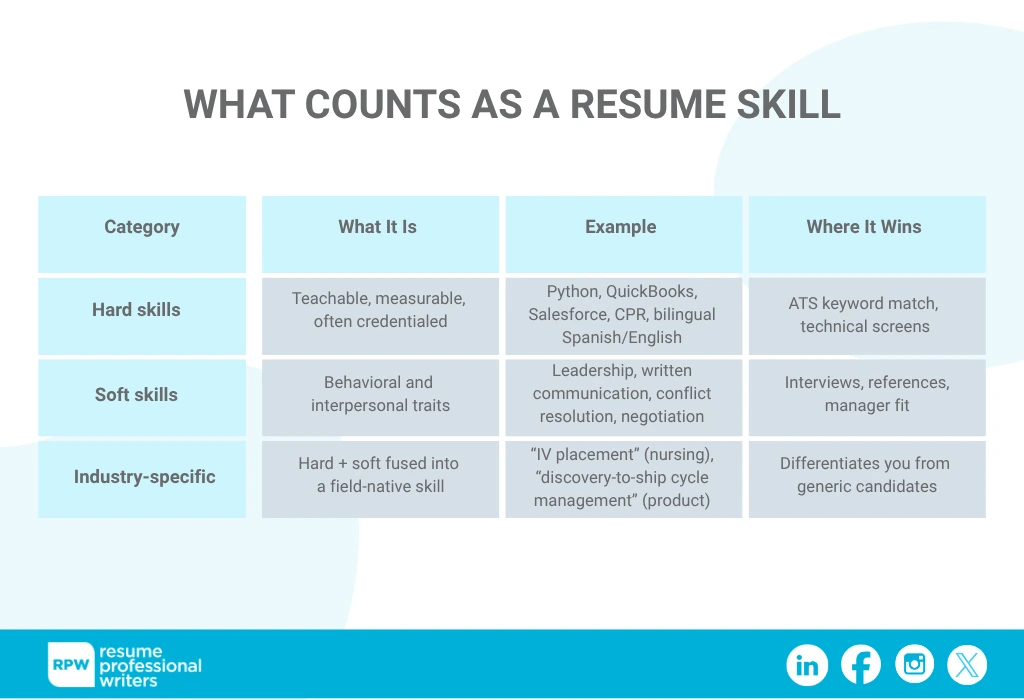
When it comes to creating a resume, understanding the different types of skills that employers are looking for is crucial. In this section, we will break down the different types of skills and provide examples of each.
- Hard skills — teachable, measurable abilities. Python, QuickBooks, Salesforce, GMP compliance, bilingual Spanish/English, CPR certification.
- Soft skills — behavioral traits and interpersonal abilities. Leadership, written communication, conflict resolution, negotiation, time management.
- Industry-specific skills — the combination of hard + soft that’s native to a particular field. Examples: a nurse’s “IV placement,” a product manager’s “discovery-to-ship cycle management,” and a security officer’s “conflict de-escalation.”
Most job seekers over-list soft skills and under-list industry-specific ones. That’s exactly backwards for 2026 hiring. Hard and industry-specific skills are what ATS platforms parse against; soft skills are what humans evaluate in interviews.
Hard Skills Worth Listing in 2026
Hard skills age the fastest. A skill that was in demand in 2020 may not be in 2026. Current high-value hard skills across most professional fields:

Data Fluency
Skills in SQL basics, Excel/Google Sheets at a functional level, and comfort with dashboards such as Looker, Tableau, and Power BI allow you to interpret, organize, and visualize data effectively, providing actionable insights that support decision‑making and business growth.
AI Workflow Tools
ChatGPT, Claude, Perplexity, and industry‑specific AI platforms enable automation, research, and content generation. The ability to utilize them is now a standard expectation across most roles.
Project Management Systems
Proficiency in Asana, Jira, Monday, ClickUp, and Notion supports task tracking, agile workflows, and cross‑functional project delivery.
CRM Systems
Experience with Salesforce, HubSpot, and Close enhances client engagement, pipeline management, and relationship tracking—critical for customer‑facing roles.
Collaboration and Async Communication
Tools like Slack, Loom, Notion, and Figma streamline team communication, feedback sharing, and remote collaboration across distributed teams.
Cloud Productivity
Advanced use of Google Workspace and Microsoft 365 features improves document management, real‑time collaboration, and enterprise productivity.
The specific tools that matter vary sharply by role. A marketing manager needs different hard skills than a nurse, and a nurse needs different hard skills than a paralegal. The best way to surface the hard skills for your target role is to pull 5–10 current job postings from companies you’d want to work for and list every technical tool, platform, and certification they mention. That list is your 2026 hard-skill shortlist for your field.
Soft Skills That Actually Read as Credible
Every resume lists “communication” and “teamwork.” Neither distinguishes you. Credible soft skills work when they’re specific enough to be tested.

Use these formulations:
- Instead of “team player” → cross-functional collaboration with engineering, design, and sales stakeholders.
- Instead of “communication” → written briefs for executive audiences or verbal de-escalation in high-pressure situations.
- Instead of “leadership” → direct management of teams ≤10 / indirect influence of teams up to 50. See our deeper guide on leadership skills on a resume for examples by seniority
- Instead of “problem-solving” → root-cause analysis or decision-making under incomplete information. Our walkthrough on problem-solving skills on a resume shows how to back this up with specifics
- Instead of “detail-oriented” → audit-quality documentation or contract review accuracy ≥99%.
The pattern: specify the context and the scale. “Leadership” is a claim anyone can make. “Managed a 12-person engineering team across three time zones” is verifiable.
If you want a wider taxonomy of how skills break out, our explainer on what soft skills actually are covers the full list of workplace competencies that show up across roles.
Industry-Specific Skills by Role
The strongest skills sections lean heavily on industry-specific language. A few examples of what this looks like in practice:
Healthcare
For a registered nurse, skills in IV placement, trauma assessment, and EHR systems (Epic, Cerner) support accurate patient documentation and safe care delivery. Proficiency in SBAR handoffs, infection control, and certifications (CPR, BLS, ACLS) ensures compliance and readiness in critical settings. Bilingual Spanish/English communication strengthens patient trust while maintaining HIPAA standards.
Software Engineering
Skills in production incident response and distributed‑systems design (Kubernetes, Kafka) enable resilient infrastructure. Code review expertise in Go, Python, and TypeScript ensures quality, while database fluency in PostgreSQL and Redis supports scalable applications. CI/CD pipeline management and on‑call rotation experience reinforce reliability in fast‑moving environments.
Marketing
Applied knowledge in paid search (Google Ads, LinkedIn Ads) and marketing automation (HubSpot, Marketo) drives measurable lead generation. Strength in attribution modeling, SEO, and content strategy enhances visibility, while CRM segmentation and statistically rigorous A/B testing optimize campaign performance.
Finance / Accounting
Comprehensive skills in GAAP compliance, FP&A modeling in Excel, and month‑end close processes deliver accurate reporting. Hands‑on experience with SOX compliance, ERP systems (NetSuite, SAP), and audit liaison work strengthens governance. Cash flow forecasting informs strategic decision‑making and supports financial stability.
Executive / Leadership
Proven leadership in P&L ownership (specify $ scale) and board reporting demonstrates accountability. Experience in M&A integration, organizational design at scale, and CEO succession planning highlights strategic foresight. Capital raising (Series B/C) expertise supports growth initiatives and investor confidence.
For worked examples by role, our resume examples library has industry-specific skill sections you can model. Our deep dive on resume skills examples and the soft-vs-hard breakdown is the companion piece to this one — read both together if you’re rebuilding your skills section from scratch. And if there are gaps you want to close before applying, our skills development resource hub covers the most career-impactful skills to build in 2026.
How ATS Software Reads Your Skills Section
MIT Sloan reports that an estimated 87% of companies have deployed AI screening tools in their hiring process, with the AI hiring tool market projected to top $1B by 2027. Translation: applicant tracking software is now the first reviewer for most mid-size and large employer applications, and the skills section is usually the first thing the parser extracts.
Emphasizing the right skills helps demonstrate your qualifications for the role and showcases your ability to meet the job requirements effectively. A well-crafted skills section can improve your resume’s chances of passing through applicant tracking systems (ATS) that many companies use to filter applications.
Three rules for making your skills section ATS-friendly:
- Use a simple, single-column list. No tables, no columns, no text boxes, no icons. Parsers drop content in those containers.
- Mirror the posting’s exact phrasing. If the job description says “project management,” use that phrase — not “managed projects.” Some parsers match exact strings, not synonyms.
- Spell out acronyms at least once. “Search Engine Optimization (SEO)” catches both forms. “Certified Public Accountant (CPA)” does the same.
ATS often scan resumes for specific skills that match the job description. By clearly presenting your relevant skills, you increase the likelihood that your resume will catch the eye of hiring managers and lead to an interview opportunity. Presenting your skills in a targeted and impactful manner can make your resume stand out in a competitive job market.
Expert Tip:
Look for the intersection of technical expertise and soft skills. This means striking the right balance between hard skills (quantifiable abilities that can be measured) and soft skills (interpersonal attributes that contribute to effective collaboration and communication).
For a starter list of skills by role, we maintain keyword lists organized by industry for the most common positions. Our applicant tracking system explainer covers what those parsers are doing under the hood, which is useful context when you’re deciding which keyword variants to include.
Where AI Resume Builders Get Skills Wrong
ChatGPT, Rezi, Teal, Kickresume, and Enhancv all produce respectable-looking skills sections that share the same three failures. Knowing these is how you make a human-written skills section stand out:
1. They pad with soft skills that sound strong but are unfalsifiable.
“Detail-oriented, results-driven team player with strong communication skills.” Every resume the ATS saw today has those exact phrases. They’re invisible.
2. They don’t know your industry’s specific vocabulary.
An AI builder will add “patient care” to a nursing resume but won’t know to add “SBAR handoff” or “Epic charting” — the exact phrases ATS systems match on for nursing roles.
3. They list current tools without regard to whether you actually use them.
AI builders default to recognizable tools (Salesforce, Excel, ChatGPT). If you claim a skill you can’t demonstrate in an interview, you lose credibility fast.
What a human-written skills section gets right: industry-specific vocabulary, honest scoping (you list what you actually use, not what sounds impressive), and keyword alignment to one specific job description rather than a generic template.
If you’re writing a summary to go with your skills section, see our walkthrough on building a professional summary.
Common Skill Section Mistakes That Kill Interviews
Even with the best intentions, there are common mistakes job seekers often make when listing skills on their resumes. Avoid these pitfalls to ensure your resume remains impactful and relevant.
1. Listing skills without any hard-skill anchors
A section with only “leadership, communication, teamwork, adaptability” tells a hiring manager nothing. Every section needs at least 3–4 concrete hard skills.
2. Using outdated tools
“Proficient in Microsoft Office” in 2026 signals that you haven’t updated your resume in five years. Name the specific feature set (Excel pivot tables, Google Sheets array formulas, Office 365 Power Automate).
4. Adding the same skill twice in different words
“Time management, organization, prioritization, deadline management.” That’s one skill. Pick the phrasing the posting uses.
5. Skipping proficiency level
“Spanish” could mean conversational or native. If the posting requires Spanish, specify your level (native / fluent / conversational / basic).
6. Cramming skills into a 3-column layout to fit more
ATS parsers routinely drop content in multi-column layouts. Use a single column even if it looks less dense.
How to Choose the Right Skills for Each Application
The most important step is one most job seekers skip: read the job description twice and list every skill the posting explicitly names.
1. Read the posting twice.
Analyze job postings to identify the job skills that employers frequently seek. Tailoring your resume to include these job skills can enhance your fit for the role. First read for meaning, second read with a highlighter for specific skills.
2. Make two columns on paper.
In the left column, list down all of these skills that the posting explicitly names. Right column: your existing skills that match.
3. Put the overlap at the top of your skills section.
Copy the exact wording of the skills listed in the job description and place them directly into your resume’s skills section — without rewording, paraphrasing, or substituting synonyms. This alignment shows that you’re a good fit for the position.
In some cases, you might need to consider using a specific resume format depending on how your experiences stack up to the requirements of your target job.
4. Fill remaining slots with complementary skills you can demonstrate.
Prioritize hard and industry-specific over soft.
5. Delete anything you can’t speak to in an interview.
If “leadership” is on your resume and you freeze when asked for a specific example, cut it.
You’ll often find you need to rewrite your skills section for each application. That’s the right workload — a one-size-fits-all skills section reads as lazy to both the ATS and the human reviewer.
For more on how to apply this discipline across your whole resume, our career library has role-specific guides.

Have a Senior Writer Rebuild Your Skills Section
If you’ve rewritten your skills section three times and still aren’t getting interviews, the issue is usually one of three things: you’re listing skills that don’t match what employers actually want for your target role, your skills aren’t phrased the way ATS platforms match, or your skills undersell what you actually bring.
A second set of eyes from someone who reads resumes full-time can find the gap quickly. If you’d like us to have our team rewrite your skills section — aligned to specific target roles and ATS-tested — we’re happy to take a look. No pressure, no obligation.
Frequently Asked Questions
What are the best skills to put on a resume in 2026?
The best skills are the specific hard and industry-specific skills that appear in the job description you’re applying for. Generic soft skills like “team player” or “hard-working” no longer differentiate candidates. Strong 2026 resumes lead with concrete hard skills — specific tools, certifications, measurable abilities — and use soft skills only when they’re scoped and credible (e.g., “cross-functional collaboration with 12-person teams” rather than “teamwork”).
How many skills should I list on my resume?
Between 8 and 15 is the practical range. Fewer than 8 gives applicant tracking systems too little to match against; more than 15 reads as padded and recruiters skim past it. Within that range, prioritize by which skills appear most often in the target job description.
Should I include soft skills on my resume?
Yes, but sparingly and with specificity. Two or three scoped soft skills carry more weight than ten generic ones. Instead of “communication,” write “written briefs for executive audiences” or “cross-functional coordination across engineering, product, and design.” Soft skills are what interviews evaluate, so only list ones you can demonstrate with a specific example.
What skills do employers want in 2026?
Employers want candidates who can use modern workflow tools (AI fluency is now expected in most white-collar roles), who know the specific software and systems of their field, and who can demonstrate measurable outcomes. Hard skills with verifiable evidence beat vague soft-skill claims. Industry-specific language beats generic descriptors.
What skills should I NOT put on my resume?
Skills you can’t demonstrate in an interview, outdated tools (e.g., “proficient in Microsoft Office” without specifying features), duplicates in different words, and soft skills that every applicant claims. Also avoid listing AI tools generically (“ChatGPT”) without context — specify how you use them in your workflow, or leave them off.