

“References available upon request” used to be a standard resume line. In 2026, it’s outdated, and in most cases, you shouldn’t list references on the resume itself at all. But that doesn’t mean references don’t matter. Knowing how to list references on resume correctly, when to provide them, how to format them, and who to choose, can be the difference between a smooth final stage and a stalled offer.
This guide covers the modern approach: whether references belong on your resume, how to build a separate reference page, the exact format to use, and how to prepare your references so they help rather than hurt.

Why Resume References Still Matter in 2026?
References act as professional endorsements from supervisors, colleagues, clients, or mentors, validating a candidate’s skills, integrity, and performance. They remain a critical factor in final hiring decisions, offering employers credible insights beyond the résumé itself.
- Provide third-party verification about a job seeker’s work ethic, achievements, and conduct.
- Serve as trusted proof points that employers use to confirm résumé details and cultural fit.
- Validate management experience, cross-functional collaboration, or measurable achievements,
- Carry extra weight in senior, federal, healthcare, and academic roles.
- Influence hiring decisions when candidates are closely matched.
Once an essential part of printed resumes, references are now checked later in the hiring process. A 2025 Society for Human Resource Management survey found that most HR professionals stated they contact references only after extending a conditional offer. This makes listing references directly on the resume redundant and premature.
Understanding when and how to share references strategically shows you grasp modern hiring expectations and strengthens your credibility.
Should You Put References on Your Resume?
In almost all cases, no. The modern standard is to keep references off the resume and provide them separately when an employer asks — usually late in the hiring process. Here’s why:
- Space is valuable. Your resume should use every line to sell your experience, not list contacts the employer doesn’t need yet.
- References come later. Employers typically request them at the offer or final-interview stage, not during the initial screen.
- Privacy matters. Listing a reference’s name, phone, and email on a widely shared document exposes their information unnecessarily.
The one exception: If a job posting explicitly asks you to include references with your application, follow that instruction. Otherwise, prepare them on a separate page and hand them over when requested.
Expert Tip
Skip “References Available Upon Request”
This phrase is a relic. Employers already assume you can provide references if asked, so the line adds nothing and wastes a row of prime resume space. Delete it and use that space for an achievement, a skill, or a stronger summary instead. For help making the top of your resume work harder, see our resume summary template.
How to Create a Separate Reference Page
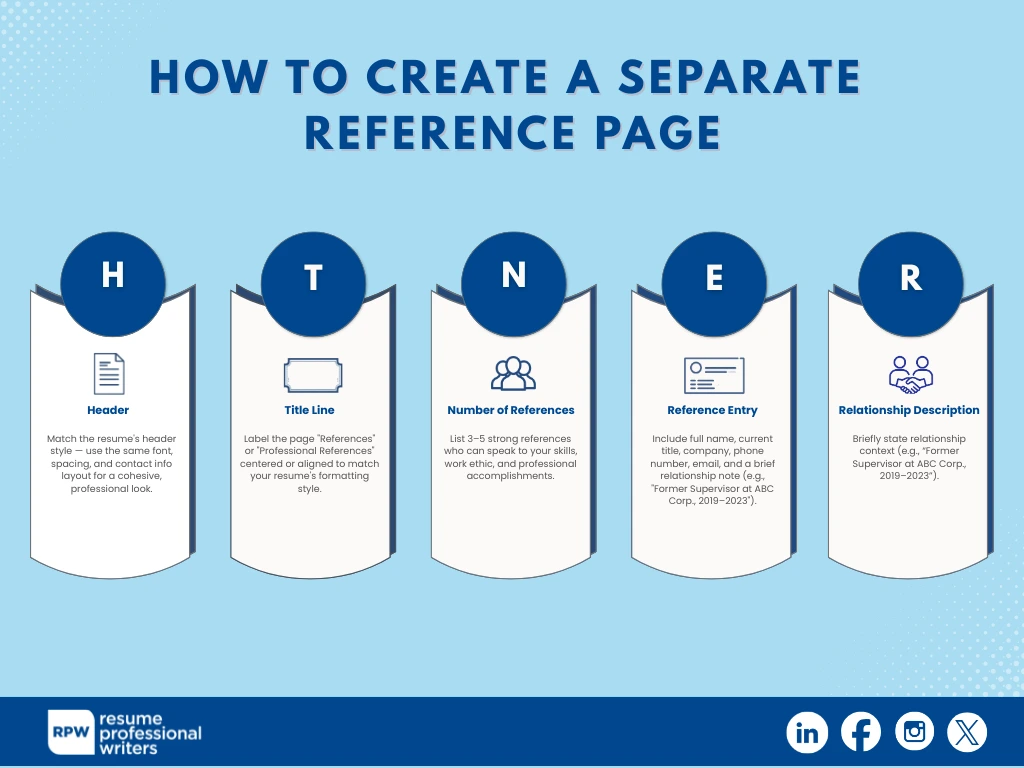
When learning how to list references on resume, keep in mind that presentation matters as much as content. The right move is a standalone reference page that matches your resume’s design. Bring it to interviews and send it the moment an employer requests references.
1. Match your resume’s header.
Use the same name, contact details, font, and styling as your resume so the two documents look like a set. This signals attention to detail.
2. Add a clear title.
Label the page “References” or “Professional References” near the top so its purpose is obvious.
3. List three to five references.
Three is the minimum; four or five gives the employer options. Quality matters more than quantity; choose people who can speak specifically to your work.
4. Include complete reference entries.
For each person, list their full name, current title, company, phone number, and email.
5. Add relationship descriptions.
Briefly explain the context (e.g., “Former Supervisor at ABC Corp., 2019–2023”) so employers understand how the reference knows your work.
Formatting consistency signals attention to detail—a key trait hiring managers assess across application materials. The same font, spacing, and alignment used in the resume and cover letter should carry through to the reference document.
The Correct Format for Each Reference
For every reference, include a consistent block of information.
Full name
Job title
Company or organization
Phone number
Email address
Relationship to you (e.g., “Former manager at Acme Corp”)
Keep the formatting identical across all references for a clean, scannable page. For example:
Jane Martinez
Senior Marketing Director, Acme Corp
(555) 123-4567 · jane.martinez@email.com
Relationship: Direct Manager, 2022–2025
This example on how to list references on resume demonstrates brevity balanced with depth—each entry contains sufficient information for hiring verification without unnecessary personal detail. Consistency between reference details and resume accomplishments reinforces authenticity, especially if job titles and timeframes align accurately.
Who to Choose as a Reference
The best references can speak to your work with specifics. Prioritize people who managed or worked closely with you.
- Former Managers or Supervisors: The strongest choice, since they offer direct insights into performance, leadership, and reliability.
- Colleagues or Team Leads: Speak to collaboration, adaptability, and interpersonal competence.
- Clients or Stakeholders: Provide external validation for consultants, freelancers, or sales professionals.
- Professors or Academic Advisors: Ideal for recent graduates with limited work experience.
Avoid family members, friends, and anyone who can’t speak credibly to your professional abilities. A reference who barely knows your work can do more harm than good.
How to Ask Someone to Be a Reference
Courtesy and preparation are essential. Always ask before listing someone; being contacted unexpectedly puts a reference on the spot and can lead to a lukewarm response.
- Reach out personally and explain the role you’re pursuing.
- Confirm they’re comfortable speaking positively about your work.
- Share your current resume and a few points you’d like them to emphasize.
- Give them a heads-up when you submit their name so they expect the call or email.
A prepared reference gives a stronger, more specific endorsement than one caught off guard. Additionally, candidates should rotate references periodically, keeping a mixture of professional perspectives relevant to evolving career goals. This proactive approach ensures that when deciding how to list references on resume, the references remain fresh, credible, and aligned with the candidate’s current career trajectory.
Common Mistakes to Avoid

Misuse of references can weaken an otherwise strong resume. Job seekers must avoid several common pitfalls that distract from professionalism and potentially compromise credibility.
- Listing references directly on the resume when not requested: Including references can make the resume appear outdated or misaligned with digital hiring processes.
- Keeping “References available upon request” on the page: This statement wastes valuable space; employers already assume availability.
- Using references who can’t speak to your professional work: Non-professional endorsements lack objectivity and lower perceived credibility.
- Listing people without asking them first: Individuals caught off guard during background checks often deliver less favorable feedback.
- Providing outdated contact information that bounces or goes unanswered: Outdated phone numbers or emails create communication delays that reflect poorly on organizational diligence.
- Formatting the reference page inconsistently with your resume: A mismatched format looks careless. Recruiters expect your resume and reference page to feel like one cohesive package, with same header, font, and layout. Consistency reinforces professionalism; inconsistency weakens credibility.
Each of these errors can diminish hiring momentum. Proper reference etiquette not only protects professional relationships but also demonstrates communication awareness, a quality valued across all industries.
When and Why Employers Check References
Understanding the employer’s side explains why references belong on a separate page rather than your resume. Reference checks almost always happen late: after interviews, often once you’re a finalist or the offer is being prepared. By that point the company is fairly confident and is verifying, not discovering.
Employers check references to confirm three things:
- That your employment history is accurate (titles, dates, scope).
- That your performance matched how you described it.
- That there are no serious red flags around reliability or conduct.
A strong reference doesn’t just confirm facts; it adds color, describing how you work and what you’re like on a team. This is also why timing matters. Because the check comes at the end, references on your resume sit unused for weeks while exposing your contacts’ personal details. Keeping them separate means you control exactly when each person is contacted — and can give them a heads-up first.
What Employers Typically Ask Your References
Knowing the common questions helps you choose and prepare the right people. Most reference calls cover some version of these:
- How do you know the candidate, and for how long?
- What were their main responsibilities and biggest contributions?
- What are their strengths, and where could they grow?
- How did they handle pressure, deadlines, or conflict?
- Would you hire or work with them again?
A reference who can answer these with specifics: a concrete project, a measurable result, a real example, is far more persuasive than one offering vague praise. That’s why a former manager who saw your work closely beats a senior name who barely interacted with you.
How to Prepare Your References for the Call
A little preparation turns a good reference into a great one. Once you know a reference check is coming, take a few minutes to set each person up to succeed.
- Tell them which company and role you’re interviewing for, and share the job description so they can tailor their comments.
- Remind them of specific projects or wins you’d like them to mention — especially ones that match the new role’s requirements.
- Confirm the best phone number and email and let them know roughly when to expect contact.
- Thank them afterward, and keep them posted on the outcome. References are part of your network — treat them well and they’ll help you again.
Reference Page Template You Can Copy
Use the structure below for a clean, professional reference page. Keep the header identical to your resume so the two read as a matched set. Matching the design to your resume is a small touch that signals professionalism — for layout ideas that carry across both documents, see our guide on the best resume format examples.
[Your Name] — same size and font as your resume header
[Phone] · [Email] · [City, State] · [LinkedIn URL]
Title: “Professional References”
Reference 1: Full name · Job title · Company · Phone · Email · Relationship and dates
Reference 2: Full name · Job title · Company · Phone · Email · Relationship and dates
Reference 3: Full name · Job title · Company · Phone · Email · Relationship and dates
Add a fourth and fifth reference in the same format if you have strong options.
For digital submissions, saving it as “Firstname_Lastname_References.pdf” ensures organization and traceability in ATS-compatible systems. Keep it ready to send the moment it’s requested. For federal applications, where documentation requirements differ, candidates should review USAJOBS template expectations before finalizing reference pages.
References for Special Situations
A few circumstances call for a slightly different approach to references.
1. Recent Graduates
Lean on professors, academic advisors, internship supervisors, or coaches who can speak to your work ethic and potential when you have limited job history.
2. Career Changers
Prioritize references who can speak to transferable skills relevant to your new field, even if the role itself was different.
3. Currently Employed and Confidential
Don’t list your current manager if your search is private. Use former managers or trusted colleagues, and tell employers your current employer can be contacted only after an offer.
4. Freelancers and Contractors
Use client references who can vouch for the quality and reliability of your delivered work.
In every case, the rule holds: choose people who know your work and will speak about it specifically and positively, and always ask before you list them.
Maintaining Etiquette and Privacy Compliance
Ethical and privacy considerations play growing roles in job search communication. Candidates must exercise discretion when sharing third-party information. Listing references publicly on job boards or open-access documents without consent violates professional trust. Federal and healthcare professionals should pay special attention, as their references might hold confidential or regulated information.
- Always obtain verbal or written consent from every reference before listing them.
- Clarify the job title, employer, and potential contact timeline with each reference.
- Avoid including personal addresses; only work-based or verified contact channels.
- Secure reference details using encrypted digital storage or password-protected files to safeguard privacy.
- Respect reference fatigue by alternating between contacts during active job searches.
When deciding how to list references on resume, respect and transparency leave a lasting impression. Well-managed references often continue recommending professionals informally across networks long after hiring processes conclude. Responsible communication elevates a candidate’s reputation across industries where personal branding increasingly defines success.

Get Your Resume and Reference Page Reviewed by a Professional
References are the final checkpoint before an offer — and a sloppy reference page or a poorly chosen contact can stall momentum at the worst moment. A polished, consistent set of documents keeps the process moving in your favor.
Resume Professional Writers has helped more than 70,000 job seekers present themselves professionally from the first application to the final reference check. Explore our resume writing services to have your resume and reference page reviewed by a professional.
Frequently Asked Questions
Should I include references on my resume in 2026?
Generally no. Keep them on a separate page and provide them when an employer requests them, usually at the final-interview or offer stage. Include them on the resume only if a job posting specifically asks you to.
How many references should I list?
Three to five. Three is the accepted minimum; four or five gives employers options. Choose people who can speak specifically and positively about your work.
Is “references available upon request” still acceptable?
No. Employers already assume you can provide references, so the phrase wastes space. Remove it and use the room for something that strengthens your candidacy.
Who should I not use as a reference?
Avoid family, friends, and anyone who can’t credibly speak to your professional performance. Stick to former managers, close colleagues, clients, or academic advisors.
How do I format a reference page?
Match your resume’s header and styling, title it “References,” and list each person with name, title, company, phone, email, and your relationship — formatted identically for every entry.