

Most resumes are screened by software before a human reads them. An ATS resume checker lets you see your resume through that software’s eyes — scoring how well it parses and matches a job before you apply. Used well, it’s one of the fastest ways to spot why your applications aren’t getting responses.
This guide explains what an ATS resume checker actually does, what it can and can’t tell you, how to read a score without overreacting to it, and the concrete steps to fix the issues it surfaces. The goal is to help you apply with a resume that clears the software and reaches a recruiter.

What an ATS Resume Checker Is
An ATS resume checker is a tool that simulates how an applicant tracking system reads and scores your resume. You upload your resume — and usually paste a target job description — and the checker reports how well the two match and how cleanly your resume parses.
It’s essentially a preview. Real ATS software, used by employers, parses your resume into structured data and ranks it against the job. A checker runs a similar analysis on your side, so you can fix problems before a hiring system penalizes you for them. For the underlying mechanics, see our guide on what an ATS resume is.
What an ATS Resume Checker Looks For
Different tools weigh things differently, but most evaluate the same core areas:
1. Keyword Match
The checker compares your resume against the job description and flags important skills, titles, and terms that are missing. This is usually the heaviest factor, because real ATS rank candidates on relevance to the posting.
2. Parsing and Formatting
It tests whether your resume’s structure reads cleanly — single column, standard headings, contact info in the body, no text trapped in tables or images. Formatting that breaks parsing is a common, hidden reason resumes get filtered.
3. Section Completeness
It checks that standard sections — work experience, education, skills — are present and recognizable, since a missing or mislabeled section can drop information entirely.
4. Readability and Length
Some checkers flag overly long resumes, dense walls of text, or missing quantification, nudging you toward a cleaner, more scannable document.
How to Use an ATS Resume Checker Step by Step
Getting value from a checker is a quick, repeatable process. Run it once per application, not once ever.
- Choose the specific job you’re applying to and copy its full description.
- Upload your tailored resume and paste the job description into the checker.
- Review the match score and the list of missing or weak keywords.
- Add the genuinely relevant missing terms — using the posting’s exact wording — only where they truthfully apply.
- Fix any flagged formatting issues (columns, tables, header-hidden contact info).
- Re-run the check to confirm the score improved, then submit.
If you want to check your resume now, you can run it through our own ATS resume checker and get an instant read on where it stands.
How to Read Your Score Without Overreacting

A match score is a guide, not a grade. Treat it as a prioritized to-do list rather than a verdict.
- Don’t chase a perfect score. A very high match often means keyword stuffing, which real recruiters and AI-enabled systems penalize.
- Focus on relevance, not volume. Adding a skill you don’t have to game the score backfires in the interview.
- Weight formatting fixes heavily. A parsing error can hide your whole experience section; that’s more urgent than one missing keyword.
- Use it per job. A resume that scores well for one posting may score poorly for another — that’s expected, and it’s why you tailor each application.
The Limits of ATS Resume Checkers
Checkers are useful, but they’re an approximation, and it helps to know where they fall short.
- They simulate, not replicate. No checker knows the exact algorithm a given employer’s ATS uses, so scores are estimates.
- They can’t judge substance. A checker can confirm you mentioned “leadership,” but only a human can tell whether your bullets prove it.
- They reward keywords, sometimes too much. Over-optimizing for a checker can produce a robotic resume that underperforms with people.
- They don’t replace tailoring or proofreading. A clean score with a typo in your summary still loses interviews.
Use a checker to catch parsing problems and obvious keyword gaps — then rely on judgment, and ideally a second human read, for everything else.
Beyond the Checker: Make Your Resume Genuinely Strong
A checker gets you past the software; content gets you the interview. Pair the tool with these fundamentals.
- Tailor every application to the posting’s real requirements, not just its keywords.
- Quantify achievements so each bullet proves impact a human can evaluate.
- Keep an ATS-friendly format — single column, standard sections, clean fonts. Our guide on ATS-friendly resume format covers the rules.
- Lead with a focused summary that signals fit in the first few seconds.
Why ATS Checkers Matter More in 2026
The case for running a checker has only gotten stronger. More than 90% of large employers now route applications through an ATS, and a growing share layer AI on top of traditional keyword parsing. That means two things are being judged at once: whether the software can read your resume, and whether it interprets your experience as relevant.
A checker is the cheapest way to test both before you apply. Without one, you’re submitting blind — you might have a strong resume that a two-column layout quietly breaks, or a perfectly formatted resume that misses the three terms the posting cares about most. Either way, you’d never know; the rejection arrives with no explanation. A quick check surfaces those issues while you can still fix them.
The shift toward AI screening also raises the stakes on doing this honestly. Older systems counted keywords; newer ones evaluate context. A resume optimized only to score well can read as robotic to an AI model and to the recruiter who follows. The right use of a checker is to find genuine gaps and parsing errors — not to manufacture a high number.
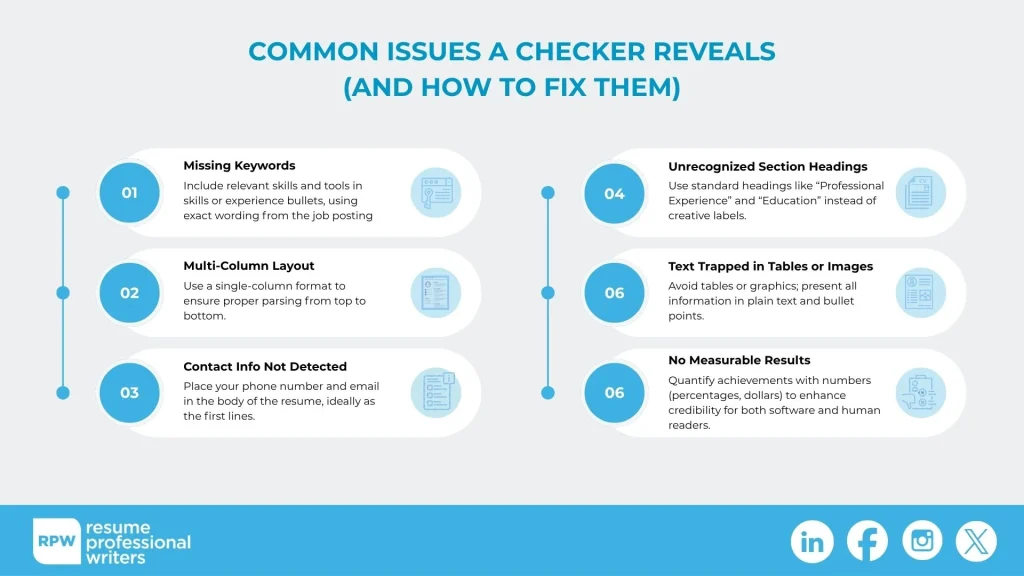
Common Issues a Checker Reveals (and How to Fix Them)
Most reports flag a handful of recurring problems. Here’s what they usually mean and how to resolve each.
1. Missing Keywords
An ATS checker posts the names, skills, or tools your resume doesn’t. Add the ones you genuinely have, using the posting’s exact wording, in your skills section and relevant bullets.
2. Multi-Column Layout
The checker reports scrambled or out-of-order text. Rebuild the resume in a single column so it parses top to bottom.
3. Contact Info Not Detected
Your phone or email sits in the header or footer, which many parsers ignore. Move it into the body as the first lines.
4. Unrecognized Section Headings
Creative labels like “What I Bring” confuse the parser. Switch to standard headings: “Professional Experience,” “Core Competencies,” “Education.”
5. Text Trapped in Tables or Images
Information inside tables, text boxes, or graphics often disappears. Move it into plain paragraphs and bullet points.
6. No Measurable Results
Some checkers flag a lack of quantification. Add numbers (percentages, dollars, headcount) to make bullets credible to the human reader after the software.
ATS Checker vs. Professional Review: Which Do You Need?
A checker and a professional review solve different problems, and the strongest applicants use both.
A checker is fast, free or low-cost, and ideal for the mechanical layer: parsing, formatting, and obvious keyword gaps. Run it yourself for every application. It’s the right first pass and catches issues that would otherwise be invisible.
A professional review handles what software can’t judge; whether your bullets actually prove impact, whether your summary positions you for the role, and whether the overall narrative is convincing. A tool can confirm you used the word “leadership”; only an experienced reviewer can tell you the example beneath it is weak. For high-stakes applications, pairing a quick checker pass with an expert read gives you both a clean parse and genuinely persuasive content.
What to Look for in an ATS Resume Checker
Not all checkers are equal. If you’re choosing one, weigh these factors so you get useful, trustworthy results.
1. Job-Description Matching
The best checkers compare your resume against a specific posting, not just a generic template. Per-job matching is far more actionable than a one-size score.
2. Clear Formatting Diagnostics
Look for a tool that tells you exactly what broke, a column, a table, header-hidden contact info, rather than just a number.
3. Specific, Honest Keyword Guidance
A good checker shows which terms are missing and where they belong, without pushing you to stuff irrelevant words.
4. Transparent Privacy Handling
You’re uploading a document full of personal data. Favor tools that clearly explain whether they store or share your resume.
5. No False Promises
Be skeptical of any tool guaranteeing you’ll “beat the ATS” or hit a perfect score. Real systems vary by employer, and no checker can promise a result.
Used thoughtfully, a checker is a powerful first line of defense against silent rejections. Just remember its job is to make your resume readable and relevant; the persuasion still comes from strong, honest content.
Let Professionals Review and Improve Your Resume for Results

An ATS resume checker shows you where your resume stands — but turning a flagged report into a resume that wins interviews takes judgment a tool can’t provide. Knowing which keywords matter, how to prove impact, and where to draw the line on optimization is where expert help pays off.
Resume Professional Writers has helped more than 100,000 job seekers build resumes that clear ATS systems and impress recruiters. Run your resume through our ATS checker, then explore our resume writing services to have it written or reviewed by a professional.
Frequently Asked Questions
What is an ATS resume checker?
A tool that simulates how applicant tracking software reads and scores your resume. You upload your resume and usually a job description, and it reports how well they match and how cleanly your resume parses.
Are ATS resume checkers accurate?
They’re a close approximation, not an exact replica of any one employer’s system. They reliably catch parsing problems and obvious keyword gaps, but scores are estimates and shouldn’t be treated as a guarantee.
What score do I need to pass an ATS?
There’s no universal passing score, and chasing a perfect one usually leads to keyword stuffing. Aim for a strong, honest match on the skills you genuinely have, and prioritize fixing formatting issues.
Do ATS checkers store or share my resume?
It depends on the tool. Review the privacy terms of any checker you use, and prefer reputable tools that are clear about how they handle your data.
How often should I check my resume?
Run a check for each job you apply to, since the keyword match changes with every posting. Re-run it after edits to confirm your changes improved the result.