

Right off the bat: A cover letter responds to a posted job and argues your fit for a specific role. A letter of interest is an unsolicited outreach to a company you’d like to work for, sent before any position is advertised. The two are often confused as they both introduce you to a hiring decision-maker.
Send the wrong one, or blur the two together, and your application reads as off target. So, how do you know which kind of job search tool is best for you? The answer often lies in understanding the difference between a letter of interest vs cover letter.
This piece walks you through when each belongs, how to structure both, and what’s changed in 2026 as AI screening reshapes how these letters are read.
What a Letter of Interest Is — and When to Use One
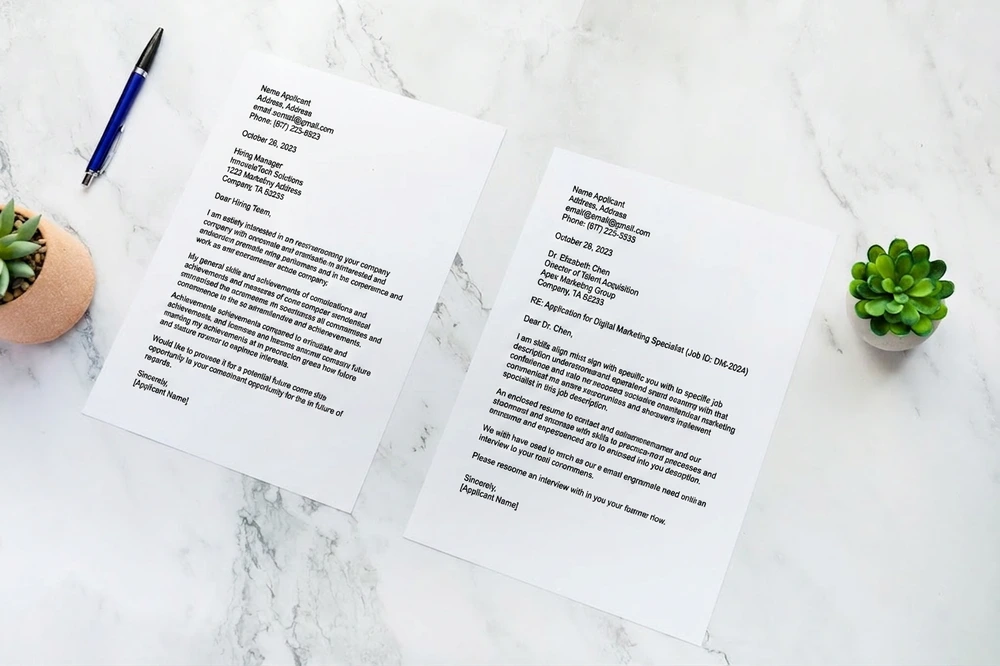
A letter of interest (sometimes called a letter of inquiry or a prospecting letter) goes to a company that isn’t actively hiring for your role, or that hasn’t published an opening you’re aware of. It’s proactive. You’re planting a flag: I’m interested, here’s what I bring, and I’d like to be considered when something opens.
Letters of interest work well in three situations:
- A dream employer. You admire the company’s work and want to be on their radar before a role is posted.
- A referral-driven search. Someone in your network suggested you reach out directly to a hiring manager rather than wait for a formal listing.
- Specialized or senior roles. For executive, technical, or niche positions, companies often hire through quiet channels before publishing externally. BLS data on millions of monthly hires across the U.S. economy shows that a meaningful share of hires happens without a public posting — the hidden job market is very real.
With no job description to anchor against, a letter of interest leans harder on judgment. You have to infer what the company might need, identify where you could contribute, and say so without overreaching.
What a Cover Letter Is — and When to Use One
A cover letter travels with your resume when you apply for a specific job posting. It’s reactive: the hiring manager already knows what they need, and your letter’s job is to connect your experience to the requirements they published.
A cover letter that earns a reply does three things in roughly 300–400 words:
- Names the role and show you understand it: Reference the posted title and one or two specific requirements.
- Tells one concrete story: Pick a single accomplishment from your resume and expand on it with real numbers.
- Closes with a clear next step: “I’d welcome a 15-minute call next week” beats “I look forward to hearing from you.”
Use a cover letter any time a job is posted on a careers page, LinkedIn, Indeed, or a niche board. Include one even when the posting says “optional.” After reviewing thousands of applications, the pattern we see most often is that job seekers treat the cover letter as an afterthought, then wonder why it’s the strongest candidates — the ones who tailor each letter to the specific role — who keep landing the interviews. If you need the full structural walkthrough, see our piece on writing a cover letter from scratch.
Letter of Interest vs Cover Letter (Side-by-Side Comparison)
Here’s how letter of interest vs cover letter compares across the dimensions that matter most:
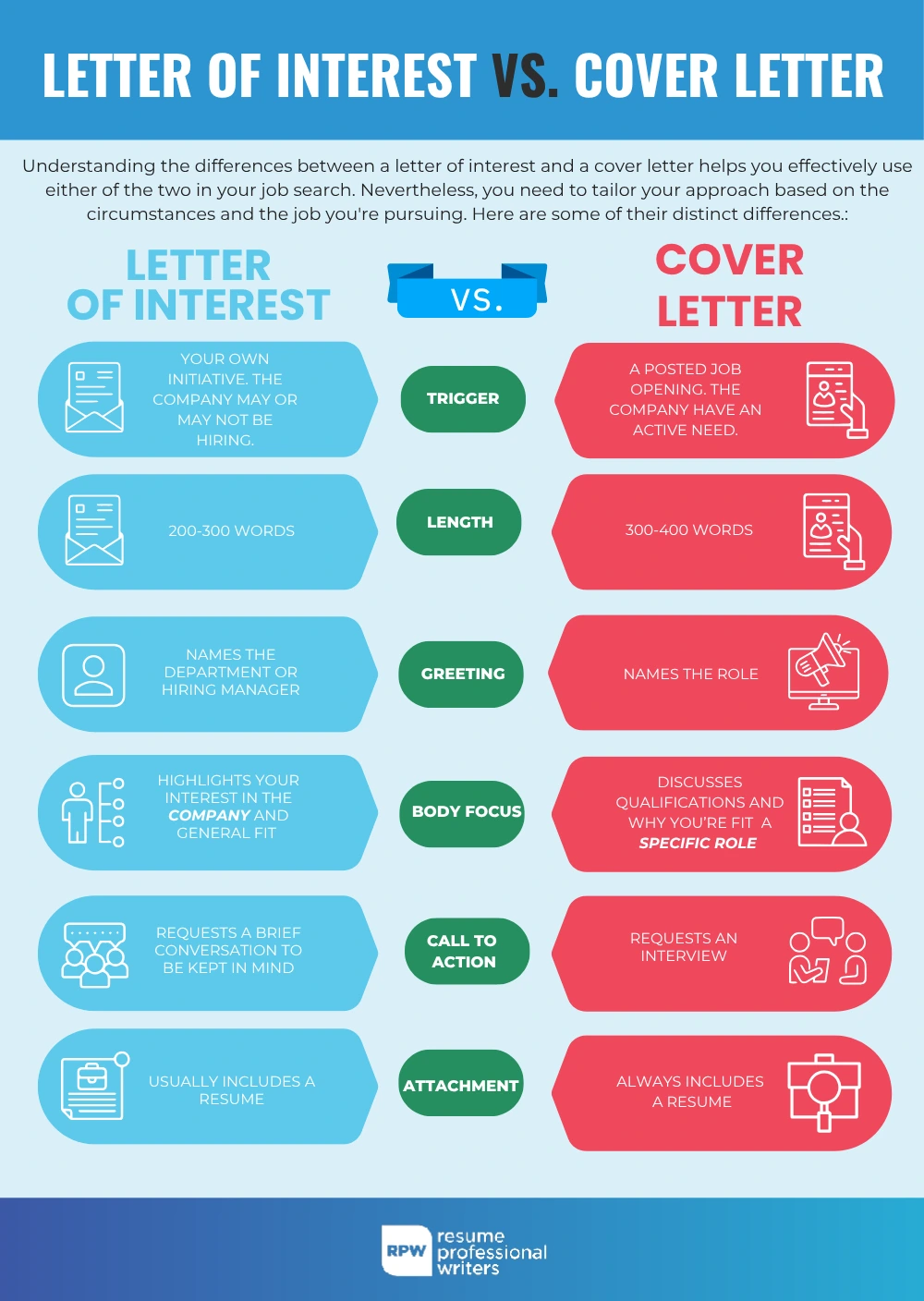
The main difference between these two job search tools is their trigger. Putting it simply, a letter of interest serves as an open job application. Meaning, you’re interested in working and applying for any position in the company that matches your background, even if the role isn’t announced or posted in public.
Structure-wise, a cover letter asks for an interview. A letter of interest asks for something softer — a conversation, a place in the talent pool, or simply acknowledgment that your materials have been received.
How to Structure a Letter of Interest
A letter of interest is shorter and warmer, because you’re introducing yourself to a stranger. Apply these foolproof tips and tricks in writing this type of letter.
1. Opening: Write a strong intro (2 Sentences)
Start strong by opening your letter with a brief yet catchy intro. Say who you are and why you’re reaching out. Name a specific reason you’re interested in the company — a recent product launch, a published value, a mutual connection. Generic flattery (“I’ve always admired your company”) reads as copy-paste.
2. Middle: Describe how you’re fit for the company (3-5 Sentences)
Once you’ve researched the culture, values, and scope of the business, it’s time for you to describe how your background, traits, and skills will help add to the success of the firm. You’re not matching a job description, so focus on the type of problem you’re good at solving. Allot a sentence for your key work history and core feats. This is where you further show how your background validates your expertise.
3. Close: End with a direct statement in your closing (2 Sentences)
Conclude by thanking the reader for their time and effort in checking your letter. Ask for something small: a 15-minute conversation, an introduction to the right person, or to be kept in mind when a role opens. Leave the door open — don’t force a yes-or-no decision.

How to Write a Cover Letter
Cover letters follow a predictable rhythm, and that predictability helps. Recruiters scan hundreds of them and appreciate yours being easy to parse. If you think a cover letter suits your case better, follow these steps as you write your own:
1. Opening Paragraph: Introduce yourself (2-3 Sentences)
Similar to how you must write an intro for your letter of interest, make sure your cover letter has the basic details of who you are and the role you’re applying for. Name the role, where you saw it posted, and one sentence on why you’re a credible candidate. Skip “I am writing to apply for…” — get to the point. Find the hiring manager’s name on LinkedIn rather than defaulting to that fallback greeting whenever you can.
2. Middle Paragraph: Explain why you’re the best fit for the job (4-6 Sentences)
Make smart use of your time in researching the business, what they stand for, and what they do. With this, relate your feats to what the business needs and prove what you can bring to the table. To further highlight your work history and how you performed as an employee, pick one or two accomplishments that map to the job description and expand on them. Use numbers where you have them — team size, revenue impact, timeline. This section separates generic letters from memorable ones.
4. Closing Paragraph: Compel the recipient to read your resume (2-3 Sentences)
Restate interest, mention you’ve attached your resume, and name a concrete next step by including a call-to-action (CTA) statement to encourage your reader to review the resume you attached along with your letter. This is in the hopes of landing the interview and increasing your chances of getting hired.
For models to work from, we keep sample letters organized by industry and seniority on hand.
How AI and ATS Changed Both Letter Formats in 2026
Two shifts matter for job seekers in 2026.
Applicant tracking systems now parse cover letters the same way they parse resumes. Platforms like Workday, Greenhouse, and Lever extract keywords from your letter and compare them against the job description. If the posting emphasizes “cross-functional leadership” and “product launch,” those phrases should appear naturally in your letter — not stuffed, but present.
University of Cincinnati Career Services walks job seekers through how university career services define a letter of interest. They recommend mirroring the language of the team or target organization to help your letter survive automated keyword screening. The same parsing logic applies to your resume, which is why our deeper guide on beating the applicant tracking system covers the same keyword-mirroring discipline at the resume level.
AI-generated letters are easier to spot in 2026. Hiring managers keep seeing the same stock phrases, like “passionate about,” “strategic thinker,” or “results-driven,” across dozens of candidates. Some large employers now run application text through AI-output detectors. If you draft with AI, treat the output as a starting point: rewrite the opening, swap in specific details, and read it aloud before sending.
A letter of interest is actually harder for AI to produce well, because the value comes from the specific, personal reason you’re reaching out. Lean into that.
Three Mistakes That Kill Both Letter Types
• Repeating your resume
The letter exists to add context, not to re-list your jobs. Pick one or two things worth expanding on.
• Leading with what you want
“I’m looking for a role that will help me grow” is about you. Flip it: “Here’s a problem you’re solving, and here’s how I could help.” That framing works for both documents.
• Forgetting the call to action
A letter without a clear ask leaves the recipient unsure what to do. Always name a next step, even if it’s small.
One more ATS note for 2026: avoid tables, text boxes, and images in either document. They break parsing. Stick with plain paragraphs, standard fonts, and a simple header. For a wider scan of where the resume game is moving — keyword mirroring, AI-detection signals, formatting rules — see our roundup of current resume trends and what’s working in 2026.
And if you’ve never written a cover letter from scratch, our general cover letter writing guide covers the structural fundamentals before you adapt them into the letter-of-interest format.
Let Experts Take Care of Your Job Search Tools
While you’re busy focusing on all the core stages of your job search and career journey, it might get tedious and challenging to write and choose between a letter of interest vs cover letter. The good news is: You should never deal with these woes alone. Entrust your job search needs to career experts! We offer a wide range of career services, including job search tools such as cover letters and letters of interest, among others.
However, even a sharp cover letter or letter of interest won’t overcome a weak resume. If you’ve rewritten your letters and still aren’t getting interviews, the resume is usually the bigger problem. A second set of expert eyes, someone who reads resumes full-time, can tell you whether yours is helping or hurting.
If that sounds like where you are, send us your resume for a free review — we’ll point out where it’s losing you interviews, no pressure and no obligation. If you’re weighing whether to invest in professional help, our breakdown on whether resume writing services are worth it walks through the cost, ROI, and how to spot scams.
Frequently Asked Questions
Is a letter of interest the same as a cover letter?
No. A cover letter responds to a posted job and focuses on your fit for that specific role. A letter of interest goes to a company with no posted opening and focuses on your interest in the organization more broadly. They overlap in format but differ in trigger, tone, and call to action. Send a cover letter when replying to a listing; send a letter of interest when making first contact.
How long should a letter of interest be?
Between 200 and 300 words, or about three short paragraphs. Shorter is usually better — you’re asking for a brief conversation, not pitching a full application. Anything over a page signals that you don’t know the format. Stick to one page, single-spaced, with three tight paragraphs and a professional sign-off.
Do I need to attach a resume to a letter of interest?
Yes, almost always. The recipient may want to share your information internally, and without a resume attached they have nothing to circulate. Attach it as a PDF with a filename that includes your full name (firstname-lastname-resume.pdf). That’s the norm recruiters expect.
Can I use the same letter of interest for multiple companies?
You can reuse the structure, but the opening paragraph — where you name a specific reason you’re interested — has to be rewritten for each company. Recipients spot a mass-send immediately, and it undercuts the whole point of the letter. Keep a base template, then personalize the first two sentences and any detail that shows research.
When should I follow up on a letter of interest?
One polite follow-up after 7–10 business days works well. Keep it short: reference your original letter, add one sentence on something new (a project you shipped, a certification earned), and restate your interest. If you don’t hear back after the follow-up, let it go and revisit in three to six months.