


A hiring manager spends about seven seconds on the first scan of your resume, and most of that time lands on the top third of the page. That is where your resume summary lives. Get it right, and you earn a full read. Get it wrong, or leave it blank, and you are relying on a recruiter to dig for reasons to keep you.
A resume summary is a two-to-four sentence pitch at the top of your resume that tells the reader who you are, what you are good at, and the value you bring. This guide gives you a resume summary template with fill-in-the-blank formulas, copy-paste examples, and real samples for every experience level, plus the ATS rules that decide whether your summary is ever seen by a human.
What a Resume Summary Is (and Is Not)
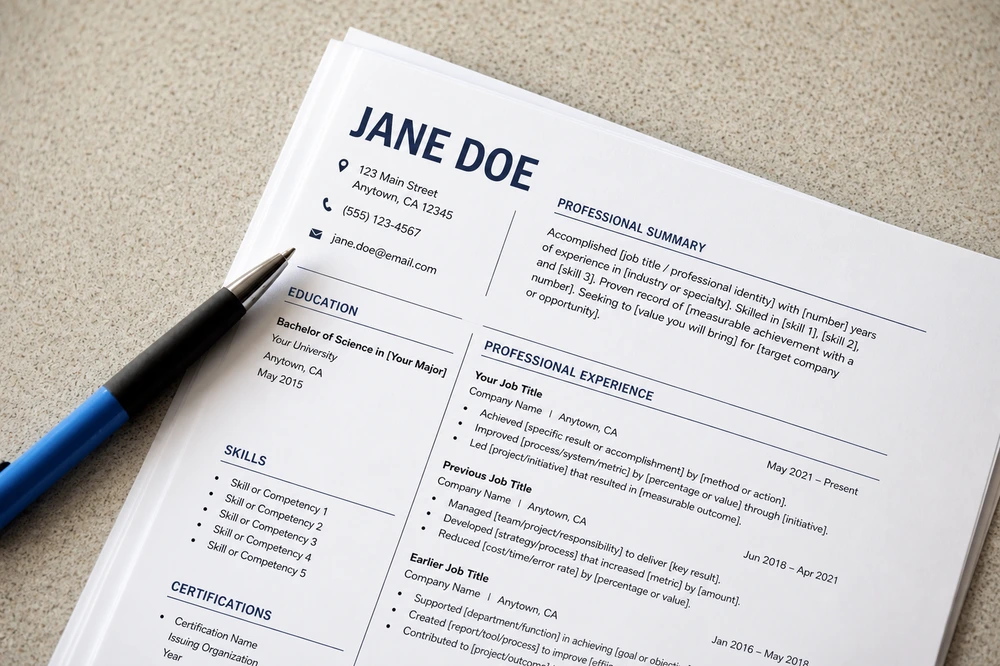
A resume summary sits directly under your name and contact information. It replaces the outdated “objective” statement for most candidates because it focuses on what you offer the employer rather than what you want from them.
Here is how the three common openers differ:
- Resume Summary: a short pitch highlighting your experience, top skills, and a measurable achievement. Best for anyone with relevant experience.
- Resume Objective: a statement of the role you are targeting and your goals. Best for career changers, new graduates, or applicants with employment gaps.
- Resume Profile: a slightly longer hybrid that blends summary and objective. Used interchangeably with “summary” by many employers.
If you have at least a year of relevant experience, write a summary. If you are early-career or pivoting, you can lean on an objective or profile, and we link to dedicated guides for both at the end of this article.
The Resume Summary Template (Fill in the Blank)
Copy the formula below and replace the bracketed fields. This single resume summary template structure works across industries and experience levels.
[Job title / professional identity] with [number] years of experience in [industry or specialty]. Skilled in [skill 1], [skill 2], and [skill 3]. Armed with a proven record of [measurable achievement with a number]. Seeking to [value you will bring] for [target company or role type].
A completed version looks like this:
Solutions-focused customer success manager with six years of experience in B2B SaaS. Skilled in account retention, onboarding, and data-driven renewal strategy. Noted for cutting the annual churn by 18% across a 120-account portfolio. Looking to bring the same retention focus to a high-growth software team.
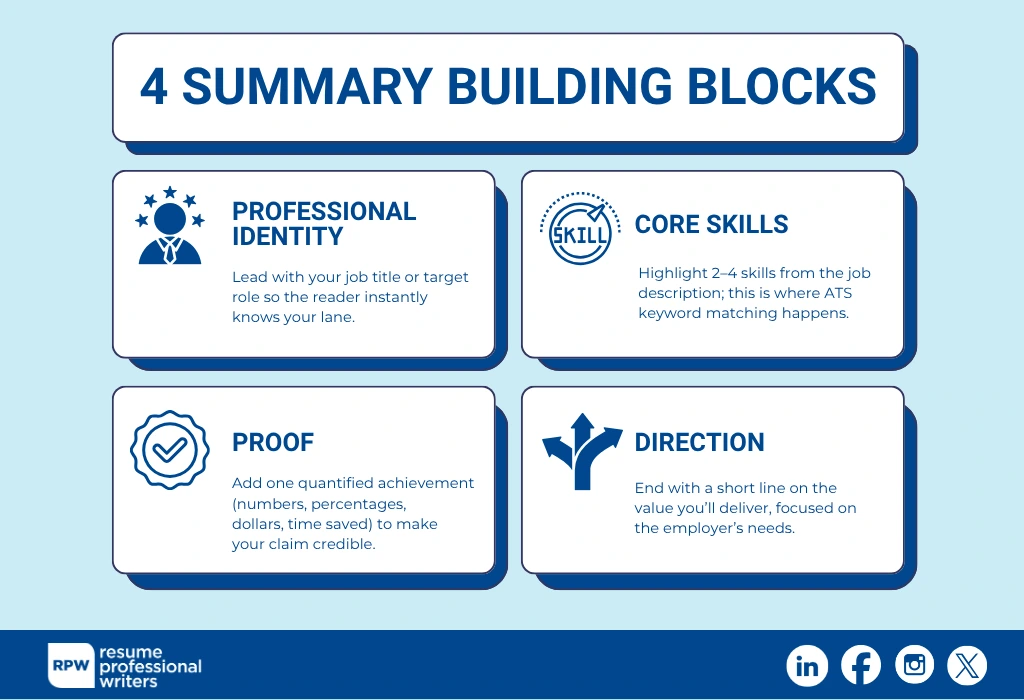
Notice the four moves: identity, skills, proof, and direction. Every strong summary hits those four beats, even when the wording changes, and this resume summary template makes it easy to structure them consistently.
The Four Building Blocks
Certified experts emphasize that a strong summary should establish identity, highlight skills, and prove value, as outlined in the PARW/CC CPRW Standard. To make that first impression count, focus on these four building blocks:
- Professional Identity: Your job title or the title you are targeting. Lead with it so the reader instantly knows your lane.
- Core Skills: Two to four skills pulled straight from the job description you are applying to. This is also where ATS keyword matching happens.
- Proof: One quantified achievement. Numbers (percentages, dollars, headcount, time saved) make the claim credible.
- Direction: A short line on the value you will deliver. Keep it about the employer, not your personal goals.
Resume Summary Examples by Experience Level
The template flexes by career stage. Here are worked examples you can adapt.
Entry-level (0–2 years)
Focus on transferable skills, internships, coursework, and any measurable wins, even from part-time roles.
Recent marketing graduate with internship experience in social media and email campaigns. Skilled in content scheduling, Canva, and Google Analytics. Adept at growing a student-org Instagram account from 400 to 2,300 followers in one semester. Eager to support a brand team with data-informed content.
Mid-level (3–7 years)
Lead with your specialty and a strong quantified result.
Forward-thinking operations analyst with five years of experience in retail supply chain. Skilled in inventory forecasting, Excel modeling, and vendor management. Recognized for reducing stockouts by 22% by rebuilding the reorder-point model across 40 stores. Ready to bring tighter forecasting to a national operations team.
Senior Management (8+ years)
Emphasize scope, leadership, and business impact.
Meticulous engineering manager with 11 years of experience and four years leading distributed teams. Skilled in platform architecture, hiring, and agile delivery. Known for shipping a billing-system rebuild that cut payment failures by 30% and onboarded 14 engineers in 18 months. Seeking to lead a growing platform organization.
Career Changer
Bridge your past experience to the new role with transferable skills.
Former classroom teacher transitioning into instructional design, with a completed UX certification. Skilled in curriculum development, stakeholder communication, and Articulate Storyline. Accomplished at building five self-paced training modules adopted district wide. Looking to apply learning-design expertise to a corporate L&D team.

How to Write a Resume Summary in Five Steps
If the resume summary template feels abstract, build your summary in this order.
- Step 1: Write your professional identity line first — your title and years of experience.
- Step 2: Scan the job posting and pull the three skills it repeats most. Use the employer’s exact wording.
- Step 3: Choose your single best quantified achievement. If you have no metric, estimate conservatively (e.g., “managed a $50K event budget”).
- Step 4: Add one directional line about the value you bring to that specific role.
- Step 5: Cut every word that does not earn its place. Aim for two to four sentences, never a full paragraph.
Resume Summary and the ATS: Keyword Rules
More than 90% of large employers route resumes through an applicant tracking system (ATS) before a human reads them. Your summary is prime keyword real estate, so treat it strategically. This resume summary template shows how to structure those keywords, so they parse correctly and boost your match score.
- Mirror the job title. If the posting says “Project Coordinator,” use that exact phrase rather than a creative variant.
- Include two to three hard skills from the posting verbatim. ATS matching is literal. For instance, “Excel” and “Microsoft Excel” are not always scored the same.
- Avoid tables, text boxes, and graphics in the header. Many ATS parsers drop anything outside a standard single-column layout.
- Spell out then abbreviate key terms once, “search engine optimization (SEO)” so you match either phrasing.
For a deeper walkthrough of formatting that survives the parser, see our guide on what an ATS resume is and how to build one.
Mistakes to Avoid
Writing about what you want instead of what you offer. “Seeking a challenging role to grow my skills” wastes your strongest line.
- Going Generic: “Hard-working team player with excellent communication skills” says nothing and matches no keywords.
- Skipping Numbers: A summary with zero metrics reads like an opinion; one quantified result makes it evidence.
- Making it Too Long: A six-line block buries the point. Two to four tight sentences outperform a dense paragraph.
- Copying a Template Word-for-Word: Use the structure, but the specifics must be yours or the summary rings hollow.
A resume summary template is meant to guide your phrasing, not replace your unique achievements.
Resume Summary Template: Quick Copy-Paste Versions
Three ready-to-edit starters for common situations:
1. Experienced Professional
“[Title] with [X] years in [industry]. Skilled in [skill], [skill], and [skill]. [Quantified achievement]. Seeking to [value] for [role type].”
2. Recent Graduate
“[Degree] graduate with [internship/project] experience in [field]. Skilled in [skill], [skill], and [skill]. [Measurable result]. Eager to support [team type].”
3. Career Changer
“Former [past role] moving into [new field], with [credential or training]. Skilled in [transferable skill], [skill], and [skill]. [Achievement]. Looking to apply [strength] to [new role type].”
Resume Summary Templates by Industry
The four building blocks stay the same, but the skills and metrics that matter shift by field. Use these as starting points.
Sales
Success-driven account executive with seven years in B2B SaaS sales. Adept in pipeline management, consultative selling, and Salesforce. Noted for closing $2.4M in new business last year at 118% of quota. Seeking to drive revenue for a scaling software company.
Healthcare
Patient-focused registered nurse with nine years in acute care, including four in the ICU. Skilled in critical care assessment, EHR documentation, and patient education. Highly capable of maintaining a 98% patient-satisfaction score across a 12-bed unit. Looking to bring bedside expertise to a Level I trauma center.
Administrative
Detail-oriented executive assistant with five years of supporting C-suite leaders. Proficient in calendar management, travel coordination, and Microsoft 365. Commended for reorganizing an executive scheduling system that cut double-bookings to near zero. Ready to support a fast-paced leadership team.
Information Technology
Quality-focused systems administrator with eight years of experience managing Windows and Linux environments. Specialized in cloud migration, scripting, and incident response. Recognized for leading an AWS migration that cut infrastructure costs by 27%. Seeking a senior infrastructure role at a cloud-first organization.”
Where to Place Your Summary on the Page
Placement matters as much as wording. The summary should be the first thing under your header, so it lands inside that seven-second scan.
- Position it directly below your name and contact details, above your work experience.
- Skip a separate ” Qualifications Summary” label if space is tight, the position at the top makes its purpose obvious, but a clear heading helps ATS parsing.
- Keep it to a single short block. Do not split it across columns or wrap it in a text box, which can break ATS parsing.
- On a two-page resume, the summary stays on page one. It frames the entire document and should never spill onto page two.

Get Your Resume Summary Reviewed by a Professional
Your summary is the first, and sometimes the only, thing a recruiter reads closely. It is also one of the easiest places to sound generic without realizing it. A second set of expert eyes can sharpen your opener so it matches the role, clears the ATS, and earns a full read.
Resume Professional Writers has helped more than 100,000 job seekers tailor their resumes for ATS systems and modern hiring. Explore our resume writing services to have your summary and the rest of your resume written or reviewed by a professional.
Frequently Asked Questions
How long should a resume summary be?
Two to four sentences, or roughly 40 to 60 words. It should fit in the top third of the page without pushing your experience below the fold.
Do I need a resume summary at all?
If you have at least a year of relevant experience, yes, so it frames everything below it. If you are entry-level or changing careers, a resume objective or profile may serve you better.
What is the difference between a resume summary and objective?
A summary highlights your experience and a measurable achievement and is aimed at experienced candidates. An objective states the role you want and your goals, and works better for new graduates, career changers, or applicants with gaps.
Should I customize my summary for every job?
Yes. Swap in the exact job title and the two or three skills each posting emphasizes. This takes a few minutes and meaningfully improves your ATS match score.
Can I use a resume summary template word-for-word?
Use the structure, not the exact wording. Recruiters read hundreds of resumes and recognize a copied template instantly. Keep the four building blocks but make the details specific to you.