


Many job seekers struggle to navigate structured interview formats, particularly those involving closed questions. These questions, requiring concise responses, often determine whether candidates appear focused or unprepared. Interview panels use them to test factual accuracy, measure confidence under pressure, and assess alignment with job requirements. Understanding common closed questions and their intent can significantly boost performance in both screening and in-person interviews.
Recruiters consistently value well-constructed, professional answers that reflect clarity and composure. Career specialists emphasize how knowing example closed questions helps professionals—from entry-level candidates to executives—respond strategically and demonstrate fit. This comprehensive guide explores the structure, purpose, and 25 curated example closed questions interviewers use to evaluate applicants in 2026. It further clarifies how these questions function within behavioral assessments, competency frameworks, and modern recruitment processes.

Understanding Closed Questions in Interviews
Closed questions are direct queries that solicit specific, limited responses—often “yes,” “no,” or factual details. They differ from open-ended questions that invite elaboration, storytelling, or reflective analysis. Hiring managers frequently rely on closed questions to clarify technical qualifications, verify employment dates, confirm credentials, or assess baseline compliance with organizational policies.
In structured interviews, these questions help maintain consistency among multiple candidates. For example, federal agencies following strict selection guidelines under the U.S. Office of Personnel Management (OPM) rely heavily on standardized question sets to ensure objective scoring. Similarly, industries such as healthcare, finance, and IT include closed questions to confirm licensing, clearances, or software proficiency.
Mastering these questions enhances communication control. When job seekers understand the potential phrasing and purpose, they can prepare concise, credible, and accurate answers. It also helps them avoid unnecessary details that may inadvertently reduce confidence or clarity. Well-prepared responses to closed questions show attention to precision, professionalism, and respect for the interviewer’s time.
Why Employers Rely on Example Closed Questions
Employers use closed questions to streamline hiring evaluations and extract factual data. Human resources specialists conduct over a million interviews each year nationwide, and structured questioning ensures legal and procedural uniformity. When recruiters ask closed questions, they aim to verify eligibility, experience, and compliance with hiring prerequisites.
In behavior-based interviews, these questions also frame baseline queries before deeper exploration. For example, a manager might begin with “Have you supervised a team before?” followed by an open-ended exploration like “Describe your leadership approach.” This dual-layer model helps organizations align quantitative qualification checks with qualitative insights.
Closed questions serve key HR compliance and verification roles, including confirming citizenship, background check consent, or work availability. They also ensure fairness, since every candidate receives the same set of objective filters. The rise of automated applicant tracking systems (ATS) in 2025 further reinforces their importance, as many platforms integrate pre-interview questionnaires containing closed responses for screening efficiency.
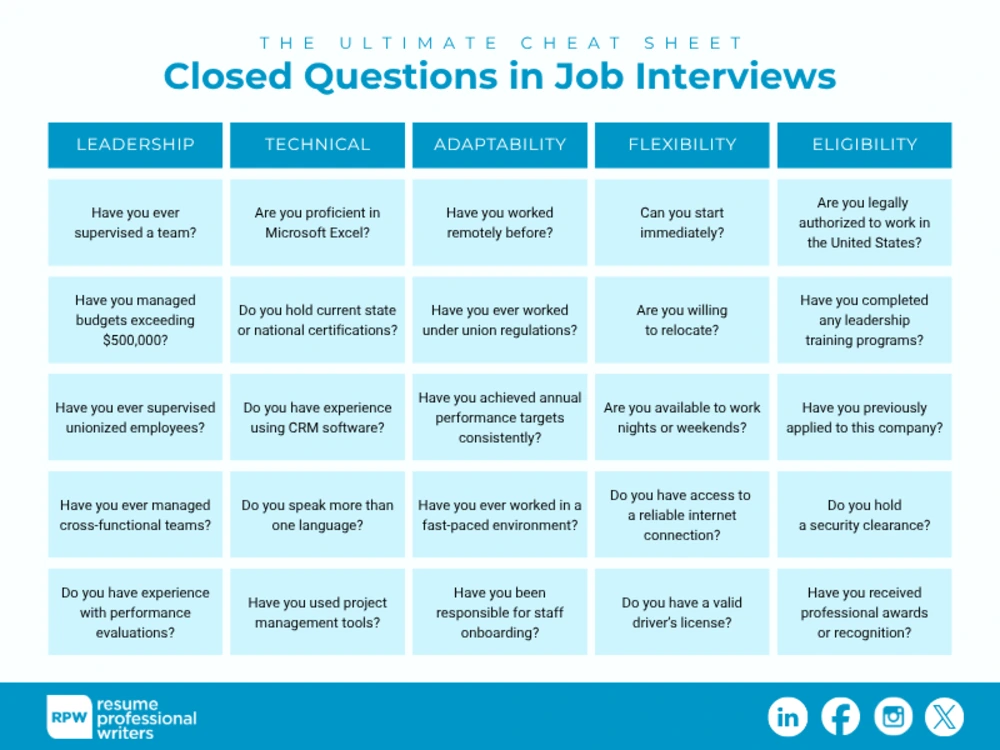
Top 25 Example Closed Questions Employers Commonly Ask
The following questions reflect the most frequent types encountered in modern interview environments. By analyzing answer expectations and the recruiter’s intent, job seekers can prepare responses that demonstrate alignment while maintaining professionalism.
- Have you ever supervised a team? – Used to confirm leadership experience and managerial readiness.
- Are you legally authorized to work in the United States? – Determines eligibility before employment processing.
- Do you have a valid driver’s license? – Applies to roles requiring transportation responsibilities or vehicle use.
- Have you worked remotely before? – Confirms comfort and adaptability to hybrid work environments.
- Are you proficient in Microsoft Excel? – Validates technical skills essential for data-driven positions.
- Can you start immediately? – Helps recruiters assess candidate availability for urgent vacancies.
- Have you managed budgets exceeding $500,000? – Confirms experience with high-level financial accountability.
- Do you hold current state or national certifications? – Ensures compliance with regulated professions such as nursing or teaching.
- Have you ever worked under union regulations? – Tests familiarity with collective bargaining environments.
- Do you have experience using CRM software? – Measures knowledge of digital customer management tools.
- Have you completed any leadership training programs? – Indicates investment in professional development.
- Do you speak more than one language? – Confirms multilingual proficiency, critical in multicultural workplaces.
- Have you previously applied to this company? – Helps recruiters track recurring applicants and interest level.
- Are you willing to relocate? – Determines flexibility for regional or national placements.
- Have you ever supervised unionized employees? – Validates management experience in structured labor environments.
- Have you used project management tools? – Confirms technical familiarity with platforms like Asana, Jira, or Trello.
- Are you available to work nights or weekends? – Tests scheduling flexibility for operations roles.
- Do you hold a security clearance? – Required for federal, defense, or sensitive-data roles.
- Have you ever managed cross-functional teams? – Establishes the ability to collaborate across departments.
- Have you achieved annual performance targets consistently? – Confirms accountability and outcome orientation.
- Do you have experience with performance evaluations? – Tests familiarity with supervisory assessment systems.
- Have you received professional awards or recognitions? – Highlights measurable distinction in prior roles.
- Have you ever worked in a fast-paced environment? – Measures adaptability to production or service pressures.
- Have you been responsible for staff onboarding? – Determines familiarity with HR and training processes.
- Do you have access to a reliable internet connection? – Common for remote jobs verifying operational readiness.
Each question above captures decisive hiring criteria. These examples remain constant across sectors such as federal service, healthcare, education, engineering, finance, and information technology. Candidates who anticipate such questions can streamline their pitch and eliminate hesitation during interviews, ultimately improving confidence and recall accuracy.
How Job Seekers Should Prepare for Closed Questions
Preparation starts with identifying specific competencies required for the target role. Job seekers should analyze the job description for factual qualifiers such as licenses, degrees, or skills. Each closed question typically corresponds to one of these non-negotiable traits. By aligning credentials, availability, and verifiable achievements with the employer’s requirements, applicants can deliver stronger yes-or-no responses backed by concise confirmation statements.
Structuring concise answers improves perception of professionalism. For example, when asked, “Do you have project management certification?”, a simple “Yes, PMP certified since 2023,” reflects both affirmation and added credibility. Including factual enhancements, without digression, communicates authority and relevance.
Rehearsal also matters. Candidates benefit from mock interview practice focusing solely on yes/no questions, using real-time feedback to eliminate filler words. Reviewing frequently asked industry-specific questions enhances readiness. Controlled, factual tone creates an impression of dependability and precision—traits every recruiter values in technical, administrative, or executive functions alike.
Closed vs. Open Questions: Strategic Application
Understanding the relationship between closed and open-ended questions is essential for effective interview management. Closed questions limit response range, securing confirmations. Open questions invite elaboration that showcases storytelling ability, emotional intelligence, and strategic thinking. Skilled candidates balance both formats by knowing when to conclude with a fact and when to extend with an example.
For instance, answering a closed question about leadership, such as “Have you supervised a team?”, is affirmative. However, experienced applicants often follow up by adding, “Yes, I supervised a cross-departmental team of ten during an ERP system transition.” This concise elaboration blends the accuracy of a closed response with the persuasiveness of an open example without overstepping the interviewer’s pacing.
Interviewers design question patterns around both types to build a full candidate profile. Many talent acquisition systems record closed-answer responses numerically and open-ended ones qualitatively. Thus, mastering both contributes to stronger aggregate evaluation scores and demonstrates self-awareness, clarity, and verbal control throughout the conversation.
Optimizing Closed Question Responses for AI and Video Interviews
As more employers adopt AI-assisted interviews in 2026, concise and structured responses to closed questions have grown essential. Video interview software powered by natural language processing detects tone, confidence, and timing. Extended or off-topic answers may lower automated engagement scores. Closed questions provide anchors, allowing candidates to demonstrate clarity and consistency across recorded sessions.
Applicants should therefore align with time-limited response models. Most AI interviews restrict each answer to 30–90 seconds. Practicing rapid delivery of factual answers preserves both accuracy and verbal efficiency. For engineering, IT, and finance professionals, quantifiable references—such as “Yes, managed $2M annual budget successfully”—reinforce measurable credibility that algorithms interpret as higher confidence levels.
Additionally, maintaining eye contact through the camera, using even pacing, and minimizing filler expressions improve algorithmic evaluation. Knowing standard closed prompts such as “Do you have experience with data visualization tools?” or “Are you familiar with Python?” ensures preparedness across increasingly digitized screening processes now standard in U.S. corporate recruitment platforms.
Industry-Specific Variations of Closed Questions
Every sector adapts closed questions according to its regulatory and operational realities. In healthcare, recruiters may ask, “Are you licensed in this state?” or “Have you completed HIPAA compliance training?” In technology, it might be “Do you have experience with agile methodologies?” while the education sector focuses on “Are you certified to teach in this district?”
Professionals applying for government or defense contractor positions encounter strict verification-based questions like “Do you hold an active security clearance?” or “Are you willing to undergo a background investigation?” Engineering or construction professions, meanwhile, emphasize certification and safety readiness with prompts such as “Do you have OSHA 30-hour training?”
Understanding these distinctions allows job seekers to adapt documentation and credentials for immediate validation. Providing immediate, affirmative answers, paired with evidence or document readiness, significantly accelerates post-interview administrative approvals. Many employers shortlist candidates based on how efficiently they cross compliance thresholds during initial interviews, making these responses decisive factors in hiring outcomes.
Building Confidence When Answering Example Closed Questions

Confidence in short-form questioning arises from repetition and factual certainty. Candidates should prepare reference sheets summarizing key employment dates, certifications, and quantifiable achievements to prevent errors during rapid questioning. Many seasoned recruiters report that inconsistencies in factual data undermine credibility, even when unintentional.
Practicing under timed conditions enhances composure. Recording self-responses simulates video interviews and reveals speech patterns, such as hesitations or repeated qualifiers. Eliminating redundancy and maintaining a positive tone ensures professional consistency. Clear articulation of “yes” or “no” with brief follow-ups communicates readiness and eliminates perceived doubt.
Finally, preparation extends beyond memorization. Job seekers should internalize their professional narratives so each closed answer integrates seamlessly with their career story. Even when a question seems binary, thoughtful brevity can imply competence, situational awareness, and disciplined communication—all hallmarks of candidates who perform well under structured assessments.
Enhancing Employability Through Mastery of Interview Questions
Understanding example closed questions equips candidates to face a variety of interview contexts confidently. These concise assessments permeate recruitment—from entry-level retail positions to executive board interviews—because they provide clarity for both parties. Job seekers who can navigate them successfully demonstrate preparedness, accuracy, and fit.
Crafting factual answers backed by credible achievements, supported by documentation, fosters professional trust. Candidates who perceive each “yes” or “no” not merely as a response but as a data point of their career story succeed in maintaining recruiter engagement. Strategic mastery of both question types ensures lasting impressions during selection panels and subsequent negotiations.
Professionals aiming to improve their career communication often benefit from specialized guidance. Many streamline their preparation by working with professional resume writers who also provide interview readiness insights, ensuring each response conveys confidence, competence, and alignment with employer expectations.
Frequently Asked Questions
What are closed questions in an interview?
Closed questions are direct prompts that require short, factual answers—often “yes” or “no.” Recruiters use them to verify information such as work authorization, education, certifications, or availability. These questions help maintain fairness, consistency, and efficiency during structured interview processes.
Why are closed questions important in hiring?
They allow HR teams to gather objective data quickly. By focusing on measurable criteria like credentials and experience, employers reduce subjective bias and accelerate decisions. Closed questioning also supports compliance with equal employment guidelines and applicant tracking system (ATS) accuracy.
How should job seekers answer closed questions?
Job seekers should respond confidently and concisely. Each answer should be factual, followed—if appropriate—by one short qualifying statement to provide context. For example, “Yes, I’ve managed teams of five to ten in previous roles” is both accurate and informative.
Are closed questions used in online interviews?
Yes. AI and video interview platforms integrate structured closed questions to measure speech clarity and content accuracy. Candidates benefit by practicing concise replies, as excessive elaboration may reduce automated clarity scores or drift from the evaluation parameters.
How do closed and open questions work together?
Closed questions confirm facts, while open-ended ones explore behaviors and problem-solving abilities. Interviewers combine both to assess comprehensive fit. A strong candidate moves seamlessly from factual validation (“Yes, I handled budgets”) to elaborative storytelling (“…increasing efficiency by 20 percent”).