

First impressions in professional communication often hinge on small details—and nothing sets the tone faster than your opening line. The salutation in an email, cover letter, or business message can signal professionalism, courtesy, and confidence—or expose a lack thereof.
Across industries—from healthcare and finance to education and technology—sharp communication drives careers forward. That’s why mastering salutation examples isn’t just etiquette; it’s an advantage. The right greeting shows respect, builds credibility, and frames your message with authority.
This guide offers 30 curated salutation examples for diverse workplace contexts. From formal letters to casual internal emails, these greetings help job seekers and professionals communicate with clarity, confidence, and modern business savvy.
The Importance of the Right Salutation in Professional Communication
The salutation, or greeting, is often the first line in an email or letter and directly influences how the message is received. In professional environments, an opening line conveys regard and instantly sets the emotional tone of the correspondence.
When chosen wisely, salutations can project professionalism, courtesy, and attention to detail. A misstep in tone—too casual, too stiff, or incorrectly addressed—can unintentionally create carelessness, distance, or confusion.
In a business context, a salutation functions as a bridge between the sender and recipient.
- Formal: “Dear Hiring Manager” in a job application conveys respect.
- Neutral: “Good morning” in team communication fosters approachability.
- Casual but polished: “Hello [First Name]” works well for internal communication.
This nuance is particularly important in electronic communication, where tone can easily be misread. By tailoring salutations according to the relationship, purpose, and culture of the organization, job seekers demonstrate social intelligence and adaptability.
Emails remain the dominant communication medium within the American workplace. As per Statista, over 347 billion emails are sent and received daily worldwide, many of which serve professional functions. That statistic underscores the competitive value of mastering communication subtleties like salutations to stand out in hiring processes or daily operations.

Categories of Salutations Job Seekers Should Know
Effective salutations vary based on formality level, audience, and message context. Knowing these distinctions allows job seekers to select greetings that convey professionalism appropriate to the setting. Below are three main categories used across industries, followed by examples tailored for job applications, cover letters, follow-ups, and internal communication.
• Formal Greetings
Typically used for cover letters, executive communication, or when writing to clients or government officials.
Example: “Dear Mr. Anderson” or “Dear Ms. Rivera.”
• Neutral or Semi-formal Greetings
Best for workplace communication where hierarchy exists but tone remains approachable.
Example: “Hello Dr. Patel” or “Good afternoon team.”
• Casual Greetings
Appropriate for friendly workplace environments or internal communications.
Example: “Hi Jordan” or “Hey team.”
Salutation choice should reflect context. Federal applications, for instance, require more formal phrasing aligned with U.S. Office of Personnel Management (OPM) standards, while start-up settings in IT or marketing typically value simplicity and warmth. A best practice is to err toward professionalism in first interactions and adjust tone as relationships evolve.
30 Best Salutation Examples for Job Seekers and Professionals
To help professionals select suitable openings across circumstances, the following 30 validated salutations demonstrate how to balance respect and relatability. These salutation examples apply to resumes, cover letters, networking emails, and day-to-day correspondence in diverse industries.
1. Dear Hiring Manager
Ideal for job applications when the recruiter’s name is unknown.
2. Dear [Full Name],
Clear and formal; appropriate for business and professional emails.
3. Dear Ms./Mr. [Last Name],
Preferred in traditional or government settings.
4. Dear Dr. [Last Name],
Best for academic, research, or healthcare communication.
5. Dear [Department] Team,
Effective for addressing a collective department such as HR or Marketing.
6. Dear [Job Title],
Useful when addressing someone by function (e.g., “Dear Director of Finance”).
7. Hello [First Name],
Semi-formal choice for internal or established professional contacts.
8. Hello [Department Name] Team,
Friendly yet professional for workplace collaboration emails.
9. Good morning,
Appropriate for daily correspondence or follow-up communication.
10. Good afternoon,
Similar to “Good morning” but suited for mid-day professional messages.
11. Good evening,
Useful for late-day communication, particularly for clients in different time zones.
12. Hi [First Name],
Simple and approachable, acceptable in contemporary organizations.
13. Hi there,
Friendly tone; acceptable in creative or tech environments.
14. Greetings,
A neutral salutation applicable for conferences or formal notices.
15. To Whom It May Concern,
Classic but best reserved for letters when the recipient cannot be identified.
16. Dear [Organization Name] Team,
Engaging when approaching a company during outreach.
17. Dear Recruiter,
Targeted toward talent acquisition messages.
18. Dear [Committee Name],
Common in academia, grants, or hiring panels.
19. Dear Board Members,
Best for high-level presentations, proposals, or executive summaries.
20. My Dear [Title] [Last Name],
Occasionally used for formal correspondence in diplomacy or heritage organizations.
21. Esteemed [Title] [Last Name],
Increasingly used in cultural or ceremonial communication.
22. Hi [Nickname/Short Name],
Suitable only for colleagues with established rapport.
23. Team [Project/Department],
Encouraging for group updates or newsletters.
24. Dear Valued Client,
Common in B2B or customer relationship messaging.
25. Welcome [First Name],
Appropriate for onboarding emails or greetings to new employees.
26. Dear [Name of Event] Participants,
Used for webinars or training session coordination.
27. Dear [University or Alumni Group],
Useful for educational networking.
28. Warm greetings,
Respectful and polite in nonprofit or human services fields.
29. Hello Colleagues,
Inclusive and modern greeting for internal communications.
30. Dear Team,
Universal option balancing friendliness and formality.
How to Choose the Correct Salutation for Different Professional Settings
The right choice depends largely on audience, formality, relationship, and medium. A simple heuristic helps determine tone alignment. For instance, corporate executives anticipate polished professionalism, while start-up managers may prefer a lighter tone.
Below is a summary for convenience.
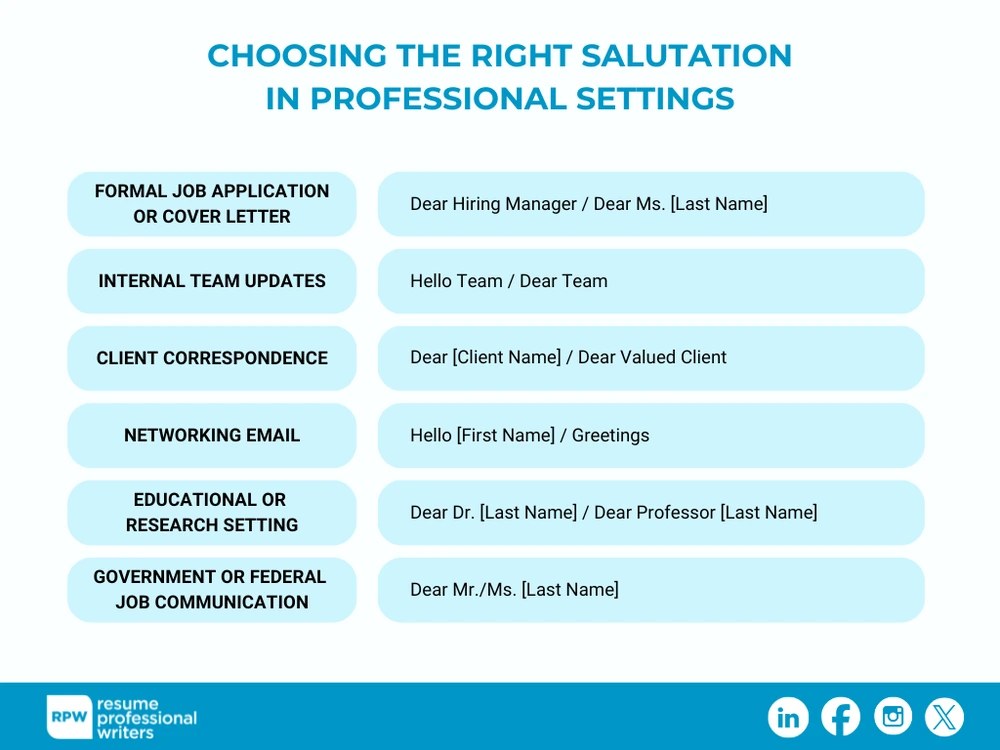
Consistency matters. Every professional message—from application to resignation—should mirror tone and etiquette aligned with industry standards. For example, federal applicants should always maintain traditional greetings, while healthcare professionals benefit from salutations reflecting empathy and trust. Meanwhile, digital marketers thrive using friendly yet concise introductions, blending brand personality with polished tone.
Common Salutation Mistakes and How to Avoid Them
Even experienced professionals occasionally make salutation errors that can undermine credibility or create the wrong impression. The most frequent include overusing outdated greetings, misgendering recipients, or omitting courtesy titles entirely. Each of these missteps can be prevented with deliberate attention to accuracy and audience awareness.
• Using “To Whom It May Concern” Too Often
Acceptable only when the recipient’s identity is impossible to verify. Whenever possible, conduct minimal research through LinkedIn or the company websites to identify the contact’s name.
• Omitting a Salutation
Skipping the greeting in professional contexts appears abrupt and impersonal. Even a simple “Hello” maintains connection and courtesy.
• Misusing Gendered Titles
Incorrectly identifying “Mr.” or “Ms.” could signal lack of diligence. Using neutral forms such as “Dear [First Name Last Name]” avoids error.
• Being Overly Casual
Greetings like “Hey” or “Hi guys” can diminish professionalism when addressing clients or senior personnel.
• Misspelling Names and Titles
Precision in spelling demonstrates respect; errors suggest carelessness. Always cross-check details before sending.
• Formatting Errors
Capitalize only the first letter of each component (e.g., “Dear John,” not “dear john”).
Modern email analytics reveal that professionalism influences open and response rates. A survey by Grammarly indicates messages with appropriate tone achieve significantly higher engagement. Therefore, even a small detail like greeting selection can affect communication outcomes.
Salutations for Specific Professional Scenarios
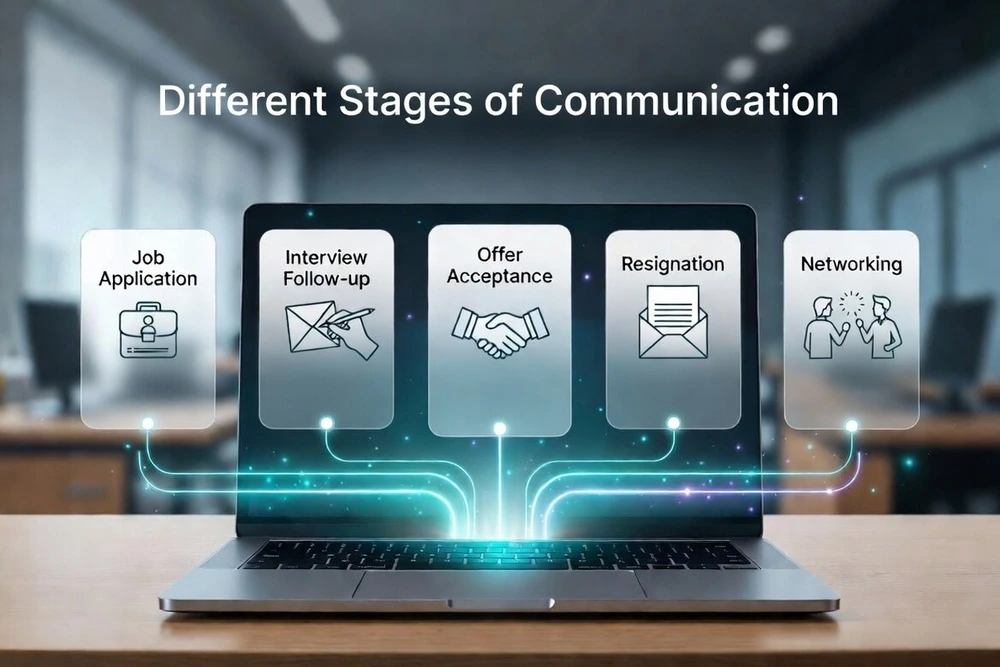
Different stages of communication—application, interview follow-up, acceptance, resignation, and networking—call for separate greetings. Selecting context-appropriate phrasing ensures recipients interpret messages positively and as intended.
Below are adaptable examples suited to common professional interactions.
- Job Application: “Dear Hiring Manager” or “Dear [Department] Recruitment Team” conveys respect and professionalism.
- Cover Letter Follow-up: “Hello [First Name], I hope this message finds you well.” maintains courtesy without sounding redundant.
- Networking Correspondence: “Dear [Full Name], I enjoyed connecting during [Event Name]…” balances warmth and structure.
- Interview Thank-You Email: “Dear [Interviewer’s Name], thank you for taking the time…” reinforces appreciation.
- Resignation Letter: “Dear [Manager’s Name], please accept this letter as formal notice…” ensures professionalism until completion.
- Offer Acceptance: “Dear [HR Name], I am honored to accept the position…” communicates gratitude and enthusiasm.
- Internal Memo: “Hello Team” emphasizes camaraderie while maintaining respect.
- Client Introduction: “Dear [Client Name], it is a pleasure to connect…” aligns with brand relationships and trust.
- LinkedIn Outreach: “Hello [First Name], I came across your profile…” keeps tone conversational yet polite.
- Formal Proposal Submission: “Dear Selection Committee,” ensures alignment with official protocol.
Federal job seekers and military-to-civilian applicants often rely on structured greetings to match government documentation practices. For instance, addressing “Dear Human Resources Specialist” in federal correspondence aligns with USAJOBS communication standards. Conversely, executives often favor succinct greetings signaling authority yet personal engagement, such as “Dear Board Members” or “Dear Executive Committee.”
Modern Trends in Email Greeting Etiquette
Email and digital communication continue evolving alongside workplace culture. In hybrid and AI-assisted environments, tone balance between efficiency and etiquette grows increasingly significant. Many companies now prioritize authenticity, plain language, and inclusivity when drafting emails. Consequently, neutral and genderless salutations such as “Hello [First Name]” dominate modern correspondence trends.
Corporate platforms like Microsoft Outlook and Google Workspace integrate predictive writing suggestions that adjust tone based on context. This automation reinforces professionals’ awareness that concise, positive messaging drives higher response rates. However, customization remains vital—generic or robotic-sounding openings reduce engagement and credibility. Personalizing greetings according to audience and shared experiences continues to generate trust and rapport within professional communication networks.
Inclusivity also influences stylistic choices. Using gender-neutral or position-based salutations prevents misidentification and supports equity in professional writing. For instance, “Dear Alex Rivera” respectfully avoids gender assumptions while maintaining professionalism. Many organizations now encourage non-gendered communication standards to promote workplace belongingness.
Adapting Salutations to Industry and Role Type
Different professions demand distinct tones. A healthcare provider may prefer warmth (“Dear Patient Services Coordinator”) to reflect empathy. Engineers and IT specialists, however, lean toward concise directness (“Hello Engineering Team”). Understanding audience expectations ensures tone synchronization, reinforcing the sender’s credibility and situational awareness.
Education professionals appreciate respectful acknowledgment of titles and academia. For example, “Dear Professor Williams” carries more esteem than a casual greeting. Meanwhile, creative marketers or designers benefit from informal flair consistent with modern branding cultures. Financial analysts, conversely, favor restraint, preferring classic openings such as “Dear Mr. Lee.” The same applies in law, healthcare administration, and government, where hierarchy dictates etiquette.
Below is a quick reference highlighting tone expectations by field:
| Industry | Salutation Tone |
|---|---|
| Healthcare | Empathetic and formal (Dear Dr. / Dear [First Name]) |
| Finance | Traditional and respectful (Dear Mr./Ms.) |
| Technology | Simple and concise (Hello [First Name]) |
| Education | Title-focused (Dear Professor / Dear Dean) |
| Government / Federal | Strictly formal (Dear [Title] [Last Name]) |
| Creative / Marketing | Light and friendly (Hi [First Name]) |
When to Adjust Tone After Initial Correspondence
As communication progresses, professionals can gradually shift tone from formal to conversational. After an interview process or partnership development, transitioning from “Dear Ms. Perkins” to “Hello Laura” reflects relationship progress while still honoring decorum. The key lies in mirroring the recipient’s style—if superiors use semi-formal tone, matching that tone maintains alignment.
Consistency across channels strengthens professional identity. Whether through email chains, internal messaging platforms like Slack, or written documentation, tone coherence signals reliability. Many American corporations value authenticity balanced with courtesy; therefore, excessive rigidity can sometimes appear detached. Professionals should evolve greetings naturally to mirror evolving relationships and communication environments while preserving essential politeness.

Strengthen Professional Impressions through Effective Greetings
Every written interaction reflects professional values and attention to detail. Aligning salutations with context reinforces credibility and establishes rapport across diverse workplace settings. Whether emailing a recruiter, client, or executive, mastery of tone ensures each message begins with clarity and respect. By demonstrating courteous communication, professionals boost their perceived competence and relationship-building capability—foundations of career success. Those seeking added guidance often elevate their applications with professional resume writing help that reinforces a consistent tone and polished presentation across all job search materials.
Frequently Asked Questions
What is the most professional salutation for a job application?
The most professional opening remains “Dear Hiring Manager” when the recruiter’s name is unknown. When identifiable, “Dear [First Name Last Name]” or “Dear Mr./Ms. [Last Name]” demonstrates personalization and formality consistent with US job application norms.
Is “To Whom It May Concern” outdated in 2026?
Yes. While still technically correct, most hiring professionals consider it impersonal. Locating the recruiter or department name through LinkedIn or company websites leads to stronger engagement and a more tailored first impression.
How should salutations be formatted in an email?
Capitalize the first letter of the greeting and follow it with a comma (e.g., “Dear Ms. Lopez,”). Leave a line break before starting the main message for clean formatting and readability.
Are gender-neutral salutations acceptable in corporate settings?
Absolutely. Many organizations encourage gender-neutral greetings such as “Dear [Full Name]” or “Hello [First Name]” to promote inclusivity and avoid misgendering. This aligns with modern DEI communication standards in the US workplace.
What salutation should federal applicants use?
Federal job seekers should use highly formal options such as “Dear Mr./Ms. [Last Name]” or “Dear Human Resources Specialist.” Such phrasing adheres to the communication conventions upheld in federal government correspondence.