


Quick answer: Ladders is worth it for senior corporate professionals (sales leadership, finance, operations, marketing directors) who are actively searching and willing to pay $35-50/month for 60-90 days. It is not worth it for senior tech roles, C-suite candidates, passive searchers, or anyone earning under $100K who isn’t already credentialed for $100K+ roles. The decision matrix below maps your situation to a recommendation.
The Ladders job search platform bills itself as the job board for $100K-plus roles. It runs a screened feed of executive and senior corporate openings, charges a subscription for the useful features, and sells a separate resume writing service on the side. For professionals targeting high‑salary positions, the Ladders job search platform positions itself as a premium gateway to vetted opportunities.
Whether Ladders is worth your money depends on three things: what you do for a living, how active your search is, and what you would otherwise spend on a job search. This review walks through what Ladders does well, where it falls short, what the platform actually costs in 2026, and the specific scenarios where the subscription pays off versus the scenarios where it does not.
Disclosure: Resume Professional Writers is a resume writing company. We are not a competitor to Ladders’ job board, and we are not affiliated with the platform. This review is editorial.

What Ladders Is, in 90 Seconds
Ladders is a U.S.-focused job board that exclusively lists roles paying $100,000 or more in base compensation. It launched in 2003 and has gone through multiple business-model shifts, including a rebrand from TheLadders.com to Ladders.com, a pivot away from charging recruiters, and the addition of an AI-powered matching feature in recent years.
The free tier shows you job listings, but most useful actions sit behind a paywall: applying directly through the platform, seeing who viewed your profile, messaging recruiters, and accessing the full search and filter set.
Premium subscriptions in 2026 run roughly $35-50 per month, depending on the tier and billing cycle, with discounts for annual commitments. The platform also upsells a resume writing service at a separate (and significantly higher) price point.
What Ladders Does Well — And Where It Falls Short
Here is the balanced view. None of these are absolute claims about every user’s experience, as the job board quality varies by industry, location, and the user’s own search behavior. However, these are the patterns that show up consistently across reviews on Trustpilot, Glassdoor Community threads, and Reddit’s r/recruitinghell.
What Ladders Does Well
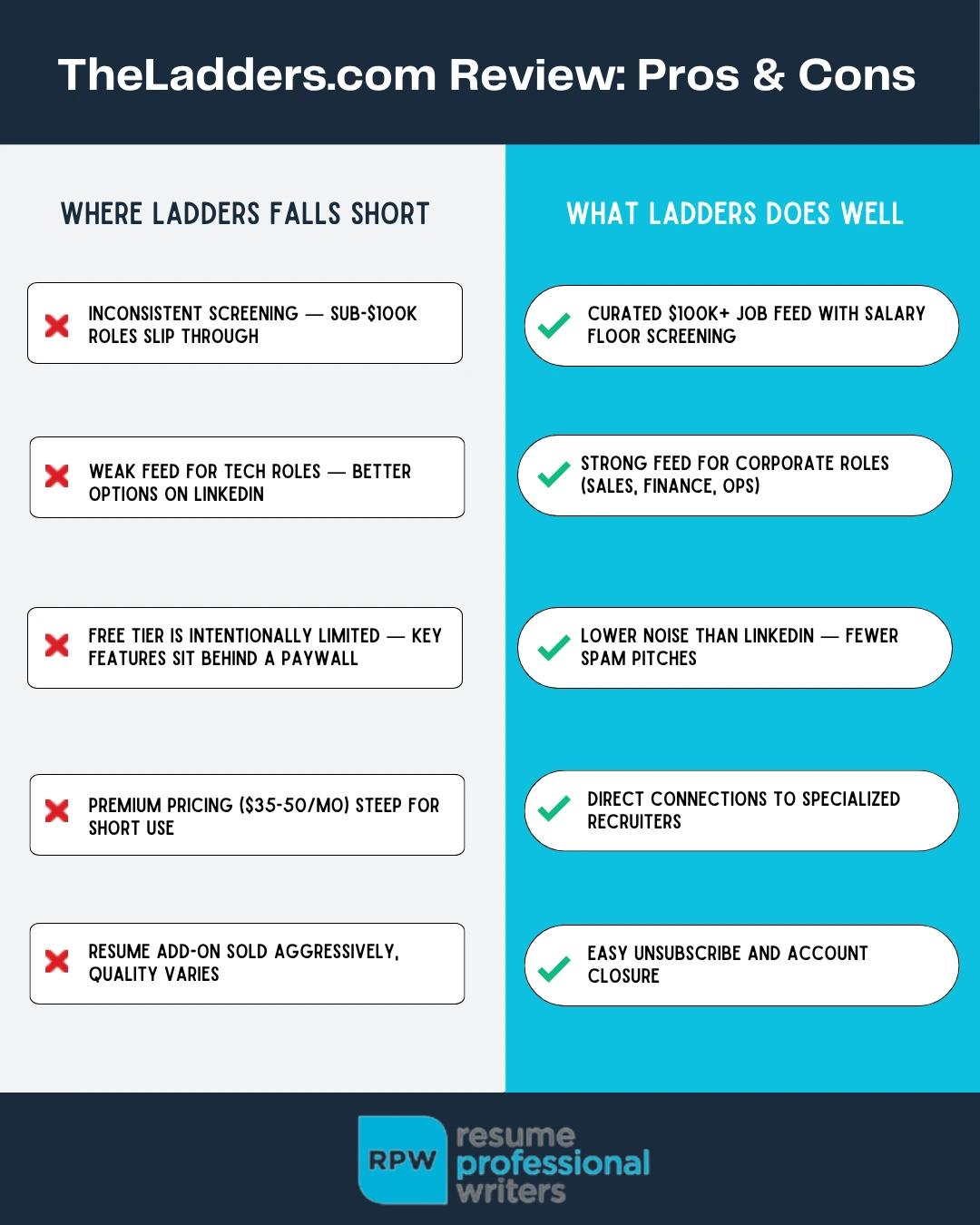
- Curated $100K+ job feed — most listings are screened to meet the salary floor.
- Strong feed for traditional corporate roles (sales leadership, finance, ops, marketing director-level).
- Lower noise than LinkedIn — fewer recruiter spam pitches, fewer entry-level postings cluttering the feed.
- Direct connections to recruiters who specialize in higher-comp searches — useful if you’re open to being approached.
- Easy unsubscribe and account closure — no aggressive retention tactics reported in recent reviews.
Where Ladders Falls Short
- Inconsistent screening — users regularly report sub-$100K roles slipping through, especially in lower cost-of-living markets.
- Weak feed for tech roles — engineers and product managers find more relevant openings on LinkedIn, Hacker News, or Wellfound.
- Free tier is intentionally limited — most useful features (applying directly, seeing who viewed you, recruiter messages) sit behind a paywall.
- Premium pricing ($35-50/month range, depending on plan) is steep if you’re not actively job-hunting or are on the platform under three months.
- Resume writing add-on is sold aggressively. The price tag is high and quality varies — verify by sample before purchasing if you’re considering it.
For a quick guide, here’s an infographic on Ladders job search platform pros and cons.
When the Subscription Actually Pays Off
A few scenarios where Ladders job search platform has produced clear value for the clients we’ve worked with:
1. A sales VP transitioning from one mid-market SaaS company to another
Ladders’ curated feed surfaced two competitor-adjacent roles she would not have found via LinkedIn alone. She subscribed for 60 days, paid roughly $70 total, landed an offer 14% above her previous comp.
2. A finance director relocating to a new metro
The geographic filter and salary floor cut out the noise of irrelevant junior postings. He used Ladders alongside LinkedIn for three months, ended up in a role sourced through Ladders’ recruiter outreach feature.
3. An operations leader who didn’t have time for active outreach
Setting the “open to recruiters” toggle on Ladders generated three legitimate inbound conversations in the first 45 days, including the one that became her next role.
The common thread: short subscription window (60-90 days), parallel use of LinkedIn and at least one other channel, and target roles in traditional corporate verticals where the $100K+ filter actually maps to real openings.
When Ladders Job Search Platform Is Not Worth It
Before diving into specific categories, it’s worth noting that the Ladders job search platform doesn’t serve all industries equally. Some sectors see limited role density compared to broader job boards.
1. Tech Roles
If you’re a senior engineer, product manager, or designer, the role density on Ladders is thin compared to LinkedIn, Wellfound (formerly AngelList), Hacker News “Who’s Hiring,” and direct company career pages. Subscription dollars are better spent on LinkedIn Premium and Otta/Welcome to the Jungle.
2. C-Suite and Board Roles
These are filled through retained executive search firms, board placement firms, and personal networks. Ladders does not meaningfully participate in this market.
3. Passive Searchers
The free version of LinkedIn with the “open to recruiters” flag will deliver similar inbound recruiter contact with no cost. Reserve a paid Ladders subscription for active search windows.
4. If Your Resume Isn’t Ready
A premium job board with a resume that doesn’t reflect $100K+ caliber experience produces no results regardless of subscription. Fix the resume first, then evaluate platforms.
5. Sub-$100K Target Salaries
The Ladders job search platform is built around a $100K floor. If your target salary is $75K-$95K, you’ll see roles you can’t realistically negotiate up to.
Should You Subscribe? A Decision Matrix
The honest answer to “Is Ladders worth it?” depends on your situation. Here is the framework we use when clients ask us about it.
| Your Situation | Try Ladders? | Better Alternative |
| Senior corporate role, $150K+, traditional industries (finance, ops, sales, marketing) | Yes — strongest fit | Combine with LinkedIn Premium + executive recruiters |
| Senior tech / engineering / product roles | Probably skip | LinkedIn, Wellfound (formerly AngelList), Hacker News Who’s Hiring |
| C-suite or board roles | Skip | Retained executive search firms, board placement firms, your network |
| Career pivot from sub-$100K to $100K+ role | Premature | Resume + LinkedIn rebuild first, then re-evaluate Ladders in 90 days |
| Passive search — open if the right thing appears | Maybe | LinkedIn “open to recruiters” flag is free and often delivers similar inbound |
| Active search, urgent timeline (next 60 days) | Yes — short subscription | Run Ladders in parallel with LinkedIn + 2-3 industry-specific boards |
The pattern: Ladders works best for active senior corporate searchers with a short timeline. It works worst for passive searchers, tech-specific roles, and C-suite candidates (who tend to find roles through retained search and network, not job boards).
How to Use Ladders Job Search Platform Effectively (If You Subscribe)

If your situation fits the “yes” rows of the decision matrix above, here’s how to get the most out of a Ladders subscription:
- Cap the salary floor to your real number, not your aspirational number. If you’re realistically targeting $130K, filtering at $130K minimum removes posts you can’t actually win.
- Use the geography filter aggressively. Ladders’ default search is broader than most users realize. Narrow it to the metros you’ll actually relocate to or commute to.
- Turn on the recruiter visibility toggle on day one. Most of Ladders’ value for senior corporate roles comes through inbound recruiter contact, not your outbound applications.
- Apply through the platform, not by copying the job to LinkedIn and applying there. Ladders’ tracking helps recruiters see you’re a serious candidate from inside their hiring funnel.
- Set a 60-day or 90-day budget for the subscription, then re-evaluate. If you haven’t had meaningful conversations in that window, the platform isn’t fitting your situation. Cancel and reallocate the budget.
What to Use Instead (or Alongside)
Ladders rarely makes sense as your only channel. The candidates we’ve seen succeed combine it with at least two of the following:
1. LinkedIn
The largest single source of $100K+ roles. The free tier is usable; Premium adds InMail credits, who-viewed-you visibility, and the “Open to Work” badge variations.
2. Industry-Specific Job Boards
Examples: Sales Hacker community job board for sales leaders, eFinancialCareers for finance, Built In for tech, Indeed Pro Match for verticals like healthcare and skilled trades.
3. Executive Recruiters
For roles above $200K, retained search firms are the primary channel. Build the relationships before you need them.
4. Direct Outreach
The strongest senior-level placements come from candidates contacting hiring managers directly. A targeted list of 30 companies and 30 hiring-manager emails outperforms 300 generic applications.
5. Your Network
The cliché is true at the executive level: most senior roles are filled through warm introductions, not job board applications. Ladders supplements this — it doesn’t replace it.

Before You Subscribe to Anything — Fix the Resume First
A common mistake we see: clients sign up for Ladders, LinkedIn Premium, and a paid resume distribution service in the same week, while their resume itself still reads like a mid-career individual contributor. The platforms surface the resume to recruiters. If the resume doesn’t reflect $100K+ caliber experience, no platform will solve that problem.
An executive-grade resume in 2026 reads differently than a mid-career resume. The opening profile leads with scope (P&L size, team headcount, board exposure, geographic span). The experience section quantifies outcomes in dollars or percentages, not duties. The skills section is short, weighted toward strategic capabilities, not software lists. ATS formatting is conservative because executive search firm software is stricter than corporate ATS.
For an executive-level resume rebuild, see how our senior writers approach this work at our executive resume writing service. Every resume is written by a human writer with industry-specific experience, end-to-end ownership, and an understanding of how recruiters and executive search firms actually evaluate senior candidates.
Frequently Asked Questions
How much does Ladders cost in 2026?
Premium subscriptions range from roughly $35 to $50 per month, depending on tier and billing cycle, with annual prepay discounts available. The resume writing add-on is sold separately at a significantly higher price point — verify current pricing on the platform before subscribing, because Ladders has adjusted its plans multiple times in recent years.
Is Ladders only for jobs over $100,000?
The platform’s stated floor is $100,000 in base compensation. In practice, users report occasional sub-$100K postings slipping through, especially in lower cost-of-living markets where local roles may be flagged with a lower band. The screening is not perfect, but Ladders job search platform is materially more curated than LinkedIn or Indeed.
Is the Ladders resume service worth it?
Independent reviews of the Ladders resume service are mixed — quality reportedly varies depending on the writer assigned. If you’re considering it, ask for a sample written by the specific writer who would handle your project, verify their industry experience, and compare the price against specialist services. The same caution applies to any premium resume service: the writer matters more than the brand.
How does Ladders compare to LinkedIn?
LinkedIn has dramatically more roles and far more recruiters, but with much higher noise from sub-$100K postings, recruiter spam, and entry-level listings. Ladders has lower volume but tighter curation. Most senior candidates we work with use both in parallel: LinkedIn for breadth and network access, Ladders for a cleaner $100K+ feed and recruiter inbound.
Can I cancel Ladders anytime?
Yes. Users consistently report that Ladders allows clean cancellation through account settings without retention friction. If you subscribe for a focused 60-day or 90-day search window, set a calendar reminder to cancel at the end of that window so you don’t get auto-renewed for a longer term.