


What are some in-demand jobs that don’t require background checks?
Short answer: Sectors that most often skip formal background checks include food service and hospitality, gig-economy delivery (DoorDash, Uber Eats, Instacart), construction and skilled trades, personal services (cleaning, lawn care), freelance creative work, and some warehouse and light manufacturing. Even in these fields, identity verification is standard. Beyond no-check work, ban-the-box laws, and EEOC guidance now protect applicants with records in 35+ states and 150+ cities.
Jobs that don’t require background checks exist, but they’re rarer than search results suggest — and the right framing matters more than the list itself. Most U.S. employers run some form of pre-employment screening, even if they don’t call it a formal “background check.” The real question for most readers isn’t “where do I work to avoid checks entirely?” — it’s “where do I have the best chance of being hired if I have a record, a gap in employment, or a credit issue I’d rather not explain?”
This piece walks through the 2026 background-check landscape, the sectors that genuinely skip formal checks, the legal protections that exist for applicants, and how to position yourself when a check is unavoidable.

Why Some Jobs Don’t Require Background Checks (and Why Many Do)
Even in 2026, many jobs that don’t require background checks remain common across service, gig, and creative sectors. Employers often skip formal screening for three practical reasons:
• Cost and Turnaround
A standard pre-employment background check runs $20–$80 per applicant and takes 3–7 business days. For roles with high turnover and low margin per hire (food service, hospitality, gig delivery), the ROI doesn’t justify the spend.
• Speed-to-Hire Pressure
When a kitchen needs a cook tomorrow, the manager isn’t waiting a week for a check. The role gets filled on the spot, often with a shorter probationary period instead.
• Legal and Compliance Risk
Some employers have learned that running checks they can’t justify exposes them to claims under the Fair Credit Reporting Act and state ban-the-box laws. For roles and industries with jobs that don’t require background checks, skipping the check is sometimes the safer move—reducing legal risk while still focusing on skills, references, and immediate job fit.
Why many jobs DO require checks:
• Industry Regulation
Healthcare, education, finance, transportation, and government roles almost always require checks — sometimes by federal law.
• Insurance Requirements
Employers carrying liability or fidelity insurance often have to verify clean records as a condition of coverage.
• Trust-Based or Fiduciary Roles
Roles handling cash, customer data, or vulnerable populations carry standard screening requirements.
What “No Background Check” Actually Means in 2026
Be careful with terminology. Most U.S. employers run at least one of these even when they advertise “no background check required”:
- Identity verification (Form I-9 — federally required for all employers)
- E-Verify (mandatory in some states; voluntary in others)
- Reference checks (informal, not a formal “background check”)
- Drug testing (separate process from a criminal-record check)
- Driving record check (for any role involving driving)
The phrase “no background check” usually means “no formal criminal history check.” It rarely means zero screening of any kind. Even in jobs that don’t require background check, employers may still verify identity, references, or basic qualifications. Setting that expectation correctly saves applicants from being blindsided during onboarding.
Sectors Where Formal Background Checks Are Genuinely Less Common
The following sectors hire at scale with reduced or skipped formal checks. Many of these roles fall into the category of jobs that don’t require background checks, where employers rely more on identity verification, references, or skill demonstrations. Volume and wages vary; we cite BLS Industries at a Glance data for leisure and hospitality and the corresponding industry pages for the most recent national figures.
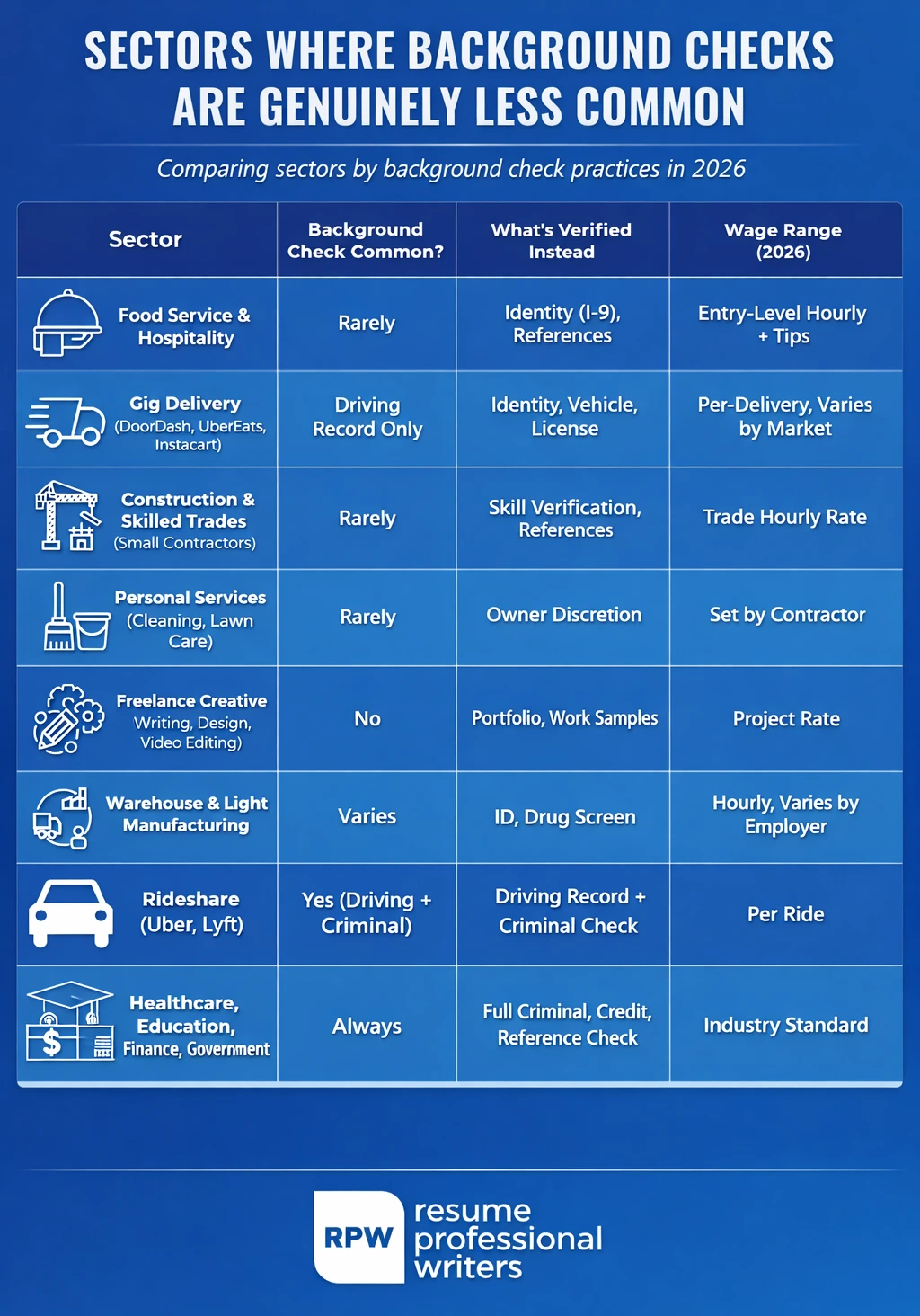
Food Service and Hospitality
Servers, line cooks, bartenders, hosts, dishwashers, and cashiers. High turnover and shift-based hiring make formal checks rare. Identity verification is required; criminal-record checks usually are not.
Gig Delivery and Rideshare Driving
DoorDash, Uber Eats, Instacart, Amazon Flex, and GrubHub. These platforms run their own internal screens (driving record, identity), but most jobs don’t require background checks because workers are classified as independent contractors. Note: rideshare driving (Uber, Lyft) does require a driving history and a criminal check on most platforms, even though it’s also gig work.
Construction and Skilled Trades
Construction laborers, framers, painters, drywallers, and landscapers often fall into the category of jobs that don’t require background checks. Many small contractors hire by referral and skip formal checks. Larger commercial sites and unionized work often do require checks.
Personal Services
House cleaners, lawn care, in-home pet care, and personal organizers. Independent contractor and small-business work where the hiring decision is the owner’s alone.
Freelance Writing, Design, and Digital Content
Most freelance work — copywriting, design, video editing, podcast production — doesn’t involve any formal screening. Clients verify work samples, not records.
Warehouse and Light Manufacturing (Varies)
Some warehouse and light-industrial employers have moved to a streamlined hiring process and skip formal background checks. Larger companies and Amazon warehouses generally still run checks. Verify per employer.
What the Law Actually Says (Fair Chance Hiring)

If you have a record, you have more legal protection in 2026 than most applicants realize. Applicants seeking jobs that don’t require background checks—or roles where checks are limited—also have stronger safeguards against unfair rejection than ever before.
Ban-the-box laws prohibit employers in covered jurisdictions from asking about criminal history on the initial job application. Over 37 U.S. states and 150+ cities or counties now have some version of these laws. For applicants pursuing jobs that don’t require background checks, this legislation helps ensure fair access to opportunities without premature disqualification. The U.S. EEOC also enforces guidance on the use of arrest and conviction records. Employers must weigh the nature of the offense, the time elapsed, and job relevance before disqualifying an applicant.
The Fair Credit Reporting Act (FCRA) governs how employers run and use background-check data. Employers must:
- Get your written authorization before running a check.
- Provide a copy of the report and a “summary of rights” if they’re considering an adverse action.
- Give you time to dispute inaccuracies before final rejection.
If an employer skips these steps—even for jobs that don’t require background checks—they’re violating federal law. In such cases, you have the right to file a complaint with the Federal Trade Commission (FTC) or pursue legal action to protect your employment rights.
What to Do If a Background Check Will Be Hard to Pass
Three practical moves:
1. Disclose proactively, in writing, after the offer but before the check.
Don’t lead with it; don’t hide it. Frame it factually: what happened, how long ago, what you’ve done since. Hiring managers respond better to a plain disclosure than to surprises mid-process.
2. Get the records yourself first.
Order your own background-check report (Checkr, Sterling, and several state agencies offer this directly to consumers). Inaccurate records are common; you have time to dispute them before an employer pulls a report.
3. Build references that vouch for current behavior.
Two professional references who’ve worked with you in the last 12 months and can speak to your reliability are worth more than any formal screen. Include them in your application materials and tell them the story upfront.
How to Position Your Resume for No-Check or Fair-Chance Roles

The resume itself doesn’t need to mention background-check history; it needs to lead with what you bring. Three principles:
1. Lead with skills and recent achievements.
A skills section near the top with concrete deliverables (tools, certifications, measurable outcomes) shifts the recruiter’s attention from history to capability. If your work history is sparse — first job, returning after a long gap, or pivoting from informal to formal employment — our walkthrough on building a resume with no work experience covers what to put in place of a traditional experience section.
2. Include any current certifications or training.
Forklift, CDL, ServSafe, OSHA, CPR, food-handler permits — anything that shows you’ve invested in the work recently. These are stronger signals than a clean record because they’re forward-looking.
3. Use professional references strategically.
A reference list with two or three current managers or coworkers, with phone numbers and explicit permission, replaces the “screen for trust” function that a background check would have served.
Our keyword lists organized by industry cover the specific certifications and skills that recruiters scan for in each sector. And if you’re putting together a cover letter to accompany the resume, our walkthrough on writing a cover letter from scratch covers the structure most likely to land an interview.
The principle of showcasing relevant work experience applies regardless of whether your work history is patchy — whatever you’ve done that maps to the target role belongs near the top, with detail. Some of the strongest fair-chance candidates lean heavily on transferable competencies like clerical experience, which crosses many of the no-check sectors above.

The Growing Second-Chance Hiring Movement
A growing segment of U.S. employers has publicly committed to fair-chance hiring. HR Dive’s reporting on Jobs for the Future’s acquisition of the Dave’s Killer Bread second-chance hiring program documents how mainstream the movement has become — Dave’s Killer Bread, Greyston Bakery, and a network of 34+ companies that have completed the Second Chance Corporate Cohort training, including Dick’s Sporting Goods, General Motors, Union Pacific Railroad, Cisco, Koch Industries, and Gap.
These employers actively recruit candidates with records and have built screening processes that consider the nature of the offense and time elapsed, rather than rejecting on a hit. If a record is your concern, target this group directly rather than limiting yourself to no-check sectors.
Common Mistakes Job Seekers Make
1. Lying or omitting on the application.
A check eventually catches it, and the disqualifying issue becomes the lie, not the record. Disclose what’s required, when it’s required.
2. Refusing the check.
If the employer says they’ll run a check and you decline, the application closes. Engage with the process; don’t fight it.
3. Targeting only “no check” jobs without considering fair-chance employers.
Plenty of great employers will hire you with a record. Limiting yourself to no-check sectors closes off the better-paying side of the market.
4. Not getting your own records first.
You can find out exactly what an employer will see — saves the surprise.

Get Help Rewriting Your Resume for Fair-Chance Hiring
If you’ve been applying for months without callbacks, the resume is usually doing more harm than the screening process. A second set of eyes from someone who reads resumes full-time can find the gaps fast — formatting issues that break ATS parsing, missing keywords for your target sector, sections that draw attention to gaps you’d rather minimize.
If you’d like us to have our team rewrite your resume, we’ll review what you have now and tell you exactly where it’s losing interviews. No pressure, no obligation — and we work with applicants across every employment background. (If you’re weighing the decision, our breakdown on whether resume writing services are worth it covers the cost, ROI, and the warning signs of services that overpromise.)
For more job-search tactics across pillars, our career library has guides for cover letters, interview prep, and salary negotiation.
Frequently Asked Questions
What jobs don’t require background checks in 2026?
Most food-service, hospitality, gig-delivery (DoorDash, Instacart, Uber Eats), construction, freelance/creative, and small-business personal-services roles don’t involve formal background checks. That said, all U.S. employers must verify your identity and work eligibility (Form I-9), and many run drug tests, reference checks, or driving-record checks even when they don’t run a formal criminal background check.
Can employers legally skip background checks?
Yes, in most cases. Background checks are not federally required for most jobs. Some sectors (healthcare, education, finance, transportation, government, childcare) have legal or regulatory requirements that make checks mandatory. For other sectors, skipping a check is a business decision the employer can make freely, as long as they don’t discriminate when they choose to run one.
What is ban-the-box, and does it apply to private employers?
Ban-the-box laws prohibit employers from asking about criminal history on the initial job application — the goal is to delay the disclosure until later in the process so applicants get a fair first look. Over 35 U.S. states and 150+ cities have some version of these laws. Coverage varies — some apply only to public-sector hiring, others to private employers above a certain size.
Will a background check find dismissed or expunged charges?
Generally no, if the expungement was completed correctly. A dismissed-but-not-expunged charge can still appear in some reports. Errors are common, so order your own background-check report (Checkr, Sterling, your state attorney general’s office) to see exactly what employers will see — and dispute inaccuracies before an employer pulls a report.
How do I find fair-chance employers?
Look for employers that have publicly signed the Fair Chance Pledge, large companies with explicit second-chance hiring programs (Target, Starbucks, Dave’s Killer Bread, Greyston, JPMorgan Chase, Microsoft), and local nonprofits that partner with fair-chance hiring initiatives. Search for “fair chance hiring [your city]” or check your state’s reentry workforce-development office for an active employer list.