


Today’s job market is full of confusing titles. Similar names can hide very different responsibilities, while inflated or outdated titles leave applicants guessing. Misunderstanding the job title meaning can cost candidates opportunities or cause resumes to be overlooked by applicant tracking systems.
This guide strips away the confusion. With insights from recruiters and industry experts, it explains the real job title meaning—how companies define roles, why titles matter, and how to use them strategically. Whether you’re entry‑level, an executive, a career changer, or a federal job seeker, you’ll learn how to align titles with your experience, optimize your resume, and chart a clear path for career growth.

Understanding Job Title Meaning and Purpose
A job title is more than a label—it’s a formal designation that defines the nature of work, level of responsibility, industry classification, and place in the organizational hierarchy. The job title meaning signals the scope of work, authority level, and even pay scale.
In every industry, job titles serve several critical functions:
- For Employers: Job titles organize teams, establish reporting lines, and shape salary structures.
- For Job Seekers: Titles reveal valued skills, career paths, and advancement opportunities.
- For HR and Analytics: Job titles classify positions for payroll, compliance, and workforce metrics. A Marketing Coordinator and a Marketing Director may share a department but carry very different expectations—showing how the job title meaning shapes career progression.
- For Recruitment: Applicant Tracking Systems (ATS) rely on recognized titles. Creative labels like “Content Wizard” may hurt visibility, while standardized titles like “Content Strategist” improve discoverability.
Clear job title meaning bridges communication between employees and employers. It underpins performance reviews, salary benchmarks, and credibility. A precise title strengthens professional branding and boosts hiring outcomes.
Categories of Job Titles Across Career Levels

Every organization structures job titles according to experience and seniority. These tiers give clarity to professional growth within an organization and ensure consistency in talent evaluation. Titles typically fall into five principal job levels: entry-level, mid-level, senior-level, managerial, and executive. Understanding these levels enables job seekers to target opportunities that match their skills and aspirations.
1. Entry-Level Titles
- These positions mark the starting point of a career path. Examples include Marketing Assistant, IT Support Specialist, or Staff Nurse. They require foundational knowledge and a willingness to learn on the job.
2. Mid-Level Titles
- Roles such as Project Coordinator, Software Developer, or Senior Accountant indicate growing specialization and independent execution of key responsibilities.
3. Senior-Level Titles
- Professionals with titles like Senior Engineer or Lead Analyst demonstrate mastery in a specialized area, often mentoring junior colleagues or supervising small teams.
4. Managerial Titles
- These include Project Manager, Operations Manager, or Department Head. They involve balancing technical expertise with leadership and decision-making authority.
5. Executive Titles
- Common designations include Chief Executive Officer (CEO), Chief Financial Officer (CFO), and Chief Technology Officer (CTO). Executives focus on strategy, vision, and high-level organizational management.
Each progression typically brings increased accountability, broader influence, and higher salary bands. Job seekers should look beyond titles alone when comparing roles between organizations. An Engineer II at one company may carry responsibilities equal to a Senior Engineer elsewhere. Always evaluate the job description, required skills, and organizational context to truly understand the job title meaning.
Job Titles and Organizational Hierarchies
Job titles map out internal hierarchies and reporting structures that maintain workflow efficiency. The job title meaning signals authority levels, chain of command, and collaboration pathways. While corporations often assign narrowly defined roles, startups may combine multiple responsibilities under hybrid titles.
| Career Level | Sample Job Titles |
|---|---|
| Entry-Level | Administrative Assistant, Junior Analyst, Technician |
| Mid-Level | Operations Specialist, Systems Engineer, Finance Associate |
| Senior-Level | Senior Consultant, Senior Software Engineer, Lead Designer |
| Managerial | HR Manager, Project Manager, Marketing Manager |
| Executive | Director, Vice President, Chief Officer |
In most corporate settings, titles progress vertically within departments (from Coordinator to Senior Manager to Director) and horizontally across business units (for example, Marketing Director and Finance Director). This dual ladder ensures both managerial and individual contributor growth opportunities.
Federal and public sector organizations follow stricter title standards through systems like the General Schedule (GS), which standardizes pay grades and role equivalence. Here, the job title meaning is tied directly to classification and compensation.
Understanding these patterns helps professionals navigate promotions, internal transfers, and salary negotiations effectively.
Why Job Titles Matter in Recruitment and Career Development

1. Shapes Perception
Job titles do more than define work—they influence how employers view expertise, leadership potential, and compensation. During recruitment, the job title signals professionalism. Clear, recognized titles pass through applicant tracking systems (ATS) more easily, while inflated or quirky titles can raise red flags.
2. Impacts Career Development
A recognizable title boosts networking and career mobility. Recruiters scanning LinkedIn or resumes prioritize clarity. For example:
- Software Engineer III → instantly conveys seniority.
- Tech Ninja → leaves uncertainty about scope and skills.
3. Benchmarks Compensation and HR Standards
HR teams and compensation analysts rely on standardized titles to benchmark pay. The U.S. Bureau of Labor Statistics uses occupational titles to compare salaries across industries. Ambiguous titles make it harder to validate pay expectations or justify promotions.
4. Reinforces Engagement and Retention
Consistent titling strengthens employee engagement. When professionals understand their place in the hierarchy, they gain direction and confidence. This transparency supports succession planning, career progression, and professional branding.
The Relationship Between Job Titles, Roles, and Responsibilities

A job title offers a snapshot, but the description reveals the full scope. The job title meaning is tied directly to responsibilities, qualifications, and performance expectations. Yet the relationship isn’t always one‑to‑one—a Project Coordinator in a small company may lead cross‑functional projects, while a Project Manager in a larger firm might only oversee specific phases. Professionals evaluating new opportunities should examine the relationship between title and role content carefully.
Relationship to Career Growth
Inflated titles can create unrealistic expectations, while understated ones may undervalue expertise. Aligning the job title with actual duties ensures fair pay, accurate career trajectories, and realistic growth opportunities.
Relationship in Recruitment
During interviews, professionals should clarify how responsibilities match the title. This transparency ensures the job title aligns with both employer needs and personal career goals, preventing mismatches that stall career development.
Relationship in Workforce Management
Organizations that audit titles against real performance outcomes strengthen equity and talent management. Inaccurate titles disrupt succession planning, confuse career paths, and misalign compensation. HR teams rely on classification systems to maintain parity among roles with equivalent impact—making the job title central to workforce stability.
Optimizing Job Titles for Resumes and Online Profiles
Strategic use of job titles on resumes and digital profiles significantly enhances discoverability and ATS compatibility. Job seekers should adopt precise, standardized language that aligns with industry conventions. For instance, including alternate recognized titles in parentheses (“Customer Success Specialist (Account Manager)”) can improve search reach without misrepresenting experience.
Consistency across platforms—resume, LinkedIn, and professional directories—strengthens branding. Recruiters often verify that position titles match official records such as offer letters, especially in regulated fields like healthcare or finance. Professionals applying for federal roles must match official occupational series codes, ensuring compliance with government standards.
- Use official or widely accepted industry terminology.
- Capitalize titles properly without excessive stylization.
- Include context for unconventional roles (e.g., “Startup Operations Lead—equivalent to Operations Manager”).
- Update older job titles to reflect current standards when appropriate.
- Ensure accurate chronology when multiple positions are held within one employer.
Adhering to these practices communicates professionalism and clarity, helping resumes pass both human and algorithmic review stages more effectively.
Common Challenges with Modern Job Titles

Job titles today have become increasingly creative, leading to complications in recruitment processes.
Creative Titles Confuse Systems
Tech startups and creative agencies often prefer unique titles like “Growth Hacker” or “Brand Evangelist,” which may intrigue prospective employees but confuse automated recruitment systems. Such creativity might impair standardization and limit cross-industry interpretation of role significance.
Title Inflation
Another challenge lies in title inflation—granting higher-sounding roles without corresponding responsibility or compensation. While it can boost employee morale temporarily, the job title meaning becomes misleading, creating frustration when market value doesn’t align with actual duties.
Title Compression
Some organizations compress hierarchies, limiting differentiation between roles. This erases clarity in career progression and weakens motivation. The job title meaning loses impact when growth paths are unclear.
Industry Variations
A “Consultant” in management, healthcare, or IT can mean very different things. Without context, the job title meaning is inconsistent across industries, making it harder for job seekers to evaluate opportunities and set realistic expectations.
How Job Titles Influence Salary and Market Value

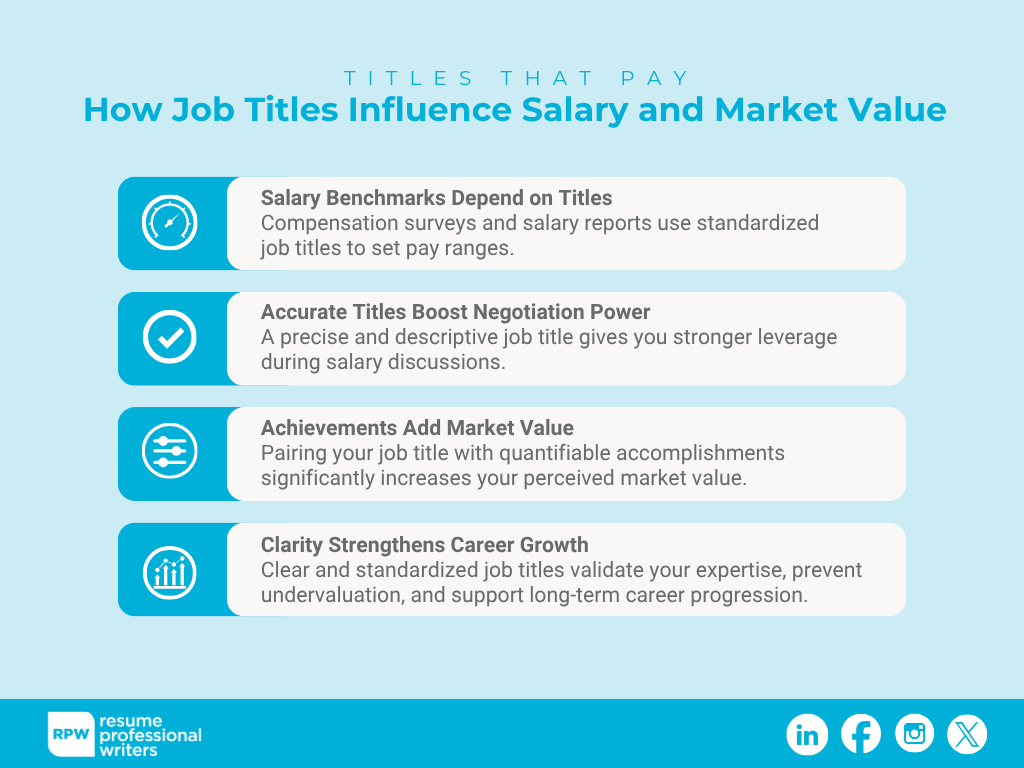
Salary Benchmarks Depend on Titles
Compensation surveys and employment reports categorize pay ranges by job titles. When the job title meaning doesn’t match actual responsibilities or industry context, salary expectations skew. Employers rely on standardized data from sources like the US Bureau of Labor Statistics and PayScale to ensure fair comparisons.
Accurate Titles Boost Negotiation Power
Professionals who position their titles correctly gain stronger leverage. For example, a Product Manager overseeing budgets, staff, and global launches commands higher pay than one managing a single process. Clear descriptors align salary discussions with industry parity and prevent career stagnation.
Achievements Add Market Value
Employers look beyond labels. Pairing titles with measurable results—such as “Software Engineer – automated workflows saving $500K annually”—adds weight to the job title meaning and signals leadership, impact, and upward mobility.
Clarity Strengthens Career Growth
Ambiguous or inflated titles weaken credibility and hinder promotion opportunities. A precise, standardized title ensures salary alignment, validates expertise, and enhances professional branding across industries.
Future Trends in Job Titles and Classification
Workplace evolution continues to reshape how job titles function.
Rise of AI and Hybrid Work
Artificial intelligence, remote collaboration, and cross‑functional teams are reshaping job titles. New roles highlight digital integration and skill versatility beyond traditional corporate structures. Some of these new job titles that emerge due to AI and remote environments include:
- Prompt Engineer → designs and optimizes AI prompts for better outputs.
- AI Ethics Analyst → ensures responsible use of AI technologies.
- Remote Experience Manager → enhances employee engagement in hybrid and remote environments.
Competency‑Based Frameworks
Organizations are moving away from rigid hierarchies. Instead, they adopt competency‑based systems that define roles by skills and impact rather than job ladders. This shift makes the job titles more flexible and aligned with modern workforce needs. Examples include:
- Customer Success Specialist (Level 2) → defined by skill tier, not seniority.
- Data Visualization Expert → emphasizes expertise rather than managerial rank.
- Agile Coach → role based on capability to guide teams, not hierarchy.
Predictive Career Ladders
Human resource management software now uses predictive analytics to redesign career paths dynamically. Employees can progress through flexible, skill‑driven ladders rather than fixed title sequences. For job seekers, understanding this evolving job title offers early‑mover advantages in emerging industries. Examples of evolving job titles include:
- Digital Transformation Associate → Digital Transformation Strategist → Digital Transformation Leader (progression based on skill mastery).
- Cybersecurity Analyst → Threat Intelligence Specialist → Cybersecurity Architect (titles adapt as responsibilities expand).
Nevertheless, professionalism and clarity remain guiding principles for title adoption. Clear role naming supports transparency, compliance with labor laws, and efficient global collaboration—particularly in multinational operations that require cross-border alignment of job classification systems.
Elevating Professional Branding Through Accurate Job Titles
Professional branding relies heavily on how job titles are communicated. Every online profile, networking introduction, or resume header conveys perceived expertise through titles.
1. Maintain Consistency Across Platforms
Consistency is critical. Using Director of Operations on a resume but Operations Lead on LinkedIn creates doubt. Aligning the job titles across all platforms—resumes, LinkedIn, portfolios—builds credibility and avoids confusion during background checks.
2. Use Standardized, Recognized Titles
Creative labels may sound appealing, but recruiters and ATS systems prioritize clarity. Titles like Software Engineer or Marketing Manager carry recognized weight, while vague alternatives weaken professional branding. Standardized wording ensures the job title meaning resonates across industries.
3. Pair Titles with Achievements
A title alone is not enough. Professionals elevate branding by linking titles to measurable results. For example: Project Manager – led global rollout, saving $2M annually. This transforms the job title meaning into proof of leadership, innovation, and impact.
4. Build a Cohesive Career Narrative
Each role should be a chapter in a larger story. Aligning titles chronologically and contextually creates a seamless narrative that resonates with recruiters and algorithms alike. A cohesive career path strengthens the job title meaning as a signal of growth and expertise.
5. Balance Creativity with Professionalism
While modern branding encourages individuality, clarity must remain the priority. Titles should reflect both organizational context and personal achievement—without exaggeration or understatement. This balance ensures the job title meaning supports long‑term credibility and trust.
Aligning Titles with Long-Term Career Goals
A well‑chosen job title does more than describe a role—it signals career trajectory, transferable skills, and future potential. By strategically aligning titles with long‑term goals, professionals can build credibility, maintain continuity across industries, and strengthen negotiation power.
Use Titles as Career Progression Signals
Clear titles guide long‑term strategy by signaling progression within chosen fields. When professionals map future ambitions, they can seek progressive titles that indicate growth—transitioning from Associate to Manager to Director levels across successive roles shows growth, leadership exposure, and skill acquisition. Evaluating each role through this lens ensures advancement rather than lateral moves.
Choose Transferable Titles for Career Shifts
When changing industries, transferable titles maintain continuity. For example, a Program Manager in education transitioning to tech might adopt Project Manager or Implementation Manager. This preserves the job title meaning, enhances recruiter comprehension, and maintains perceived seniority.
Align Titles with Salary and Market Tools
Accurate titles strengthen salary benchmarking and visibility on job boards. Tools like compensation surveys and career development programs rely on standardized wording. Aligning responsibilities with the job title ensures fair comparisons and supports negotiation leverage.
Expert Tip: Titles should map a clear trajectory. Each designation becomes a milestone in a professional story, signaling growth, expertise, and readiness for leadership. A cohesive narrative built on an accurate job title creates a stable foundation for recognition and measurable progress.
Building Competitive Advantage Through Strategic Titling
A strategically framed job title can set professionals apart in competitive markets. By refining how titles are presented, candidates strengthen recruiter comprehension, enhance credibility, and gain a long‑term edge.
Audit and Refine Historical Titles
- Review past titles for clarity. Replace internal jargon with industry‑standard equivalents or add them in parentheses (e.g., Workflow Specialist (Operations Analyst)). This ensures the job title meaning is transparent and signals capability to recruiters.
Adopt Global, Recognized Terminology
- Employers value candidates who use clear, globally understood titles. Choosing Marketing Manager over Brand Evangelist or Software Engineer over Code Ninja broadens opportunities and improves compatibility with international job networks like LinkedIn, Indeed, and Glassdoor.
Standardize Language Across Platforms
- Consistency builds trust. Aligning the job title across resumes, LinkedIn, and networking profiles reduces ambiguity, shortens hiring cycles, and strengthens professional branding.
Ultimately, career advancement thrives on clarity, equity, and consistency. A professional title should always reflect both organizational context and personal achievement—without exaggeration or understatement. Thoughtful framing of the job title demonstrates awareness of recruiting psychology and positions candidates for long‑term success.

Empower Career Growth Through Clarity and Authentic Representation
Understanding the meaning of job titles enables professionals to navigate the evolving job market with confidence. Precise titles communicate credibility, reinforce professional branding, and align talent with opportunity. By analyzing job hierarchies and optimizing career documentation, candidates can better position themselves for both vertical advancement and cross-industry transitions. Many professionals streamline this process through professional resume writing help that ensures every title conveys measurable impact and industry relevance.
Frequently Asked Questions
What does a job title indicate about a position?
A job title signals the rank, responsibilities, and type of work performed within an organization. It helps determine where the position fits in company hierarchy and serves as a reference for salary benchmarking, performance assessment, and recruitment categorization.
Can job titles vary between companies for similar roles?
Yes. Companies name titles differently even for comparable roles. For example, a “Client Success Manager” at one firm might perform similar tasks to an “Account Executive” elsewhere. Job seekers should read descriptions to understand practical differences.
How do recruiters use job titles during resume searches?
Recruiters often search candidate databases using industry-standard job titles. Applicant tracking systems depend on accurate wording to match resumes with job listings, which means standardized titles improve the likelihood of appearing in relevant searches.
Should professionals modify job titles on resumes?
Minor clarifications are acceptable when internal titles are unclear externally. For instance, “Operations Associate (Supply Chain Coordinator Equivalent)” maintains honesty while improving transparency and discoverability for recruiters.
Why are job titles important for salary negotiations?
Employers rely on job titles to determine compensation structures and market parity. Accurate and standardized titles make it easier to benchmark salary offers using trusted resources such as the US Bureau of Labor Statistics.