


Job loss can be both an emotional and financial turning point, no matter the role or industry. Professionals across fields—from healthcare and IT to finance, education, and management—often face the challenge of decoding complex severance agreements. Knowing how to assess a fair average severance package is essential for protecting income, benefits, and long‑term career stability during transitions.
Well‑informed employees negotiate smarter and move forward with confidence. This guide breaks down the structure, purpose, and key factors that define the average severance package in the United States, offering practical strategies for securing fair compensation. By learning how benefits are calculated and which terms carry the most weight, job seekers can approach negotiations with clarity, protect their financial future, and turn career transitions into opportunities for growth.

What Is a Severance Package?
A severance package is a financial and benefit‑based safety net offered to employees facing involuntary termination, whether through layoffs, downsizing, or corporate restructuring. It acts as a financial bridge between employment and future job opportunities, helping professionals maintain stability during uncertain transitions. While not mandated by federal law, many organizations provide severance to protect goodwill and reduce legal risk.
The average severance package in the United States often includes:
- Salary continuation for a set period.
- Extended healthcare coverage to ease medical costs.
- Payment for unused vacation or PTO.
- Outplacement support or job search resources.
- Executive or senior manager perks such as stock options or performance incentives.
Severance terms are shaped by company policy, individual employment contracts, or collective bargaining agreements. The Fair Labor Standards Act (FLSA) does not require severance pay, but if promised in writing, employers are legally bound to honor it. State-level regulations may also impose disclosure requirements or specific payment timelines.
Average Severance Package in 2026
The size and structure of the average severance package in 2026 depend heavily on factors such as industry, tenure, job level, and contract type. Latest data compiled from compensation benchmarking firms and U.S. Bureau of Labor Statistics reports show the most common formula remains one to two weeks of pay for every full year of service. Executives typically receive more extended severance—ranging from three to six months of salary—while hourly and entry-level workers may receive smaller lump sums or limited benefits.
Typical Severance Ranges by Employment Level
| Employment Level | Typical Severance Range |
|---|---|
| Entry-Level Employees | 1 week per year of service or fixed lump sum |
| Mid-Level Professionals | 1–2 weeks per year of service, plus benefit continuation |
| Senior Managers | 2–4 weeks per year of service, up to 16–24 weeks maximum |
| Executives | 3–6 months of full pay, often extending to 12 months |
For example, a marketing director with eight years at a mid-size firm might receive 16 weeks of pay, continued healthcare coverage, and assistance with outplacement services. In contrast, an hourly warehouse associate could receive a smaller lump sum equivalent to two or three weeks’ wages.
These averages also shift based on corporate policy and severance trends. Large employers, especially those in the tech and finance sectors, often provide more generous severance packages to preserve brand reputation and minimize potential disputes. Many of these include extended COBRA payments or stock option acceleration clauses that supplement the base financial payout.
Key Components of a Typical Severance Package
While monetary compensation is the most visible element, a severance package often covers multiple layers of financial and career continuity support. Understanding each component allows job seekers to evaluate whether an offer truly meets fair standards of separation.
• Base Pay
The central portion of severance, typically calculated from the employee’s most recent salary. Lump-sum or salary continuation arrangements are common structures.
• Health Benefits
Employers may subsidize continued healthcare coverage for several weeks or months after termination, sometimes under COBRA extension rules.
• Retirement and Stock Options
Vesting schedules or option acceleration clauses may apply, particularly for mid-to-senior-level personnel or those in corporate roles.
• Outplacement Assistance
Many companies offer career coaching or resume development services to help displaced employees secure their next opportunities faster.
• Non-Compete and Release Clauses
Employees should carefully review legal agreements that may restrict future employment or require waivers in exchange for payment.
Certain industries, such as government contracting and healthcare systems, may mandate additional disclosures or offer supplemental pay if employees work under licensed or classified projects. Reviewing all written terms before acceptance ensures full transparency and compliance.
Factors That Influence Severance Pay Amounts
Several measurable elements determine how employers calculate severance amounts. These range from internal policy to job classification and economic context. Knowing these influences helps job seekers understand their negotiation leverage.

• Tenure and Years of Service
Employees with longer service histories are typically eligible for higher compensation due to loyalty and institutional knowledge.
• Position Level
Leadership positions and roles involving confidential data often receive amplified severance packages reflecting organizational impact.
• Employment Contract Terms
Written agreements can guarantee specific pay levels or benefits that override company-wide policies.
• Company Size and Financial Condition
Larger organizations may afford broader packages, while smaller employers base its compensation on liquidity and operational needs.
• Reason for Separation
Layoffs and restructuring typically trigger severance, whereas terminations for cause may not qualify.
The overall economic landscape also affects employer practices. During nationwide layoffs, such as those across the technology sector, severance pay often becomes standardized to retain company reputation. Conversely, when workforce reductions stem from isolated performance issues, payment amounts may be minimal or conditional upon non-litigation clauses.
Tax Implications of Severance Pay
Severance pay may feel like a financial cushion, but it’s also taxable income under the Internal Revenue Service (IRS) rules. Employers are required to withhold federal income tax, Social Security, and Medicare contributions—just as they would from regular wages. This lump‑sum payment, hence, can temporarily raise an employee’s tax bracket.
To minimize short‑term tax impact, financial advisors often recommend:
- Setting aside funds for estimated tax payments to avoid underpayment penalties.
- Exploring retirement rollovers, like a 401(k) transfer, before severance is paid to reduce taxable income.
State income taxes also apply, though rates differ across jurisdictions. Some states—such as Florida, Texas, and Washington—do not levy income tax, potentially preserving more net severance value for affected employees residing there.
Regardless of residence, reviewing recent pay statements and consulting reliable tax trackers helps ensure clarity before signing any severance agreements. Understanding how the average severance package is taxed, along with these regional differences, empowers professionals to plan smarter, protect their payout, and transition with confidence.
Negotiating a Better Severance Package
Negotiation remains one of the most underutilized aspects of severance discussions. Many professionals feel obligated to accept initial offers without review, but employers often leave room for adjustments. Effective negotiation can extend payment duration, preserve benefits, or remove restrictive non-compete clauses.
Here’s an infographic guide with five clear steps to securing a fair severance package:
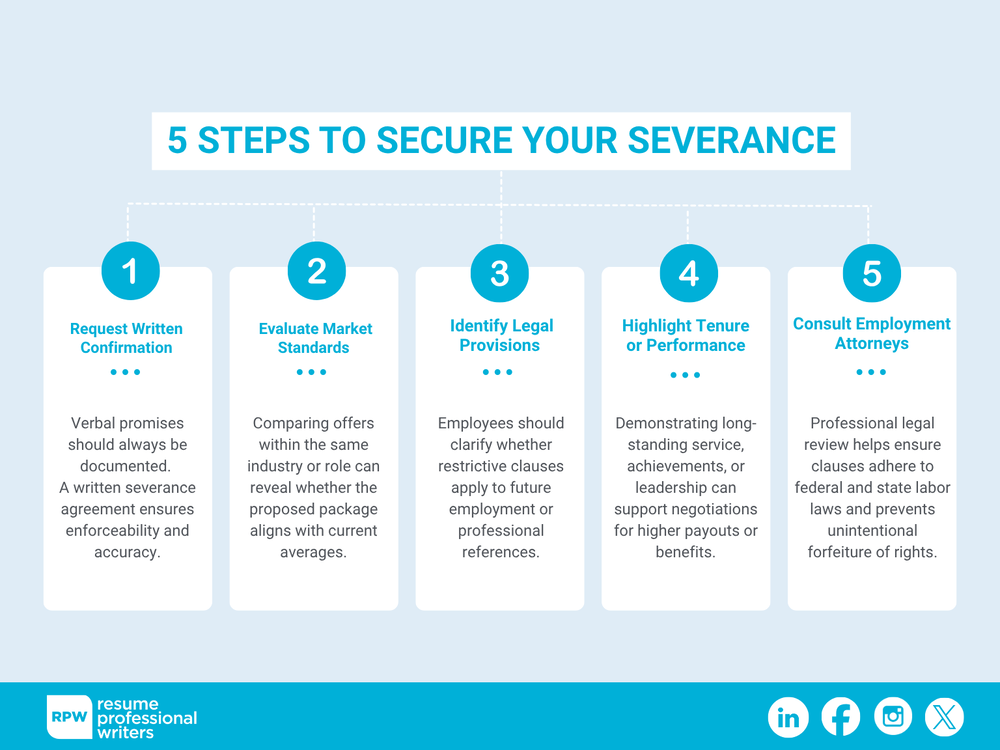
Employers typically prefer to finalize severance within 21 days of termination notice, per standard practice encouraged by U.S. labor compliance procedures. However, signing immediately is never mandatory. Employees have legitimate grounds to request more time for review or negotiation, especially in cases involving long service or executive contracts.
Executive and Specialized Severance Agreements
Executives and specialized professionals often receive elevated severance structures due to the strategic value of their roles. These contracts go beyond the average severance package, typically including longer pay durations, extended non-compete protections, and accelerated equity vesting clauses. Chief officers, financial controllers, or senior engineers working with proprietary technology are typically covered under such arrangements.
A corporate vice president, for example, may secure:
- 6–12 months of salary continuation.
- Extended healthcare coverage lasting up to a year.
- Stock option exercise extensions and accelerated vesting schedules.
- Confidentiality or non‑disparagement clauses to safeguard company’s reputation post-separation.
When reviewing executive severance contracts, professionals should focus on:
- Retention of benefits and premium coverage timelines
- Stock vesting dates and equity acceleration clauses
- Reference to “good reason” departures that allow voluntary resignation with severance if the company reduces pay, demotes the role, or alters responsibilities
For executives, severance is not just about financial security—it’s about protecting long‑term career value, reputation, and compliance during transition. Understanding how these specialized contracts differ from the average severance package empowers leaders to negotiate strategically and safeguard their professional brand.
Beyond financial terms, executives must also consider career branding. Updating LinkedIn profiles or personal branding during this period often requires careful compliance review with executive transition clauses.
State and Federal Considerations for Severance in the U.S.
Severance pay in the United States is shaped by a mix of federal guidelines and state‑level protections. While the average severance package is not federally mandated, several labor laws influence how employers must handle workforce reductions.

• Federal WARN Act
The Worker Adjustment and Retraining Notification (WARN) Act requires employers with 100 or more employees to provide 60 days’ notice in case of mass layoffs. Failure to comply may require back pay or benefits equivalent to that period, effectively functioning as severance compensation.
• State Regulations
State laws may impose additional protections. For example, California’s labor regulations emphasize timely payment upon termination, while New York employers must comply with notice obligations under the state’s mini-WARN Act. Public sector employees also follow different severance structures governed by civil service rules or collective bargaining agreements.
• Federal Employees and Military Transitions
Federal employees and military-to-civilian workers often receive distinct separation pay scales determined by Office of Personnel Management (OPM) guidance. Severance for federal roles typically depends on length of continuous service and highest rate of basic pay, subject to statutory caps.
These overlapping rules mean severance can look very different depending on jurisdiction and employment type. For professionals navigating career transitions, knowing how state and federal frameworks interact with the average severance package isn’t just about compliance—it’s about turning legal awareness into financial confidence and strategic leverage.
How Severance Packages Support Career Transitions
When structured fairly, severance packages ease financial strain and provide momentum for professional reinvention. Beyond the average severance package, many mid‑to‑large employers now include outplacement or job coaching services, offering practical tools for resume writing, interview training, and networking outreach. Partnering with external firms ensures departing employees maintain career progress rather than stall in transition.
Key career‑support elements often include:
- Resume optimization services tailored to modern hiring systems.
- Professional networking preparation to strengthen industry connections.
- Interview simulations and coaching to build confidence and shorten job searches.
- Placement outreach that connects candidates with new opportunities faster.
These resources not only enhance employer branding but also empower workers to reenter the job market with confidence. Employees who leverage severance‑linked career services often secure comparable or better roles within three to six months.
Severance should be seen not just as compensation for job loss, but as a launchpad for career growth. By combining financial security with access to job search tools, the average severance package becomes more than a payout—it transforms into a bridge toward reinvention and long‑term opportunity

Secure Stability After a Layoff
Strategic planning after receiving a severance package helps maintain financial stability and career direction. Job seekers should analyze their monthly expenses, health benefits, and future job prospects before making major financial decisions. Transitioning the severance payout into short-term saving accounts ensures liquidity during the job search phase, while revising resumes, portfolios, and professional branding maximizes re-entry potential.
A well-prepared career document remains essential for regaining footing after separation. Many professionals expedite their comeback with professional resume writers who tailor resumes to match updated hiring trends, quantify achievements, and maintain compliance with current applicant tracking systems. Transforming severance into opportunity requires methodical effort, professional storytelling, and readiness to leverage new career paths.
Frequently Asked Questions
How is severance pay calculated?
Employers typically calculate severance based on tenure, offering one to two weeks of pay per year of completed service. Executives or contract employees may receive higher amounts, often expressed as months of salary. The total amount may also consider unused vacation or performance bonuses accrued prior to separation.
Is severance pay required by U.S. law?
Federal law does not require employers to provide severance. However, if it is guaranteed by a written employment contract, company policy, or collective bargaining agreement, it becomes legally enforceable. Some states have advanced notification laws under the WARN Act for mass layoffs.
Are severance payments taxable?
Yes. The IRS treats severance pay as regular taxable income, subject to federal income tax, Social Security, and Medicare withholdings. Employees should review withholding rates to prevent an unexpected tax burden at year-end.
Can employees negotiate their severance package?
Yes, in most cases. Employers often expect some negotiation. Employees with extended tenure or specialized skills stand stronger when requesting higher pay duration, extended healthcare, or the removal of restrictive clauses such as non-compete terms.
What should workers do after receiving severance?
Professionals should review all terms in writing, confirm payout dates, and secure continued benefit details. Updating resumes, engaging job search preparation, and organizing finances should follow immediately to ensure a smooth transition to the next opportunity.