

Effective communication goes beyond wisely and carefully choosing your words. It also encompasses comprehensively grasping and embracing various communication styles. By understanding the characteristics and functions of a communication style, we could promote a positive workplace culture where everyone in a team motivates each other for common goals and is productive in adapting to the team’s needs.

What is Communication Style?
Communication styles are the ways people express, receive, and interpret messages in different situations. These styles influence how individuals interact in the workplace, build relationships, and handle conflict.
The four main communication styles: assertive, passive, aggressive, and passive-aggressive form the foundation of most modern communication frameworks. Understanding these styles allows professionals to improve collaboration, avoid misunderstandings, and succeed in their careers.
Whether you’re preparing for a job interview, working in a team, or improving your leadership skills, knowing how communication styles work can give you a clear advantage.
Why are Communication Styles Important?
People who communicate in different ways are more likely to encounter conflict or miscommunication. It can be easier to engage with people who have diverse communication styles when we are aware of their traits and tendencies.
Additionally, factors such as cultures and contexts may have different expectations for communicative styles. That’s why being aware various communication styles — and being respectful of these — can help to facilitate more effective communication.
The 4 Main Communication Styles (Core Framework)
The four communication styles represent the most widely recognized framework in psychology and workplace communication. Each style reflects how individuals express needs, respond to others, and manage conflict.
1. Assertive Communication
Assertive communication is a balanced and effective style where individuals express their thoughts clearly while respecting others.
Assertive communicators are confident without being aggressive. They value both their own needs and the needs of others, making this style ideal for professional environments.
Examples:
- “I understand your idea, but I’d like to suggest an alternative.”
- “Can we revisit this timeline to ensure quality?”
Key Traits:
- Direct and respectful
- Emotionally aware
- Solution-oriented
Advantages:
- Builds trust and collaboration
- Encourages open communication
- Improves workplace relationships
Limitations:
- Requires emotional intelligence
- May feel uncomfortable for passive individuals
2. Passive Communication
Passive communication avoids conflict by suppressing personal opinions and needs.
Passive communicators often prioritize others at their own expense, which can lead to long-term dissatisfaction.
Examples:
- “Whatever you think is best.”
- “I’m okay with anything.”
Key Traits:
- Avoids confrontation
- Indirect communication
- Low self-expression
Advantages:
- Maintains short-term harmony
- Reduces immediate conflict
Limitations:
- Leads to frustration and burnout
- Reduces visibility and influence
3. Aggressive Communication
Aggressive communication involves expressing ideas forcefully, often at the expense of others.
This style prioritizes control and dominance, which can damage relationships in professional settings.
Examples:
- “This is wrong. Do it my way.”
- “You clearly don’t understand.”
Key Traits:
- Dominating tone
- Low empathy
- High control
Advantages:
- Fast decision-making
- Clear direction
Limitations:
- Damages trust
- Creates fear and resistance
4. Passive-Aggressive Communication
Passive-aggressive communication expresses negative emotions indirectly rather than openly.
This style often appears polite on the surface but conveys resistance through tone, sarcasm, or behavior.
Examples:
- “Sure, I’ll do it… like I always do everything.”
- Agreeing verbally but not following through
Key Traits:
- Indirect expression
- Hidden frustration
- Inconsistent behavior
Advantages:
- Avoids direct conflict
Limitations:
- Causes confusion
- Damages team trust
Communication Styles Comparison
| Style | Traits | Strengths | Weaknesses |
|---|---|---|---|
| Assertive | Direct, respectful | Builds trust | Requires confidence |
| Passive | Avoids conflict | Maintains peace | Leads to resentment |
| Aggressive | Dominating | Fast results | Harms relationships |
| Passive-aggressive | Indirect | Avoids confrontation | Creates confusion |
When to Use Each Communication Style
Each communication style has situational value, but assertiveness remains the most effective overall.
- Assertive: Best for leadership, teamwork, and decision-making
- Passive: Suitable for low-stakes situations
- Aggressive: Occasionally useful in urgent scenarios
- Passive-aggressive: Generally ineffective

Additional Communication Styles in Professional Settings
Beyond the four core styles, your original article highlights additional workplace communication types . These help explain how people operate in real environments.
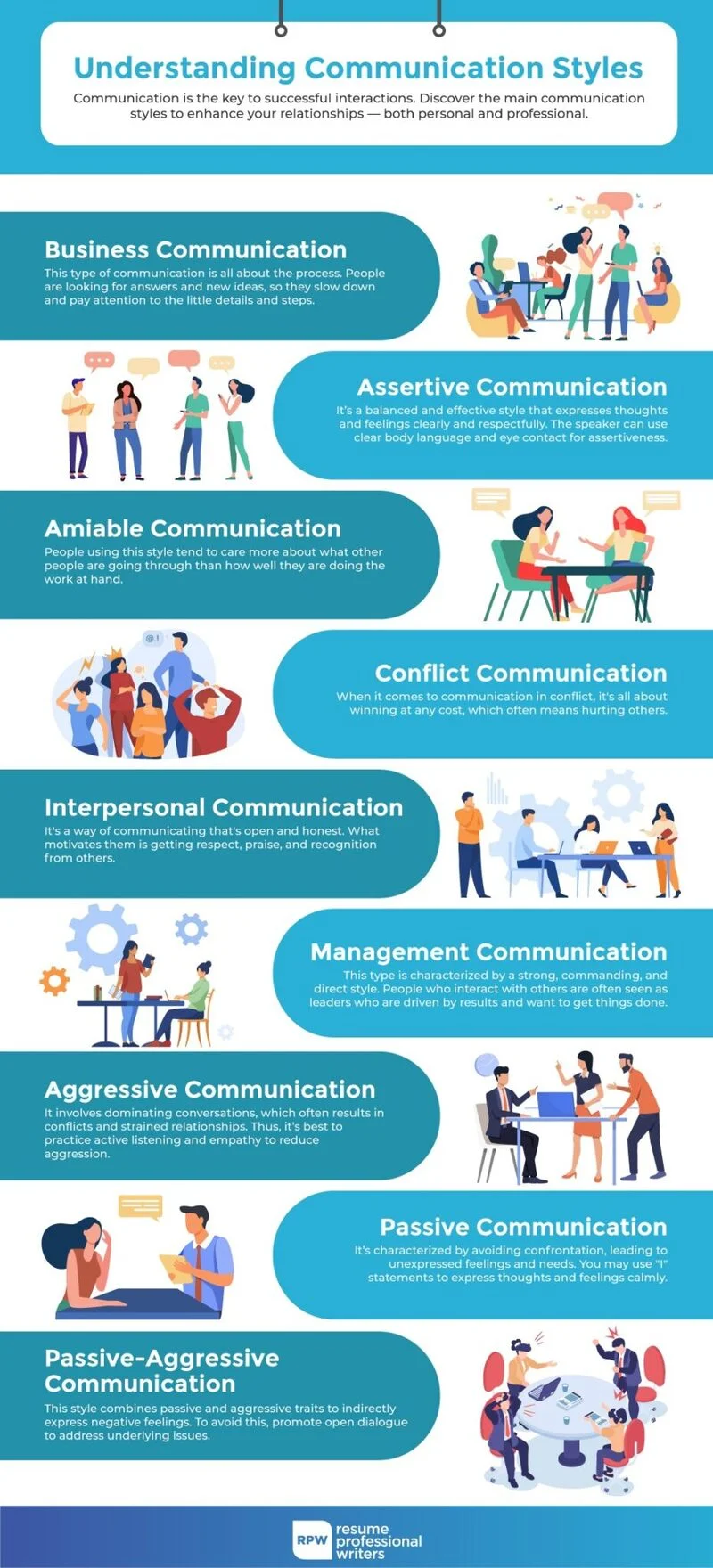
Business Communication Style
This style is structured and process-driven, focusing on details and accuracy.
Professionals using this style prioritize data, workflows, and systematic thinking.
Example:
A project manager reviews a report step by step, asking for detailed metrics and ensuring every process follows company guidelines before approving the final output.
Amiable Communication Style
Amiable communicators focus on relationships and emotional harmony.
They value cooperation and tend to avoid conflict, making them strong team players.
Example:
A team leader checks in with team members individually to ensure everyone feels supported before discussing project deadlines.
Conflict Communication Style
This style is centered on winning arguments, often at the cost of relationships.
While it may drive results in competitive environments, it can create tension.
Example:
During a meeting, a team member insists their strategy is correct and dismisses others’ input without discussion.
Interpersonal Communication Style
This style emphasizes connection, encouragement, and motivation.
It is highly effective in collaborative and supportive environments.
Example:
A supervisor praises an employee’s progress, offers constructive feedback, and motivates them to improve further.
Management Communication Style
Management communicators are direct, structured, and results-oriented.
They often lead teams and prioritize action over discussion.
Example:
A department head outlines clear goals, assigns tasks with deadlines, and expects regular progress updates from the team.
To easily access these information, feel free to download the infographic below:
Communication Styles in the Workplace
Communication styles directly affect productivity, teamwork, and leadership. Your original framework identifies four workplace communication types :
Analytical Communicator
Analytical communicators rely on data and logic. They focus on facts rather than opinions.
Functional Communicator
Functional communicators prefer structure and step-by-step processes.
Intuitive Communicator
Intuitive communicators focus on big-picture ideas and outcomes.
Personal Communicator
Personal communicators prioritize relationships and emotional connection.
Common Communication Mistakes to Avoid
Many professionals struggle with communication due to avoidable mistakes.
1. Avoiding difficult conversations
This leads to passive communication and unresolved issues.
2. Over-dominating discussions
Aggressive communication reduces collaboration.
3. Being unclear or indirect
Passive-aggressive communication creates confusion.
4. Ignoring emotional context
Effective communication requires emotional awareness.
How to Improve Your Communication Style
Improving communication requires awareness and practice.
Step 1: Identify your default style
Observe how you respond in conflict or discussions.
Step 2: Practice assertiveness
Focus on expressing ideas clearly and respectfully.
Step 3: Develop active listening
Listen to understand, not just respond.
Step 4: Manage emotions
Control tone, body language, and reactions.
Communication Skills for Resume and Career Success
Communication skills are among the most in-demand abilities in the workplace.
Examples of communication skills:
- Verbal communication
- Written communication
- Active listening
- Presentation skills
Resume examples:
- “Collaborated effectively with cross-functional teams”
- “Delivered clear presentations to stakeholders”
- “Demonstrated strong interpersonal communication skills”
Frequently Asked Questions
1. What are the 4 communication styles?
The four main communication styles are assertive, passive, aggressive, and passive-aggressive.
2. What is the best communication style?
Assertive communication is the most effective in professional settings.
3. Why are communication styles important?
They affect relationships, teamwork, and career success.
4. How do I improve communication skills?
Practice clarity, active listening, and emotional awareness.
5. What are examples of communication styles?
Examples of communication styles include assertive communication, passive communication, aggressive communication, and passive-aggressive communication. Each style reflects how individuals express thoughts and respond to others.
6. What is the most effective communication style?
Assertive communication is the most effective style because it balances confidence with respect, allowing individuals to express ideas clearly without disregarding others.
7. How do communication styles affect teamwork?
Communication styles affect teamwork by influencing how people share ideas, resolve conflicts, and collaborate. Assertive communication improves teamwork, while passive or aggressive styles can create misunderstandings.

Level Up Your Interview Responses with Professional Resume Writers
Each individual certainly has a unique communication style, so it is essential to accurately identify and understand. When you successfully transition into each style, you will be better equipped to work professionally.
All this begs the question: how do we execute the right communication skills during our scheduled job interview? You may be a job seeker who wants to advance their career. Whatever the case, effective communication skills and styles are needed. Resume Professional Writers’ career development specialists can elevate your interview responses through their industry expertise and their top-notch opening statements in job interviews. With this job search tool, you can grab the interviewer’s attention from the get-go! Inquire now.