


Career growth often collides with organizational loyalty, leaving professionals—whether fresh graduates or seasoned specialists—wondering how to move forward. Internal mobility can feel like a maze, and one of the most misunderstood opportunities is the secondment.
For ambitious job seekers, secondments aren’t just temporary assignments—they’re strategic career accelerators. By understanding the secondment meaning, professionals can expand skills, build powerful networks, and safeguard long‑term job security.
Career strategists emphasize secondments as structured transitions that fuel development. This guide breaks down the secondment meaning, its impact on organizations, real‑world examples, and actionable strategies to leverage secondments for lasting career progression.

Understanding the Secondment Meaning
In human resources and corporate contexts, the meaning of secondment boils down to this: a temporary transfer of an employee to another department, organization, or even country, while keeping their original employer’s contract intact.
Think of it as a career detour that builds skills, networks, and organizational value without burning bridges. Key features of secondments include:
- Temporary & Reversible: Unlike permanent transfers, secondments end with a return to the home employer.
- Formal Agreements: Secondments typically take place under formal agreements, wherein duration, pay, responsibilities, and reporting lines are clearly defined.
- Dual Benefit: Employees gain fresh expertise and accrue tenure with their home employer, while organizations fill talent gaps and foster collaboration.
- Flexible Duration: Can last months or several years depending on project complexity and organizational goals.
Secondments serve distinct strategic purposes but share a focus on workforce development and knowledge sharing. They can be:
- Internal: Within the same company—ideal for cross‑departmental skill building.
- External: With partner firms, clients, or government agencies—perfect for knowledge sharing and industry alignment.
For example, a federal agency might second an IT specialist to another department to implement cybersecurity policy, while a private-sector healthcare institution could send a nurse manager to a partner clinic to standardize patient care protocols. These arrangements benefit not only the employee but also enhance cross-organizational collaboration and capacity building.
Types of Secondments
Secondments differ based on structure, objective, and scope. Understanding these types allows professionals and HR teams to align placements with career development goals.
• Internal Secondment
The employee temporarily joins another department or team within the same organization. This arrangement is common in corporations encouraging internal mobility and upskilling.
• External Secondment
The employee is temporarily placed in a partner company, supplier, or client organization. It strengthens strategic relationships and exposes employees to different business models or operational systems.
• International Secondment
This involves relocation to another country or subsidiary to support global initiatives. It often requires cultural integration and logistical planning but significantly enhances global leadership capabilities.
• Project-Based Secondment
Employees join cross-functional or interorganizational projects for predefined timelines. Common in sectors like construction, engineering, and technology.
Each secondment type supports different goals—from improving cross-departmental efficiency to cultivating international management readiness. Selecting the appropriate type depends on organizational needs and individual career aspirations.
Key Benefits of Secondment for Employees
Secondments function as career accelerators by exposing employees to new environments and challenges while minimizing employment risk. They serve as bridges between roles and long-term development milestones.
1. Skill Enhancement
Working in a new role expands technical knowledge, leadership abilities, and adaptability. Employees gain hands-on experience beyond their standard job functions.
2. Career Visibility
Seconded employees often gain executive visibility and recognition, positioning themselves for promotions or strategic roles upon return.
3. Networking Opportunities
Collaborating with new teams and leaders can foster relationships across departments or organizations that may prove valuable for future projects.
4. Cross-Cultural Competence
In multinational companies, international secondments develop global awareness and cultural intelligence—a top credential for executive roles.
5. Job Security with Exploration
Unlike resigning for a new opportunity, secondments enable professionals to explore new experiences while maintaining employment stability with their parent organization.
Data from the Association for Talent Development indicates that employees in structured learning-through-experience programs show up to 35% higher retention and promotion rates compared with peers in static roles. Secondments act as practical models of such experiential learning, translating into measurable performance gains for the organization.
Value of Secondment for Employers
Organizations use secondments strategically to strengthen workforce capability and improve collaboration across business units. When applied effectively, secondments boost organizational competitiveness and talent agility.
1. Improved Knowledge Transfer
Secondments help distribute specialized expertise across teams or divisions, preventing skills silos.
2. Enhanced Employee Engagement
Offering secondments demonstrates a company’s investment in professional growth, increasing engagement and retention.
3. Cost-Effective Staffing
Instead of outsourcing talent, organizations redeploy internal employees strategically to address temporary capability gaps.
4. Succession Planning Support
Through cross-functional experience, high-potential employees build leadership pipelines organically.
5. Cross-Sector Collaboration
External secondments with public or private partners foster innovation and shared outcomes aligned with corporate responsibility initiatives.
When employees return to their primary roles, they bring back valuable perspectives that often influence future policy, operations, and culture. Employers can likewise identify top performers suited for future leadership appointments through monitoring secondment outcomes.
Challenges and Considerations During Secondment

Despite their benefits, secondments involve complexities that require careful planning. Both employee and employer must address legal, logistical, and interpersonal aspects to ensure a successful outcome.
• Unclear Role Boundaries
Employees may struggle understanding reporting lines, workload balance, or authority limits during secondment.
• Compensation Differences
Salary alignment between home and host organization must be clearly defined to avoid inequality or tax complications, particularly for international assignments.
• Reintegration Issues
After returning, employees might face role displacement or cultural reintegration challenges if their original teams evolved in their absence.
• Legal Compliance
HR departments must verify that employment contracts, confidentiality terms, and non-compete clauses comply with state and federal labor laws.
• Performance Tracking
Clarity on metrics—such as project deliverables, mentoring responsibilities, and evaluation methods—reduces potential conflict.
Organizations typically use secondment agreements to formalize terms regarding responsibilities, reporting procedures, and expected learning outcomes. Proper legal drafting ensures accountability while protecting both parties. Transparent communication and performance management throughout the assignment further enhance employee satisfaction and host department productivity.
How Secondments Differ from Transfers and Temporary Assignments
Secondments can be misunderstood as lateral transfers or short-term assignments, yet each differs in structure and intention. While all involve movement, secondments uniquely prioritize development and mutual benefit for both organizations involved.
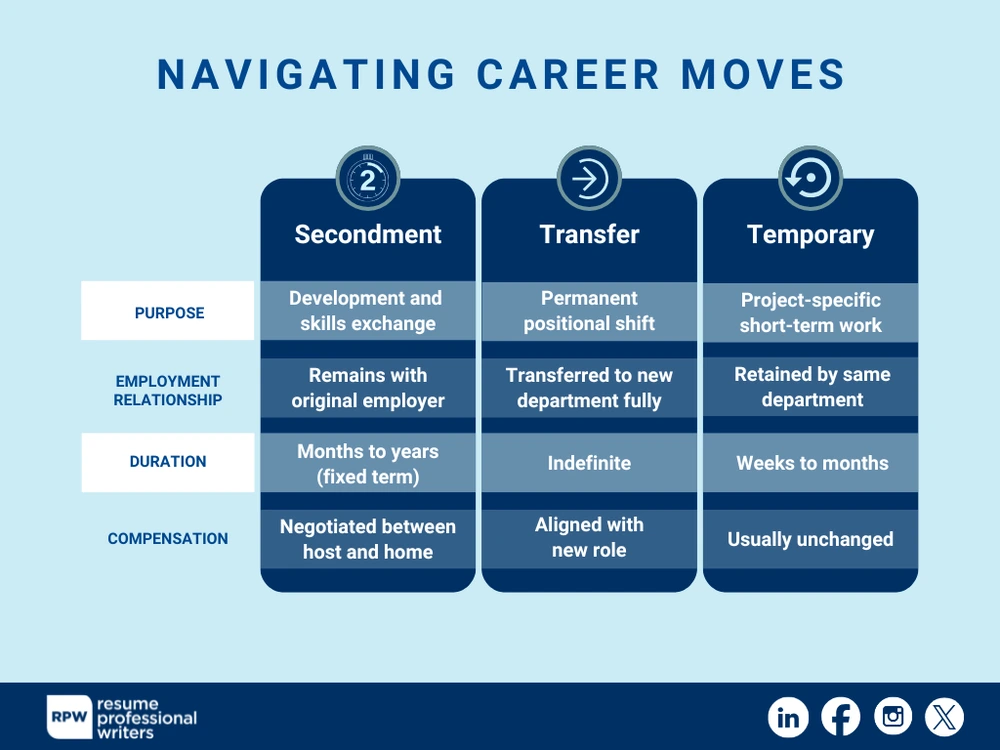
This comparison clarifies why many organizations classify secondments as strategic talent development tools rather than administrative movements. The focus lies on learning, exposure, and long-term business gain rather than immediate staffing logistics.
Legal and Contractual Aspects of Secondment
Establishing a secondment requires well-defined contractual terms. U.S. companies typically formalize this through written agreements specifying responsibilities, liability, intellectual property rights, and insurance coverage. Key elements often include:
• Duration and Termination Clauses
Clearly outline start and end dates, including conditions for early termination.
• Performance and Reporting
Assign direct supervisors and define measurement criteria.
• Confidentiality and IP Rights
Clarify data protection obligations, especially in industries reliant on proprietary information.
• Compensation Structure
Indicate payment responsibilities, including travel expenses and benefits preservation.
• Legal Jurisdiction
Define applicable laws to manage possible disputes.
Legal compliance demands coordination across departments—such as HR, payroll, and legal. For cross-border secondments, immigration considerations, visa sponsorships, and tax liabilities must also be evaluated. The consistency of benefits like health coverage and retirement contributions depends on state and federal labor protections under agencies such as the U.S. Department of Labor.
How Secondments Impact Career Development
For professionals pursuing advancement, secondments serve as career accelerators. They provide real-world proof of versatility, problem-solving capability, and cultural adaptability—attributes employers highly value.
Many senior executives, public-sector leaders, and global managers have built their reputations through early-career secondments. Professionals use secondments strategically to achieve several outcomes:
• Bridging Capability Gaps
Access to cross-disciplinary experience enhances employability for roles that demand hybrid skill sets.
• Accelerating Leadership Growth
Exposure to diverse functions builds confidence and decision-making skills relevant to executive positions.
• Strengthening Personal Brand
Demonstrated adaptability positions professionals as high-value contributors within competitive industries.
• Enhancing Resume Impact
Highlighting measurable outcomes from a secondment can distinguish candidates from peers in recruitment processes.
When represented thoughtfully on resumes, secondment experience signals initiative and agility. Hiring managers interpret such entries as evidence of resilience and cross-functional collaboration. Candidates can specify dates, host organizations, and quantitative achievements to emphasize value creation and leadership readiness.
Case Study: Professional Growth Through Secondment
Before: A project analyst at a financial institution sought promotion but lacked direct exposure to operations management.
Strategy: The organization arranged a twelve-month internal secondment to a risk management department. During this time, the analyst collaborated cross-functionally, leading policy reviews and introducing automation processes that reduced operational redundancies by 20%.
After: Upon returning, the employee was promoted to operations manager. The secondment served as measurable proof of leadership potential, demonstrating how temporary transitions translate into permanent career advancement without requiring external job changes.
Best Practices for a Successful Secondment

1. Set Clear Objectives
Both employer and employee should define what success looks like—new skills, project completion, or leadership exposure.
2. Establish Formal Agreements
Written documentation prevents miscommunication regarding pay, duration, and reporting.
3. Maintain Communication
Regular check-ins between home and host supervisors sustain alignment and employee satisfaction.
4. Evaluate Progress
Periodic reviews track learning outcomes and performance, ensuring both parties benefit.
5. Plan Reintegration
Post-secondment transitions must include career evaluations and role adjustments to leverage acquired skills effectively.
Organizations implementing these practices not only mitigate operational risk but also create environments that celebrate professional growth and loyalty. Clear planning transforms secondments from short-term arrangements into enduring contributions toward organizational competitiveness.
Leveraging Secondment Experience on a Resume
When presenting secondment experience, concisely outline the project’s scope, duration, and deliverables. Mention specific accomplishments, such as policy implementation, cost reductions, or improved interdepartmental cooperation.
Professional resume writers often recommend listing secondments as distinct entries or under experience sections with descriptors like “Seconded to [department/organization] to accomplish [objective].”
For example:
Operations Analyst — Seconded to Compliance Division (12 months)

•   Led risk management automation project, reducing manual processing errors by 30% and expediting audit turnaround times. Collaborated with cross-functional teams to align compliance systems with corporate governance policies.
This clarity demonstrates accountability and achievement.
Showcase Secondment Outcomes with Resume Experts
Professionals preparing executive or federal applications can strengthen visibility by quantifying secondment outcomes. Those aiming for advancement often collaborate with professional resume writers to ensure each secondment’s value is translated into powerful, results-driven statements consistent with ATS optimization standards.
Frequently Asked Questions
What does secondment mean in employment terms?
Secondment in employment refers to a temporary transfer of an employee to another department, organization, or subsidiary while maintaining their primary employment with the original company. It allows both the employer and employee to gain from shared experience and enhanced capability.
How long does a secondment usually last?
The duration of a secondment varies based on organizational needs but usually ranges between six months and two years. Some international or project-based secondments may extend further depending on complexity and business continuity requirements.
Is a secondment considered a promotion?
Not necessarily. A secondment is primarily a developmental opportunity rather than a promotion. However, successful completion often enhances an employee’s eligibility for future promotion or permanent leadership roles due to expanded skills and visibility.
Can an employee refuse a secondment?
Yes. While organizations may propose secondments for development purposes, employees are not legally obligated to accept unless their employment contract stipulates mobility requirements. Open communication helps reconcile employer objectives with individual career preferences.
How should secondment experience be listed on a resume?
Professionals should clearly identify secondments under the Experience section with timeframes, host organization, and quantifiable results. Using bullet points to highlight measurable achievements helps demonstrate the tangible benefits gained from the secondment.