


Resumes often look alike, but critical thinking is what makes candidates stand out. Employers want proof of how applicants think through complex challenges, evaluate evidence, weigh options, and solve problems under pressure.
Demonstrating critical thinking with examples in interviews or resumes signals authenticity and readiness for leadership, turning a qualified applicant into a standout contender. Whether it’s spotting financial discrepancies, reallocating marketing budgets, or managing healthcare staffing, showing thought processes alongside results highlights judgment and adaptability—qualities recruiters value the most.
This comprehensive guide helps job seekers understand what critical thinking entails, why it matters in professional and personal contexts, and how to apply it using detailed, real-world examples. The discussion covers the components, benefits, and ways to strengthen critical thinking skills through continuous development, workplace application, and thoughtful decision-making.

Understanding Critical Thinking
Critical thinking refers to the active process of analyzing, evaluating, and synthesizing information to guide accurate and logical decision-making. It involves questioning assumptions, identifying biases, and applying structured reasoning to reach sound conclusions. Unlike routine thinking that relies on intuition or habit, critical thinking requires deliberate engagement with facts, context, and implications before forming judgments or solutions.
The Foundation for Critical Thinking defines it as disciplined reflection that improves the quality of one’s judgments, aligning decisions with both logic and ethics. In professional settings, this skill distinguishes individuals who can navigate ambiguity, solve problems innovatively, and offer insights that go beyond surface-level analysis.
Cognitive Components of Critical Thinking
Critical thinking combines several cognitive components, with each contributing to an individual’s ability to manage complexity and uncertainty in the workplace.
- Interpretation: Allows comprehension of meaning.
- Analysis: Dissects relationships among ideas.
- Inference: Applies logic to draw conclusions.
- Explanation: Clarifies reasoning and outcomes.
- Evaluation: Assesses credibility and relevance.
- Self-regulation: Ensures objectivity when re-evaluating one’s views based on new evidence.
Whether in business strategy, patient care, or engineering design, critical thinking guides professionals to address challenges comprehensively.
Why It Matters in the Modern Workplace
According to the World Economic Forum’s Future of Jobs Report, critical thinking consistently ranks among the top five skills employers seek across industries.
- Data Analysis and Strategy: Modern organizations rely on employees capable of analyzing complex data, anticipating outcomes, and aligning solutions with strategic objectives.
- Adaptability: Job seekers who display critical thinking demonstrate readiness for dynamic, technology-driven environments that demand adaptability and sound judgment—qualities essential for thriving in fast-paced, technology-driven workplaces.
- Leadership and Collaboration: Employers particularly value this competency in leadership, project management, and innovation-driven roles because it directly influences productivity, decision quality, and collaboration outcomes.
- Risk Reduction and Innovation: Critical thinkers reduce risks, foster innovation, and uphold ethical standards—deliverables every organization depends on for long-term success.
Core Elements of Critical Thinking
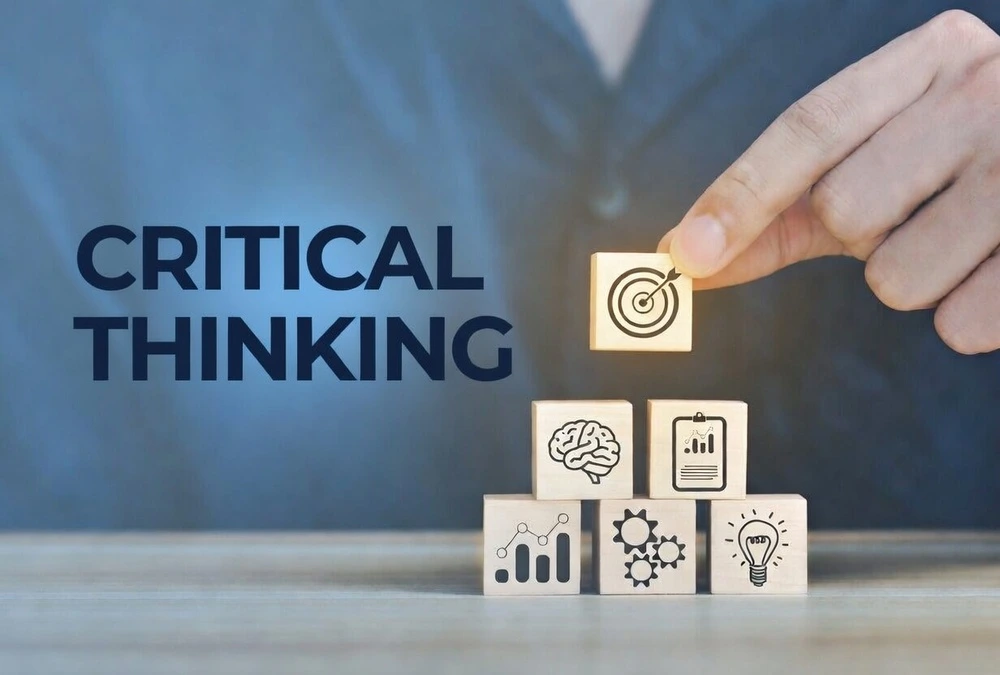
Critical thinking unfolds through interconnected cognitive steps that transform perception into judgment. These elements ensure individuals assess issues systematically before acting. Developing familiarity with each empowers professionals to apply reasoning consistently across varying scenarios, from analyzing policies to designing strategies.
1. Observation
Recognizing facts or changes in environments and identifying what merits further attention. Awareness lays the groundwork for effective evaluation.
2. Analysis
Examining patterns, relationships, and implications from multiple perspectives. Analytical thinking distinguishes causation from correlation and detects underlying factors driving outcomes.
3. Inference
Drawing logical conclusions from existing data while remaining open to alternative explanations.
4. Evaluation
Assessing credibility, accuracy, and relevance of information sources. This phase validates reasoning before application.
5. Explanation
Communicating findings coherently to justify conclusions. Effective articulation converts thought into actionable insight.
6. Reflection
Reviewing the reasoning process to identify personal biases or procedural flaws, ensuring cognitive growth with each decision.
Mastering these stages turns reactive problem solvers into strategic decision-makers. Team environments benefit as members adopt structured reasoning, improving collective outcomes across departments. Organizations that encourage reflective discussion often achieve higher retention and engagement rates, driven by employees who feel valued for intellectual contributions.
Critical Thinking Examples by Profession
Critical thinking manifests differently depending on job demands. While engineers may analyze failures in system designs, nurses might assess symptoms to determine appropriate care responses. The following examples illustrate how varied professionals apply critical thinking in real-world scenarios.
Healthcare
A registered nurse reviews patient vitals showing inconsistent results. Instead of assuming equipment malfunction, the nurse cross-references medication logs, identifies a dosage timing issue, and coordinates with physicians to adjust scheduling, preventing potential complications.
Information Technology
An IT analyst investigates recurring system downtime. By analyzing server traffic patterns, the analyst discovers bottlenecks correlated to specific third-party integrations and proposes optimized protocols reducing downtime by 40%.
Finance
An investment advisor evaluates conflicting economic forecasts. Through independent trend analysis, the advisor recommends diversified portfolio restructuring, protecting clients from sector volatility.
Education
A teacher observes lower comprehension rates in online learning modules. By comparing engagement metrics and student feedback, the educator identifies ineffective module sequencing and revises content, improving class participation rates.
Manufacturing
A process engineer notes inefficiencies in assembly line output. Analyzing sensor data reveals a mis-calibrated machine that increased waste. Realignment restores productivity across shifts.
These professional applications highlight that critical thinking connects observation with improvement. Job seekers who use similar reasoning in resumes or interviews—by framing achievements around problem identification and resolution—demonstrate value in measurable ways.
How to Develop and Demonstrate Critical Thinking Skills
Strengthening critical thinking requires deliberate practice. Professionals can cultivate it through education, workplace learning, and mindful reflection. The key lies in building awareness of reasoning habits and applying structured evaluation methods daily.
1. Engage in Reflective Journaling
Keeping a log of decisions and outcomes enhances awareness of biases and cognitive patterns.
2. Ask Open-Ended Questions
Queries like “What evidence supports this assumption?” or “What are the possible alternatives?” invite deeper analysis.
3. Seek Diverse Perspectives
Interacting with colleagues from different disciplines exposes professionals to unconventional ideas that broaden reasoning capacity.
4. Evaluate Evidence Objectively
Comparing multiple credible data sources before forming judgments strengthens argument integrity.
5. Apply the Scientific Method
Formulate hypotheses, test alternatives, and analyze results before concluding—an approach applicable far beyond research fields.
6. Participate in Team Problem-Solving Exercises
Collaborative tasks requiring justification of ideas nurture analytical and interpersonal reasoning simultaneously.
Critical Thinking in Leadership and Decision-Making
Leaders who think critically ensure organizational integrity, fiscal responsibility, and ethical direction. They navigate ambiguity effectively by assessing information validity and anticipating potential consequences of decisions. This minimizes costly missteps and amplifies employee trust in leadership judgment.
- Business Strategy: An executive facing declining market share applies critical thinking by analyzing data trends, identifying root causes such as outdated branding, and implementing new strategies aligned with customer insight.
- Public Administration: Federal agency leaders rely on this skill to balance compliance, efficiency, and fairness in policy decisions, ensuring equitable service delivery.
Modern decision-making increasingly involves data analytics, AI ethics, and sustainability considerations. Critical thinking gives leaders the intellectual flexibility to interpret large-scale information responsibly, aligning organizational goals with both profitability and social responsibility. When embedded in company culture, it drives innovation and resilience.
Everyday Applications: Critical Thinking Beyond the Workplace
Critical thinking isn’t limited to boardrooms or policy debates—it shapes everyday choices and strengthens personal decision-making. Here’s how it shows up beyond the workplace:
- Media and Information Literacy: Although it plays a pivotal professional role, critical thinking also enhances personal life decisions. It helps individuals interpret media accurately, evaluate online content, and guard against misinformation. Whether assessing healthcare treatments or investment advice, the same analytical scrutiny expected in corporate settings applies to personal decisions.
- Financial and Health Choices: Applying structured reasoning to budgeting, savings, or health-related decisions ensures wiser outcomes. By questioning assumptions and weighing evidence, individuals make informed health or community choices that protect both personal stability and long-term well-being.
- Lifelong Learning and Adaptability: Developing a critical mindset encourages continuous learning and adaptability. In fast-moving digital economies where misinformation spreads quickly, strong critical thinkers act as discerning consumers and responsible citizens. Their ability to evaluate sources objectively safeguards both personal and societal resilience.
- Family and Education: Families, educators, and mentors who model critical evaluation foster environments where curiosity thrives. Teaching younger generations to assess claims and evidence lays the foundation for creative innovation, civic responsibility, and career readiness in the knowledge economy.
Building a Career Advantage through Critical Thinking
Employers consistently reward analytical competence. The National Association of Colleges and Employers identifies critical thinking among the competencies most closely linked to high-performing teams and promotable employees.
Job seekers who integrate critical thinking examples into resumes—through metrics, outcomes, and structured reasoning—signal dependability and innovation capability. Instead of vague claims, “Improved workflow efficiency,” candidates can strengthen their applications with measurable phrasing to demonstrate action driven by critical evaluation and measurable impact, appealing directly to hiring managers seeking problem solvers. For example:
“Analyzed departmental bottlenecks, implemented software automation, and reduced turnaround time by 25%.”
Organizations across industries—healthcare, finance, technology, and education—benefit when employees question assumptions rather than accept convention. Continuous refinement of critical thinking thereby leads to more informed perspectives, operational improvements, and confident career progression. It transforms professionals from task executors into strategic contributors, shaping institutional growth.
Expert Tips
To showcase critical thinking with examples throughout the job application process, candidates can strategically highlight their thought process and decision-making skills:
✅ Resume: Use bullet points that emphasize evidence-based achievements, showing how data or analysis guided successful outcomes.
✅ Cover Letter: Demonstrate structured reasoning when explaining career transitions or setting future goals, making the narrative logical and persuasive.
✅ Interview: Situational questions such as “Describe a time you solved a complex problem” provide the perfect opportunity to articulate your approach, like how you gathered evidence, weighed options, and delivered impact
Driving Long-Term Success Through Reflection
Developing critical thinking is not a finite achievement but an evolving discipline. It deepens with exposure to new experiences, challenges, and interdisciplinary collaboration.
Professionals who regularly reassess assumptions and outcomes maintain intellectual agility—an attribute critical in a future defined by automation and complexity. To sustain this growth, job seekers should:
- Pursue environments that value inquiry and feedback.
- Participate in professional groups.
- Attend workshops.
- Read across diverse sources to strengthen analytical synthesis.
Over time, this continuous refinement fosters not only professional competence but also personal confidence in navigating uncertainty.
Propel Career Growth with a Resume That Highlights Critical Thinking
Standing out in competitive job markets ultimately depends not only on technical credentials but on demonstrating thoughtful reasoning and analytical strength. Many professionals accelerate that distinction through achievement-focused resume writers who strategically highlight analytical accomplishments and problem-solving results that reflect authentic critical thinking capacity.
Frequently Asked Questions
What is the main difference between critical thinking and problem-solving?
Critical thinking is the process of analyzing and evaluating information to form reasoned judgments, while problem-solving applies those judgments to create actionable solutions. Essentially, critical thinking supports the reasoning behind decisions, whereas problem-solving implements those decisions in practice.
Why do employers value critical thinking skills?
Employers prize critical thinking because it leads to better decision-making, risk management, and strategic innovation. Analytical employees anticipate challenges, identify efficient solutions, and strengthen team performance—qualities linked directly to organizational success and adaptability.
How can job seekers demonstrate critical thinking on a resume?
Job seekers can showcase critical thinking by describing measurable achievements, such as process improvements, cost savings, or innovative strategies implemented after careful analysis. Action verbs like “evaluated,” “analyzed,” and “resolved” emphasize evidence-based reasoning and outcome-driven performance.
What are examples of critical thinking questions in interviews?
Common examples include “Describe a time you identified a potential issue before it became a problem” and “How did you approach a decision when information was limited?” Such questions evaluate reasoning patterns, self-awareness, and adaptability in uncertain conditions.
How can students and early-career professionals strengthen critical thinking?
They can deepen their skills through academic case studies, debate participation, research projects, and reflective writing. These activities encourage structured reasoning, evidence evaluation, and communication clarity—essential habits for professional readiness.