


The line between supervision and management isn’t always clear. Job seekers often weigh which role better fits their career goals, leadership style, and growth potential.
For some, the supervisor role is the first step into leadership. For others, it’s a deliberate choice—a position that balances responsibility with direct team connection. This ambiguity can complicate decisions about promotions, professional development, or even how to frame a resume.
This guide draws on career strategy, leadership development, and organizational insights to clarify how supervisory and managerial roles differ across U.S. industries. It helps job seekers, mid‑level employees, and aspiring leaders evaluate which path aligns with their ambitions.
The following analysis of supervisor vs manager roles explores distinctions in authority, decision‑making, compensation, and skills—revealing how each title shapes professional growth in 2026 and beyond.

Defining Supervisor vs Manager Roles
Understanding the difference between a supervisor and a manager begins with the organizational hierarchy.
The Supervisor Role
Supervisors serve as the immediate link between frontline employees and upper management. Their daily responsibilities focus on:
- Ensuring that tasks are performed efficiently.
- Providing employee guidance and training.
- Enforcing company policies consistently.
They typically work in settings where performance oversight is critical—manufacturing plants, healthcare units, retail stores, and service industries. Their leadership is operational, centered on monitoring performance and supporting employees to meet company standards.
The Manager Role
Managers, by contrast, hold broader strategic authority. They oversee not only people but also processes, budgets, and departmental objectives. Key responsibilities include:
- Aligning the organizational goals with actionable plans.
- Managing multiple supervisors or teams.
- Driving innovation and long-term success.
They play a vital role in decision-making and organization-wide coordination, often dealing with financial planning, staff optimization, and policy creation. They integrate leadership with vision, building frameworks that supervisors and employees implement on the ground.
Supervisor vs Manager: Side-by-Side Comparison
While both roles require strong leadership and communication skills, their focus diverges:
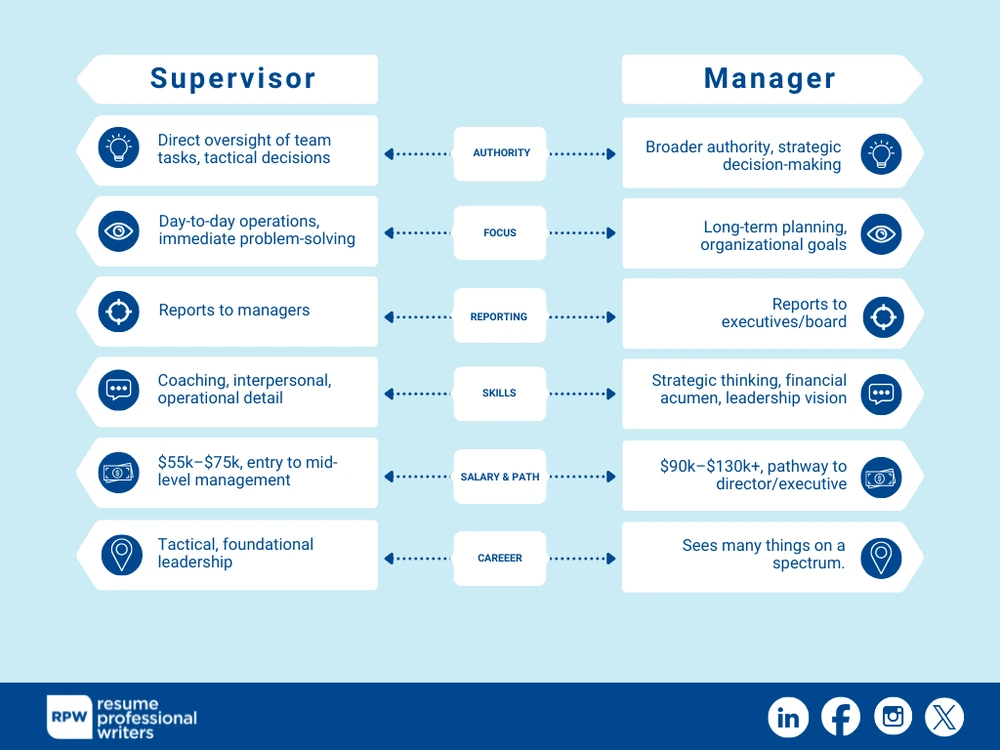
The Professional Leadership Institute highlights that supervisors primarily facilitate day-to-day operations, while managers concentrate on direction, performance goals, and organizational improvement. In most U.S. companies, a supervisor is considered an entry‑level management role, whereas a manager is mid‑level or higher authority, responsible for strategic leadership, people management, objectives, budgets, and coordination with executives.
Key Responsibilities of Supervisors and Managers
The distinction in duties often determines how these roles function within an organization.
Supervisor Responsibilities
Supervisors operate on the front line, ensuring employees stay productive and compliant with company standards. They conduct scheduling, delegate assignments, evaluate performance metrics, resolve immediate workplace conflicts, and serve as the first point of contact for operational issues.
Their role is tactical, focused on immediate workforce needs. Core duties include:
- Assign and monitor daily tasks.
- Coach and train new employees.
- Track attendance, productivity, and compliance.
- Handle minor disciplinary actions.
- Ensure workplace safety and quality standards.
Their leadership style must balance productivity with motivation, as their role directly influences employee engagement and morale.
Manager Responsibilities
Managers take on broader accountability, measured not by individual employee output but by overall departmental performance. Their day often involves setting long-term objectives, drafting budgets, forecasting hiring needs, and communicating with executives.
They often liaise across departments, bringing cohesiveness to multi-team initiatives. Key responsibilities include:
- Develop goals and performance metrics.
- Oversee budgets, staffing, and resource allocation.
- Lead organizational planning and strategic meetings.
- Coordinate multiple teams or departments.
- Ensure cross-functional collaboration aligns with business goals.
Unlike supervisors, who mainly execute direction, managers define the direction itself—translating corporate goals into achievable departmental outcomes.
Supervisor vs Manager: The Distinction
The difference lies in scale and scope:
- Supervisors drive employee performance at a tactical level.
- Managers determine operational strategies that sustain long-term organizational success.
Together, both roles are critical in ensuring that vision and execution meet seamlessly.

Required Skills and Competencies
While both supervisors and managers require leadership and communication, the depth and direction of these competencies vary.
Supervisors succeed through strong interpersonal and operational abilities. Their effectiveness depends on:
- Interpersonal communication: Motivating, guiding, and correcting employees effectively
- Tact and empathy: Handling conflicts and maintaining morale
- Observational skills: Detecting workflow challenges or behavioral issues early
- Time management: Balancing real‑time operational demands with reporting duties
- Attention to detail: Ensuring compliance with safety and quality standards
These skills allow supervisors to resolve issues quickly, keep teams productive, and maintain smooth day‑to‑day operations.
Managers rely on strategic and analytical thinking to drive organizational success. Their strengths include:
- Strategic planning: Interpreting performance data and forecasting departmental needs
- Analytical decision‑making: Designing initiatives that align with corporate growth
- Negotiation and financial acumen: Managing budgets, staffing, and resource allocation
- Innovation: Implementing new systems and fostering efficiency
- Organizational insight: Understanding behavior and culture to sustain long‑term success
Managers define direction, ensuring that departmental strategies support overall business objectives.
Supervisor vs Manager: Skills Comparison
| Essential Skill | Supervisor | Manager |
|---|---|---|
| Leadership Style | Direct and coaching-focused. | Strategic and visionary. |
| Communication | Interpersonal and empathetic. | Cross-departmental and persuasive. |
| Decision-Making | Operational, quick problem-solving. | Analytical and data-driven. |
| Technical Knowledge | Job-specific expertise for immediate processes. | Broad understanding of systems and metrics. |
| Focus Scope | Team-level performance. | Departmental or organizational success. |
Supervisors excel at day‑to‑day operations, guiding employees and ensuring compliance. Managers focus on direction, performance goals, and organizational improvement. In most U.S. companies, supervisors are entry‑level management, while managers are mid‑level or higher, responsible for strategic leadership across multiple teams or departments.
Salary Comparison and Career Outlook

Salary Differences
Compensation reflects the scope of responsibility in each role:
- Supervisors: According to the U.S. Bureau of Labor Statistics, first‑line supervisors in production, office support, and retail operations earn average annual wages between $55,000 and $75,000, depending on industry and experience.
- Managers: Median yearly salaries range from $90,000 to over $130,000, with the highest earning potential in fields such as information systems, financial operations, and healthcare administration.
Career Growth Path
Career progression often starts with supervisory experience, which builds the practical leadership and employee management skills. Advancement to managerial roles typically requires:
- Proven team performance improvements
- Strong analytical and problem‑solving abilities
- Demonstrated leadership maturity
- Additional credentials such as certifications or advanced degrees in management or business administration
Many managers start as supervisors, moving upward by consistently delivering results and developing strategic insight.
Supervisor vs Manager: Salary and Growth Comparison
| Position Type | Average Salary (Annual) | Career Growth Potential |
|---|---|---|
| Supervisor | $55,000 – $75,000 | Gateway to mid-level management; foundational leadership training. |
| Manager | $90,000 – $130,000+ | Pathway to director or executive positions. |
Career Outlook
Supervisory roles remain vital for operational continuity, while managerial roles shape long-term business resilience. Both are poised for stable demand across most sectors, particularly in healthcare, logistics, finance, and technology—fields where leadership hierarchy ensures productivity and compliance. Career momentum depends on understanding these structures and targeting roles aligned with long-term aspirations.
Leadership Impact and Organizational Influence

The leadership style of a supervisor or manager directly influences organizational culture.
Supervisors shape the workplace environment through direct, daily engagement. Their leadership impact is immediate and personal:
- Modeling behavior: Reinforcing company values and expected standards
- Employee support: Addressing challenges in real time and providing feedback
- Trust building: Creating loyalty and morale through consistent interaction
- Performance oversight: Driving productivity and ensuring compliance
Because of their proximity to frontline employees, supervisors often have the strongest day‑to‑day influence on job satisfaction and team cohesion
Managers, on the other hand, build frameworks that define how entire teams operate and guide organizational culture and long‑term success. Their leadership manifests through vision and strategy:
- Structural change: Designing systems, policies, and incentive programs
- Strategic alignment: Connecting corporate goals with departmental execution
- Organizational development: Leading training initiatives and fostering innovation
- Cultural impact: Shaping morale and productivity across multiple teams
Managers influence culture at scale, ensuring that every operational layer works cohesively toward shared objectives
In practice, both supervisors and managers are indispensable:
- Supervisors maintain control and consistency at the ground level
- Managers ensure sustainability and innovation at the strategic level.
Their collaboration influences retention, efficiency, and workplace engagement. Successful organizations recognize that the best outcomes emerge when both tiers of leadership communicate continuously and invest in one another’s development.
Choosing Between Supervisor vs Manager Career Path

Selecting between pursuing a supervisory or managerial position requires reflection on personal leadership strengths and career goals.
Why Choose a Supervisor Role?
A supervisor position is ideal for professionals who thrive on hands‑on involvement and direct team engagement. Key advantages include:
- Immediate influence over daily performance and employee morale
- Visibility that builds leadership credibility early in a career
- Opportunities to coach, train, and resolve operational challenges in real time
- A strong foundation for developing people‑management skills
Many employees find long‑term fulfillment as supervisors, especially those who enjoy coaching, mentoring, and coordinating operations without necessarily seeking higher‑level advancement.
Why Choose a Manager Role?
A managerial career path suits professionals who excel in strategic thinking and cross‑functional leadership. Core expectations include:
- Balancing analytics with people leadership
- Overseeing departmental outcomes beyond individual productivity
- Driving long‑term planning, resource allocation, and organizational change
- Exercising autonomy in decision‑making and policy development
Managers often thrive when they enjoy shaping vision, negotiating across teams, and influencing company‑wide performance. Certifications in management principles or advanced degrees in business administration can accelerate readiness for these higher‑level roles.
Supervisor vs Manager: Career Satisfaction
Career success depends on mission alignment, not just job title:
- Supervisors ensure daily excellence and frontline consistency.
- Managers drive innovation, structure, and long‑term resilience.
Clarifying this distinction early helps professionals tailor their career goals, resumes, and networking strategies—whether aiming to lead small teams or craft organizational policy.
Empower Career Growth with the Right Strategy
Understanding how supervisors and managers differ helps job seekers identify the right leadership trajectory for their ambitions. By showcasing relevant strengths, quantifiable results, and decision-making accomplishments, professionals can position themselves effectively for promotions and leadership roles. Many accelerate their progress by partnering with professional resume writers who craft tailored, ATS-ready documents that reflect true leadership impact and strategic growth potential.
Frequently Asked Questions
What is the main difference between a supervisor and a manager?
A supervisor oversees daily operations and employee performance, ensuring assigned tasks are completed accurately and efficiently. A manager, in contrast, focuses on broader departmental or organizational goals, handling strategic planning, budgeting, and high-level leadership functions that guide multiple teams.
Can a supervisor become a manager?
Yes. Supervisors often advance to managerial positions by demonstrating strong leadership, communication, and problem-solving abilities. Gaining experience in decision-making, strategic planning, and cross-functional coordination builds credibility for promotion.
Which position usually earns a higher salary?
Managers generally earn higher salaries because their responsibilities cover budgetary decisions, performance outcomes, and departmental leadership. Supervisors typically earn less but may qualify for overtime and bonuses tied to operational success.
Do supervisors and managers require different educational backgrounds?
Supervisors usually need industry experience and possibly an associate degree or certification related to their field. Managers often hold bachelor’s or master’s degrees in business, management, or operations, along with leadership training certifications.
Where are supervisor and manager roles in highest demand?
Supervisory roles are in high demand in manufacturing, logistics, and healthcare, where daily operations rely on team oversight. Managerial positions see high demand in finance, technology, and healthcare administration industries that prioritize strategic leadership and analytics.