

Standing out in today’s competitive job market requires more than technical know-how—it demands mastery of administrative skills that prove your value across industries. From coordinating complex schedules and maintaining organized records to streamlining stakeholder communications and adapting to rapid change, showcasing the full spectrum of these capabilities is essential for proving your indispensability to employers.
As hiring standards shift, administrative expertise continues to be a powerful career differentiator. This guide breaks down the essential skills professionals need to thrive—whether you’re an entry-level assistant, seasoned executive, or career changer. You’ll discover how to strengthen core competencies, highlight them effectively, and leverage administrative skills for long-term growth and advancement in 2026 and beyond.

Understanding Administrative Skills and Their Importance
Administrative skills refer to the collection of abilities required to manage daily business operations efficiently. They combine organizational, managerial, communication, and time management capabilities that ensure smooth workflow and sustained productivity.
These competencies are not limited to secretarial tasks; they underpin nearly every function within corporate, government, and nonprofit environments. Professionals with advanced administrative skills help organizations maintain operational structure. They coordinate schedules, ensure timely project delivery, balance budgets, manage internal communications, and uphold accurate documentation. In a data-driven environment, their ability to interpret and process information quickly helps decision-makers stay well-informed and proactive.
According to the U.S. Bureau of Labor Statistics, administrative and support occupations represent one of the largest employment categories nationwide. Employers consistently seek individuals who can balance multitasking with precision, particularly in remote and hybrid workplaces where digital documentation and coordination tools are essential for productivity.
Beyond technical proficiency, administrative excellence embodies adaptability and judgment. Effective administrators anticipate organizational needs, implement structured systems, and act as communication bridges across departments. These attributes influence cost reduction, efficiency, and employee satisfaction—three major metrics of sustainable business success.
Core Administrative Skills Every Professional Should Develop
Strength in administrative functions is not accidental—it results from consistent attention to workflow patterns, prioritization, and strategic planning. The most successful professionals possess a balance of soft and technical skills that optimize operations and foster collaboration.
1. Organization and Planning
Effective task structuring, document filing, and event coordination ensure that resources are used efficiently. Strong organization minimizes delays and miscommunication, creating dependable systems that leadership can rely on.
2. Time Management
Skilled administrators evaluate urgency and impact when allocating time. They maintain detailed calendars, balance competing responsibilities, and use tools such as Microsoft Outlook or Trello to manage priorities efficiently.
3. Written and Verbal Communication
Clear communication—through concise emails, reports, and meetings—enables teams to work seamlessly. Strong communicators create trust and prevent misunderstandings, especially in cross-functional projects.
4. Attention to Detail
Accuracy and a keen eye for detail fuel operational reliability. Administrative employees who spot inconsistencies in schedules, data entry, or reporting uphold compliance and protect business reputation.
5. Technical Proficiency
Familiarity with productivity software, data management systems, and project-tracking tools strengthens versatility. Mastery of applications like Microsoft Excel, PowerPoint, and digital collaboration suites is invaluable across industries.
6. Problem-Solving and Critical Thinking
Administrators frequently adapt to shifting demands. Analytical reasoning allows them to anticipate obstacles, implement preventive measures, and develop efficient responses to unexpected issues.
7. Interpersonal and Customer Service Skills
Administrators represent the front line of engagement, interacting with executives, clients, and internal staff. Empathy and diplomacy maintain professional relationships, fostering cooperation and positive experiences.
8. Adaptability and Learning Agility
As automation and workflow systems evolve, resilient professionals embrace change, upskill rapidly, and implement upgraded procedures seamlessly.
9. Ethical Judgment and Confidentiality
Administrative staff often handle sensitive materials—from payroll information to executive strategies. Upholding trust and confidentiality ensures compliance with corporate and legal frameworks.
10. Team Collaboration
The ability to coordinate efforts within and between departments reinforces efficiency. Administrators create synergy by streamlining information exchange and supporting colleagues proactively.
Cultivating these capabilities enables employees to remain adaptable in different business environments—from healthcare centers to engineering firms—while positioning them as reliable anchors within diverse teams.
Administrative Skills Across Industries and Job Levels
Administrative proficiency manifests differently depending on the sector. In healthcare, accuracy and confidentiality dominate; in technology, speed and digital literacy prevail. Nonetheless, the foundation of organization, communication, and reliability remains consistent across all levels of employment.
| Industry | Key Administrative Focus |
|---|---|
| Healthcare | Patient scheduling, record confidentiality, adherence to HIPAA, digital communications |
| Finance | Data accuracy, compliance tracking, report generation, transaction monitoring |
| Education | Registrar coordination, academic documentation, student service oversight |
| Information Technology | Project support, resource allocation, cybersecurity awareness, documentation of updates |
| Government and Federal | Regulatory compliance, record maintenance, public service coordination, correspondence |
On an entry-level, assistants emphasize technical competencies—typing, archiving, meeting logistics, and customer-facing correspondence. Mid-level coordinators and managers handle budget documents and team scheduling, ensuring departmental alignment. Executives rely on advanced administrative judgment—policy tracking, analytics, and system optimization—to guide organizational strategy. Across these levels, enhanced skill application signifies progression from tactical execution to strategic management.
Practical Ways to Strengthen Administrative Competencies
Administrative skills can be systematically enhanced through disciplined daily practice, technology integration, and professional development. Individuals in assistant or coordinator roles should focus on refining operational habits that boost reliability and precision.
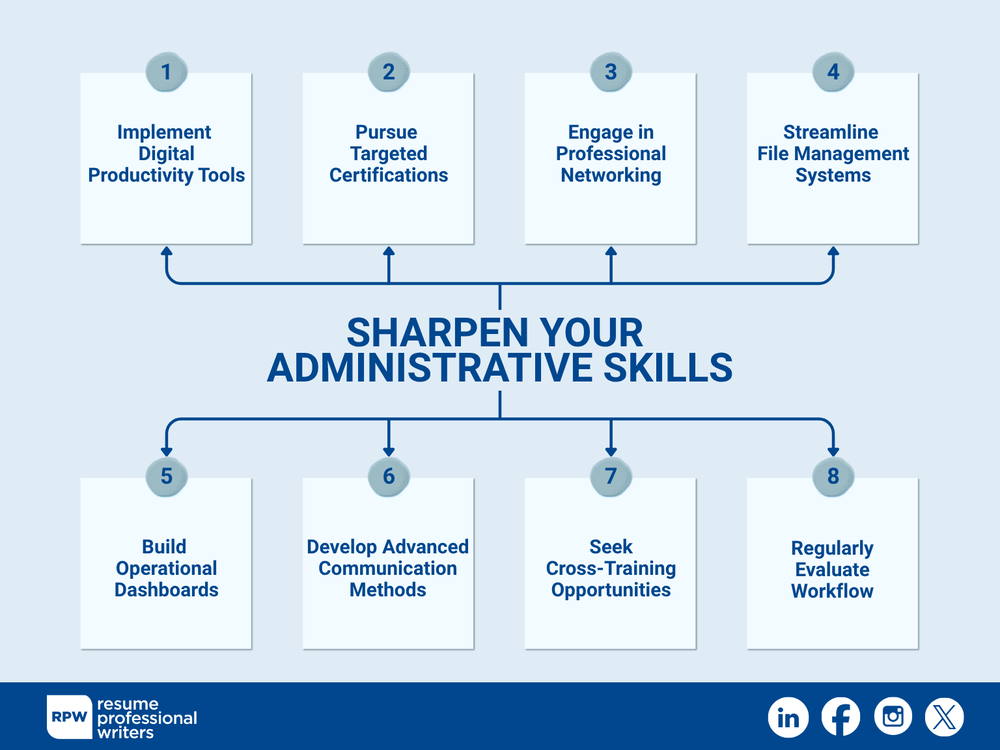
• Implement Digital Productivity Tools
Utilizing software such as Google Workspace, Microsoft Teams, and Asana improves efficiency. These solutions centralize task management, automate reminders, and prevent miscommunications.
• Pursue Targeted Certifications
Credentials such as Certified Administrative Professional (CAP) and Microsoft Office Specialist certifications validate proficiency and enhance career marketability.
• Engage in Professional Networking
Connecting with administrative peers through associations like the International Association of Administrative Professionals (IAAP) promotes knowledge-sharing and exposure to emerging best practices.
• Streamline File Management Systems
Maintaining organized, scalable file directories for both digital and physical records reduces retrieval time and protects institutional memory.
• Build Operational Dashboards
Incorporating performance indicators and task metrics helps administrators track progress, communicate results to leaders, and make data-backed decisions.
• Develop Advanced Communication Methods
Practicing concise, respectful messaging through chat platforms and emails preserves clarity and strengthens workplace relationships.
• Seek Cross-Training Opportunities
Exposure to accounting, HR, or compliance processes broadens understanding of organizational structure and promotes versatility.
• Regularly Evaluate Workflow
Periodic review of scheduling systems, approval chains, and communication gaps uncovers areas to automate or simplify.
Employers increasingly expect administrative professionals to integrate analytical tools into their routines. Creating spreadsheets that visualize productivity trends or using CRM systems to monitor communication can showcase measurable value. Efficiency combined with initiative often defines promotion readiness in administrative pathways.
For an easy guide, explore our infographic on sharpening administrative skills.
Assessing and Showcasing Administrative Strengths on Resumes and Interviews
Job seekers often underestimate the impact of administrative capabilities in job applications. Many neglect to quantify how scheduling efficiency, resource allocation, or process control improved performance outcomes. Demonstrating tangible achievements backed by metrics not only clarifies value but also aligns with employer priorities tracked through applicant tracking systems (ATS).
• Quantify Accomplishments
State measurable results. For example, “implemented a scheduling workflow that reduced meeting conflicts by 45%.”
• Align Keywords
Review job descriptions and integrate role-specific administrative terms (e.g., “office coordination,” “documentation management”).
• Tailor for ATS Systems
Place key skills in both skill sections and work accomplishments to ensure system recognition.
• Demonstrate Soft and Hard Skill Integration
Combine interpersonal examples with systems use, such as resolving client issues using CRM data.
• Prepare Scenarios for Interviews
Use structured STAR (Situation, Task, Action, Result) examples focusing on problem-solving and organization.
Expert Tip
When showcasing your administrative skills, focus on outcomes, not just tasks. Employers respond best when you demonstrate how your precision translated into measurable results—whether through cost savings, streamlined communication, or improved compliance. Frame your experience as a narrative of operational impact. This positions you as a proactive contributor driving efficiency and value, rather than a passive support role.
The Growing Role of Administrative Skills in an AI-Driven Workplace
Automation and AI are reshaping administration, but human oversight remains essential. While tools handle scheduling and data entry, professionals with strong administrative skills gain an edge by interpreting data, guiding decisions, and adapting to change.
Modern administrators partner with digital systems that track performance and streamline communication. Fluency in automation platforms like Zapier or Microsoft Power Automate eliminates repetitive tasks, freeing time for strategic coordination. Digital literacy now defines career relevance.
Why Administrative Skills Matter in an AI Era
- Human judgment ensures ethical use of AI
- Digital fluency boosts efficiency and productivity
- Interpersonal influence sustains morale in virtual teams
- Contextual insight turns analytics into action
- Adaptability secures long-term career growth
Technology enhances, but does not replace, the human element. Administrators remain cultural connectors and strategic partners, blending empathy with digital expertise to drive sustainable success.
Building Leadership from Administrative Foundations
Strong leaders often rise from solid administrative roots. Mastery of operations, documentation, and stakeholder communication equips emerging managers with the foresight to plan, track, and evaluate outcomes effectively.
Promoting from administrative positions gives organizations an advantage—employees already understand process efficiency and institutional systems. This foundation makes them natural fits for roles such as project managers, coordinators, or department heads. Employers increasingly value authentic growth that evolves from operational mastery into leadership behaviors.
How Administrative Skills Build Leadership
- Strategic foresight: Planning and evaluating outcomes objectively
- Process efficiency: Turning operational knowledge into managerial strength
- Institutional familiarity: Leveraging deep understanding of workflows and culture
- Performance impact: Demonstrating measurable improvements like cost savings or reporting accuracy
- Career advancement: Using mentorship and cross-functional tasks to showcase leadership potential
By initiating improvements, embracing cross-departmental responsibilities, and quantifying results, administrators position themselves as future leaders. Their ability to connect operational discipline with strategic vision makes administrative skills a powerful launchpad for career growth.
Administrative Careers: Outlook and Continuous Growth
The career horizon for administrative professionals is expanding as organizations prioritize efficiency, hybrid coordination, and knowledge management. These shifts place administrative skills at the center of workplace success. The U.S. Bureau of Labor Statistics projects steady demand for administrative support, underscoring their sustained necessity across industries.
Advancement opportunities are broadening through specialization. Administrative coordinators can transition into human resources, finance, compliance, or project management. Professionals who refine analytic and digital reporting skills often secure higher-level roles—executive assistant manager, operations coordinator, or program administrator—earning stronger pay and influence.
Keys to Continuous Growth
- Specialization opens career paths in HR, finance, compliance, and operations.
- Digital fluency elevates value, with reporting and automation skills driving promotions.
- Lifelong learning sustains relevance, through microlearning, workshops, and certifications.
- Data interpretation strengthens leadership, blending operational discipline with strategic insight.
By pairing administrative excellence with adaptability and technology skills, professionals remain competitive and thrive in the evolving U.S. employment landscape.
Unlock Career Advancement Through Administrative Excellence
Administrative proficiency forms the backbone of organizational success by connecting processes, technology, and people. Professionals who continuously refine these competencies not only secure job stability but open pathways to leadership and specialization. In a competitive market where performance consistency matters, many professionals optimize visibility and credibility through professional resume writers who emphasize measurable results and ATS-ready presentation.
Frequently Asked Questions
What are the top administrative skills employers seek in 2026?
Employers prioritize organization, communication, and digital literacy. Proficiency in scheduling systems, document management, and collaborative software remains essential. Based on Indeed’s job data, roles emphasizing administrative efficiency have maintained strong demand across healthcare, finance, and technology sectors.
How can administrative staff improve efficiency using technology?
Adopting project management platforms like Asana or Microsoft Teams enhances workflow visibility. Automating routine functions through tools such as Zapier or Excel macros can eliminate repetitive time blocks and improve accuracy across multi-department operations.
What is the career growth potential for administrative professionals?
Administrative roles often serve as launchpads into operations, project management, and executive support positions. With advanced certifications and process optimization experience, professionals can transition into managerial or analytical roles with competitive salary growth.
How can administrative skills be demonstrated in a resume?
Applicants should quantify outcomes. For instance, “coordinated 10+ cross-departmental initiatives, achieving a 30% reduction in document turnaround time.” Emphasizing metrics and specific software proficiencies increases ATS ranking and recruiter attention.
Are administrative skills transferable across industries?
Yes. Administrative competencies like scheduling, communication, and policy adherence apply universally. Whether in education, government, or corporate environments, these foundational capabilities ensure sustainability and professional versatility.