


Writing a resume that highlights classroom impact isn’t easy. Teachers often struggle to showcase certifications, skills, and measurable outcomes in ways that impress hiring committees and pass applicant tracking systems (ATS). A strong sample resume for teacher should capture experience, teaching philosophy, and leadership in learning environments—all in a clear, compelling format.
This guide delivers proven strategies to help educators stand out in 2026. From K–12 to college and substitute roles, you’ll find formatting tips, achievement‑focused examples, and keyword optimization methods that make resumes both ATS‑friendly and recruiter‑ready. Use this resource to craft a polished teacher resume that reflects your expertise and passion for education.

Understanding the Structure of a Teacher Resume
A teacher resume is more than a job list—it’s a showcase of classroom impact, student success, and leadership in education. Each section should emphasize clarity, measurable achievements, and a passion for teaching, while aligning with school values and curriculum goals.
Unlike conventional resumes that follow chronological, targeted, functional, or combination formats, education resumes use a specialized format designed for the teaching profession. A well‑crafted sample resume for teacher highlights skills, certifications, and teaching outcomes while remaining ATS‑friendly, recruiter‑ready, and district-compliant. This specialized approach effectively spotlights curriculum leadership, classroom management expertise, and quantifiable student growth impact, while maintaining a clear employment history.
To build a standout application, here are the essential elements every resume for teacher should include:
- Header: Contains full name, postnominal (e.g., B.Ed, M.Ed, EdD) and designation if any, address (city, state, and zip code), contact details (phone number and email address), and LinkedIn profile URL if applicable.
- Professional Summary: A concise three- to five-line overview of credentials, years of experience, expertise, notable achievements, and teaching philosophy.
- Skills Section: Combines classroom management, curriculum development, and technology competencies relevant to grade level.
- Education: Lists academic degrees, teaching credentials, and continuing education courses.
- License and Certifications: Features state teacher certification and subject endorsements.
- Teaching Experience: Details teaching-related background, with contributions, metrics, outcomes, and teaching initiatives.
- Professional/Work Experience: Includes non‑education roles that fill career chronology and add transferable skills and value.
- Leadership Experience: Highlights administrative and supervisory experiences, leadership initiatives, and achievements; exclusive for leadership-level education roles (dean, director, principal, department head, district coordinator).
- Interactive Field Experience: Adds practicum, internship, and out-of-field teaching that provide exposure and hands-on experience to aspiring educators; exclusive for entry-level positions.
- Additional Sections: Showcases additional professional development (workshops, specialized programs, or seminars attended), professional affiliations, awards and recognition, activities, volunteering or community involvement, technical skills, and publications or presentations.
Teachers who adopt this structure convey professionalism and readiness for modern educational demands. With recruiters spending just seconds scanning applications, clarity, strategic white space, and consistent formatting dramatically improve visibility and employment success.
Key Elements That Make an Outstanding Teacher Resume
Educator resumes must exhibit more than teaching experience—they should illustrate measurable contributions to student learning and institutional growth. The best resumes emphasize academic achievements, engagement tactics, and collaboration with administrators. Each component plays a role in reflecting an educator’s ability to lead a classroom effectively.
1. Compelling Professional Summary
The professional summary introduces the teacher as both a strategist and motivator. It must concisely communicate certification, years of experience, and areas of expertise, such as differentiated instruction or bilingual education. For example, an elementary educator might highlight experience in STEM curriculum development for Grades 3–5, thereby reinforcing subject specialization.
2. Targeted Keywords for ATS Compliance
Applicant Tracking Systems identify alignment through keyword relevance. Teachers should incorporate terms tied to grade level, subject matter, and pedagogical methods such as “Common Core alignment,” “IEP management,” and “student assessment interventions.” Strategic keyword inclusion ensures a higher ranking in automated screening without compromising readability.
3. Achievement Statements with Measurable Results
Transforming general duties into results-driven metrics differentiates top applicants. For instance, “Improved literacy proficiency by 18% within one academic year” delivers quantifiable value. Results verify teaching strategies’ effectiveness, demonstrating a teacher’s ability to foster measurable progress under standardized performance systems.
4. Inclusion of Modern Skills
Instructional technology proficiency holds growing importance. Listing platforms such as Google Classroom, Canvas, Microsoft Teams for Education, and virtual collaboration tools helps recruiters gauge adaptability. Digital literacy, online content creation, and data-driven instruction stand as key recruitment criteria.
5. Licensure and Professional Affiliations
Schools vet certification status early in the hiring process. Teachers should detail active licenses and include renewal dates where applicable. Association memberships—such as the National Board for Professional Teaching Standards (NBPTS)—reflect dedication to ongoing professional excellence.
These components, when well-integrated, build a compelling case for employment consideration. A teacher’s resume becomes a strategic marketing document that expresses academic authority, communication aptitude, and student-centered teaching practices.
Sample Resume for Teacher (2026)
The following layout illustrates an industry-standard teacher resume structure adapted to 2026 recruiter expectations. It incorporates readability, ATS optimization, and measurable content. This template summarizes how outstanding educators organize their credentials and showcase academic outcomes.
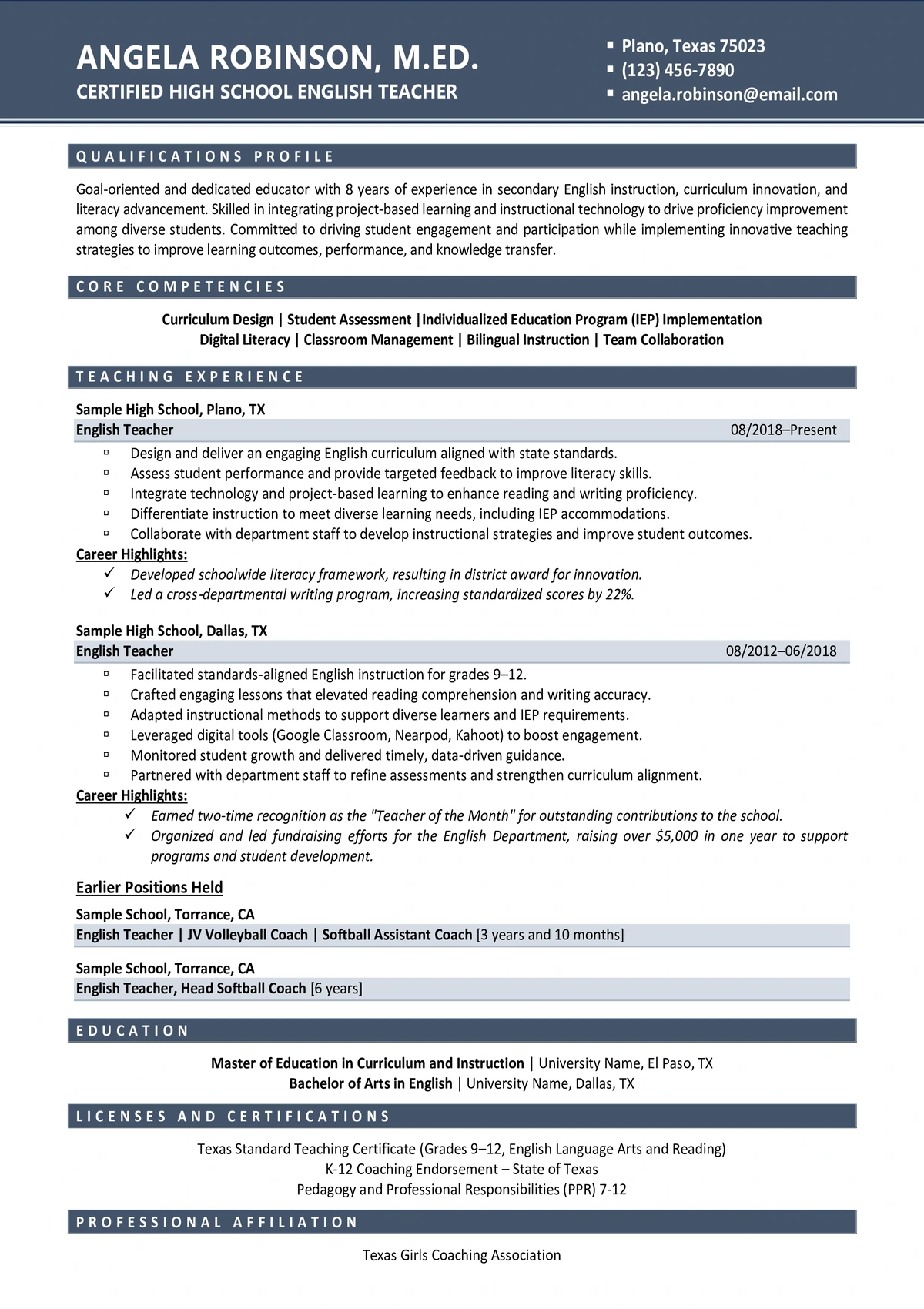
This sample demonstrates an ATS-friendly and human-evaluated format that aligns with both institutional expectations and hiring system logic. Teachers who follow such a layout ensure their professional achievements, learning outcomes, and credentials appear prominently on-screen and in print.
How to Quantify Success and Academic Achievement
In an educational job application, measurable success transforms perceptions from routine teaching to impactful instruction. Recruiters favor data-driven documentation of results, as it correlates directly to student performance and institutional growth. Teachers can quantify success across multiple areas: academic performance, attendance improvement, behavioral development, and participation in innovative initiatives.
- Show improvement percentages—such as reading comprehension gains or standardized test performance.
- Reference program participation growth, grant funding secured, or student engagement metrics.
- Note collaboration outcomes like co‑curricular projects or mentorship results using numerical indicators.
- Include awards and recognition metrics, such as “District Teacher of the Year” or “National Honor Society Advisor.”
- Demonstrate leadership accomplishments with numbers when managing grade-level teams or peer mentorship initiatives.
Quantification builds trust. It proves consistency between resume claims and verifiable performance. For example, “Implemented digital reading program enhancing vocabulary retention by 15% in one semester” conveys tangible outcomes superior to generic phrases like “encouraged student literacy.” Recruiters interpret metrics as accountability and planning competence—core values schools seek in faculty.
Optimizing Teaching Resumes for ATS and Recruiter Compatibility
More than 95% of U.S. school districts use some form of applicant tracking system to filter resumes before human review. ATS optimization remains essential for educators seeking prompt shortlisting. While teaching is people‑focused, resume visibility depends on technology alignment. An effective keyword strategy and design consistency achieve ATS readability and recruiter appeal simultaneously.
To enhance system compatibility, teachers should structure resumes using standard section headers recognizable by algorithms (“Education,” “Certifications,” “Experience”). Fancy templates or embedded graphics frequently cause parsing failures. Instead, standard fonts like Calibri or Arial, consistent bullets, and conventional date formats maintain data integrity when resumes are scanned electronically.
- Integrate keywords identical to the job posting, such as “secondary mathematics instruction,” “ESL strategies,” or “special education accommodations.”
- Exclude tables or text boxes in critical areas, as some ATS software cannot read them accurately.
- Save final versions in both PDF and Word formats to accommodate differing district portals.
- Ensure each past title matches relevant standard teacher categories so classification indexing remains accurate.
- Detect keyword gaps using free ATS simulation tools to test ranking visibility before submission.
Optimization also enhances recruiter scanning. Human readers focus on clear organization, consistent headings, and quantifiable data. Balancing algorithmic compliance and design elegance produces the best submission results within education hiring systems.
Best Practices for Tailoring Resumes to Different Teaching Levels

Teachers at varying grade levels require differentiated resume styles. Elementary, middle school, high school, and postsecondary educators each demonstrate unique teaching methodologies and outcomes. Tailoring content enhances alignment with level-specific hiring expectations. It also ensures immediate credibility in thematic areas like child development, subject mastery, and assessment integration.
Elementary Educators
Emphasize early literacy initiatives, reading intervention programs, and differentiated classroom management. Highlight collaboration with parents and use of formative assessments.
Middle School Teachers
Focus on adolescent engagement, interdisciplinary lessons, and technology integration for transitional learning stages.
High School Teachers
Showcase advanced subject matter expertise, test prep success, college readiness campaigns, and extracurricular leadership.
College Instructors or Adjuncts
Feature research projects, published works, and syllabus contributions. Include references to accreditation committees or curriculum councils.
Special Education Professionals
Prioritize individualized instruction, IEP documentation management, and tailored interventions for behavioral or developmental needs.
Research on resume writing emphasizes that tailoring resumes to specific teaching levels increases credibility and improves hiring outcomes. For example, the National Association of Colleges and Employers (NACE) notes that “resumes should be customized to highlight experiences and skills most relevant to the position being sought.”
Additionally, customization demonstrates understanding of student development variation across academic stages. By adapting examples and phrasing to each educational level, teachers enhance relevance and authority, increasing their likelihood of advancing to interviews.
Common Resume Mistakes Teachers Must Avoid
Despite strong credentials, many qualified educators lose opportunities due to preventable resume errors. Awareness of these mistakes ensures teachers present polished applications consistent with hiring committee expectations. Each error—whether stylistic or content‑based—undermines perceived professionalism and may cause bypass at both human and ATS levels.
Using Generic Descriptions
Listing duties rather than outcomes weakens career storytelling. Recruiters seek results, not repetitive task lists.
Omitting Certification Details
Unspecified licensing deters verification and slows consideration despite otherwise strong credentials.
Excessive Formatting
Decorative fonts, tables, or colored text often break in ATS upload systems. Simple elegance always performs better.
Lengthy Paragraph Blocks
Dense writing makes quick scanning difficult. Using concise bullet points facilitates readability.
Failure to Proofread
Typographical mistakes represent lack of attention to detail—an unforgivable flaw for education professionals modeling literacy.
Correcting these errors significantly improves overall professionalism and shortlisting chance. As hiring cycles tighten, a concise, accurate, and impactful resume conveys readiness and commitment to teaching excellence.
Enhancing Impact with Cover Letters and Supplemental Materials

A teacher’s job application extends beyond the resume itself. Supporting materials like targeted cover letters, teaching portfolios, and recommendation lists complete a coherent professional narrative. Each file reinforces the educator’s instructional values and achievements. When integrated strategically, these materials create a three‑dimensional candidate profile for selection boards.
- Cover Letter: Should mirror school mission statements and describe how the applicant’s teaching philosophy aligns with district vision.
- Portfolio: Includes lesson plans, student work samples, and classroom technology samples demonstrating differentiated methodologies.
- Recommendation List: Should provide supervisors, principals, or department heads who can validate teaching effectiveness through concrete examples.
- Statement of Teaching Philosophy: Offers deeper reflection about approach to diversity, inclusion, and social‑emotional learning integration.
Teachers who coordinate these documents cohesively strengthen credibility and preparedness. Consistency across materials, including tone and metrics, reinforces professionalism and ensures recruiters perceive a deliberate, aligned presentation of teaching expertise.
Building a Long‑Term Teaching Career with Continuous Resume Updates
Education evolves rapidly; resumes must evolve with it. Annual revisions ensure ongoing accuracy for certifications, new pedagogical methods, and professional development milestones. Teachers engaged in mentoring, committee participation, or technology training should refresh their resumes to highlight current relevance. A static resume undervalues professional growth and future leadership readiness.
Regular updates also ease transitions between school districts and grade levels. Over time, documented metrics accumulate into compelling career portfolios showcasing consistent improvement across diverse student populations. This documentation becomes indispensable when pursuing administrative or curriculum design roles, where measurable leadership history determines advancement eligibility.
By treating the resume as a living document rather than a one‑time submission, teachers control narrative evolution throughout their educational journey. Each revision strengthens career branding within a competitive national teaching landscape.

Empower Classroom Careers Through Professional Guidance
A teacher’s resume represents more than credentials—it reflects passion for lifelong learning and leadership. Mastering structure, readability, and keyword strategy effectively communicates instructional excellence to districts and panels. Educators ready to elevate their applications can benefit from professional resume writing help tailored to the education industry. Such support refines content, strengthens narrative flow, and ensures each document aligns with modern hiring standards and technology expectations.
Frequently Asked Questions
What is the ideal resume length for teachers?
Most K–12 teacher resumes perform best on a single page when summarizing fewer than 10 years of experience. For educators with broader responsibilities or multiple certifications, two pages are acceptable. Clarity and conciseness outweigh length, provided measurable details remain intact.
Should teaching resumes include GPA or coursework?
Including GPA benefits newly certified or early‑career teachers without extensive classroom experience. Once full‑time employment history establishes credibility, GPA becomes optional, but referencing specialized coursework or endorsements continues to add value.
Are teaching portfolios necessary with resume submissions?
While not always required, digital or print portfolios significantly enhance candidacy in competitive districts. Schools appreciate viewing lesson plans, classroom projects, and performance metrics that validate resume claims.
What keywords help teacher resumes rank higher in ATS?
Effective keywords include “lesson differentiation,” “academic intervention,” “curriculum alignment,” “student evaluation,” and “collaborative instruction.” Aligning phrasing with specific job listings maximizes ATS ranking and recruiter engagement.
How frequently should teachers update their resumes?
Educators should update resumes at least annually, ideally following performance reviews or professional development milestones. Continuous updates simplify future applications and keep credentials current in district databases.